Solute and solvent
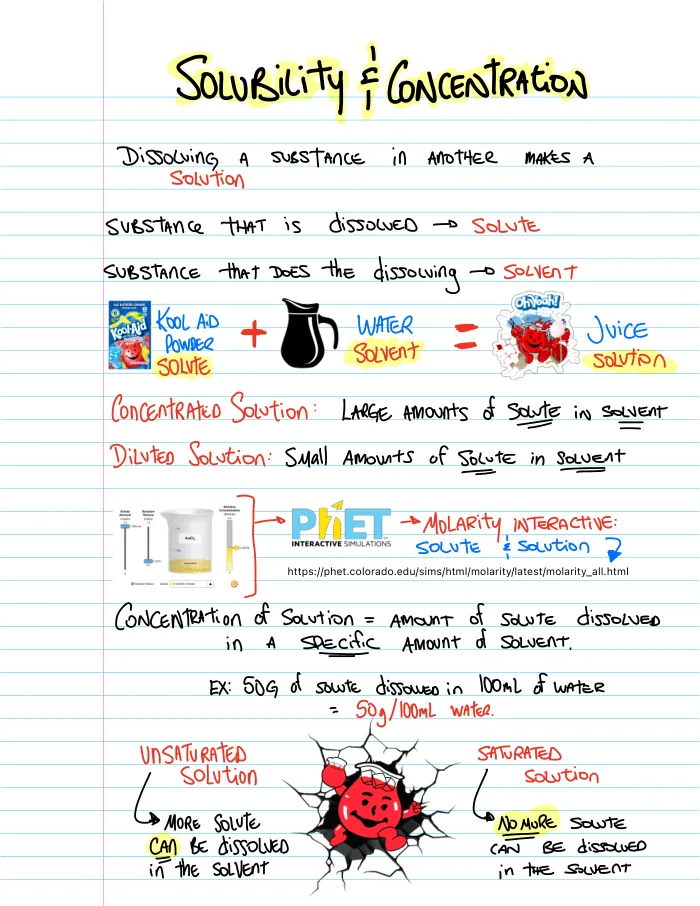
The solute is dissolved in the solvent. In salt water, salt is the solute and water is the solvent. Dissolved particles remain present even when they are too small to see.
Follow what dissolves, and compare how much.
The solute is dissolved in the solvent. In salt water, salt is the solute and water is the solvent. Dissolved particles remain present even when they are too small to see.
Concentration describes solute amount per specified amount of solution. Grams per 100 mL here means grams of solute per 100 mL of final solution, not necessarily solute added to 100 mL of water.
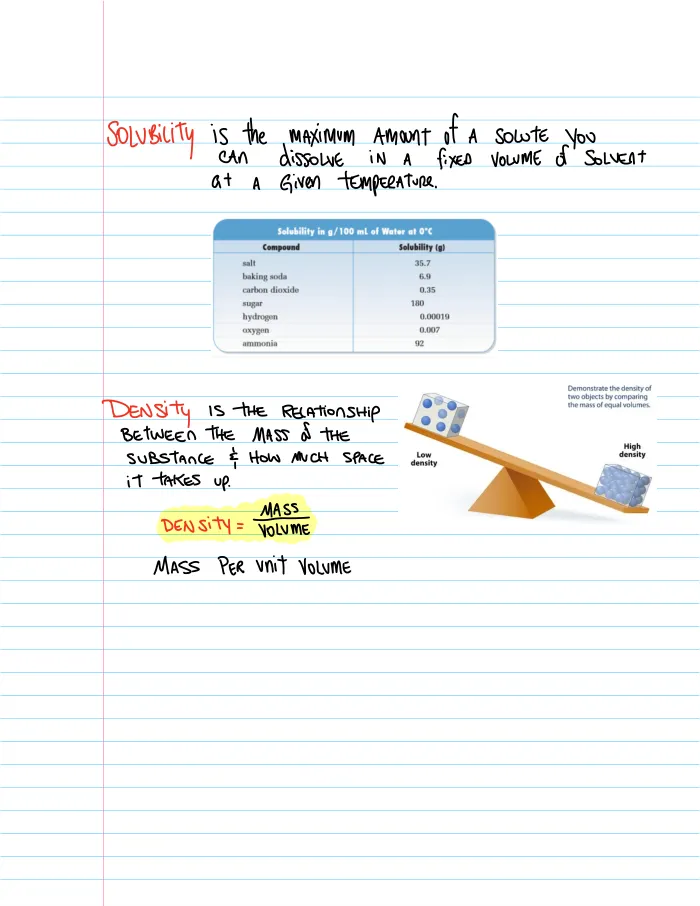
Stirring and crushing can make a solid dissolve faster without changing its equilibrium solubility at a fixed temperature. Solubility is the maximum that dissolves under stated conditions; temperature can affect it differently for different substances.
Add solute, add water, evaporate water or drain solution. Watch the concentration meter.
Compare adding water with draining some well-mixed solution. Which action changes concentration?
Find a condition with solid left at the bottom. Explain saturation. PhET uses mol/L; focus on the relationships here. Our lesson calculations use g per 100 mL.
Change the solute mass and final solution volume. How much solute is in each 100 mL of solution?
This compares concentration. It does not predict whether that mass dissolves or whether the solution is saturated.
The first is 6 g per 100 mL; the second is 9 g per 100 mL. The second is more concentrated.
Solution A contains 15 g in 300 mL. Solution B contains 12 g in 150 mL. Which is more concentrated?
Express both as grams of solute per 100 mL of final solution.
A: 15 ÷ 300 × 100 = 5 g per 100 mL. B: 12 ÷ 150 × 100 = 8 g per 100 mL. B is more concentrated.
Plan a fair test of how stirring affects dissolving time. Identify the changed variable, what you will measure, and at least three controlled conditions.
Would a faster dissolving time prove a change in solubility? Explain.
No. Dissolving time measures a rate. Solubility describes how much can dissolve under specified conditions at equilibrium. To compare solubility, keep temperature and the substances fixed and determine the amount that can dissolve, rather than timing a small amount.
Stirring often increases dissolving rate; it does not by itself increase the equilibrium limit at the same temperature.
Choose an answer, then use the feedback to refine your reasoning.