Fraction Land
A classroom team challenge: choose a card, explain a solution, and rotate the roles that keep everyone thinking.
Open the activity guide →Build problem-solving confidence →Equal parts. Clear reasoning. Confident problem solving.
Number · Demonstrate an understanding of multiplying and dividing fractions, concretely, pictorially and symbolically (N6).
The criteria at each level include those described at prior levels.
From the linked CBE Math Assessment and Reporting Guide, January 2020, page 83. Website practice summaries are not proficiency marks.
Go straight to a skill, or follow the connections. Each lesson brings together an explanation, a visual model, your class notes and practice.
Name, compare and represent the same amount.
Choose an operation. Explain why it works.
Bring the strategies together in a problem.
Split every part in the same way. Explain why the amount stays fixed.
Predict before changing a value. Every whole in a bar diagram uses the same size. The models use non-negative amounts up to two wholes per input.
A classroom team challenge: choose a card, explain a solution, and rotate the roles that keep everyone thinking.
Open the activity guide →Build problem-solving confidence →
Four mathematical stops connect addition and subtraction, multiplication, division, and order of operations.
Explore the four stops →Review multi-step calculations →Why is 1/2 + 1/4 different from 1/2 ÷ 1/4? Draw both situations before checking.
Addition combines half a whole and a quarter of the same whole, giving 3/4. Division counts how many quarter-sized groups fit into one half, giving 2 groups. The output units and the relationships differ.
Work through eight questions. Two independent correct answers introduce a harder version; supported answers bring the next question back to the foundation. You can use hints at any time.
This round saves on this device. It is practice, not a school mark.
Use these collections with the matching lesson. Predict before moving a model; pause a video to work out the next step.

Use the diagrams to explain the fraction units, rather than only copying the symbolic steps.

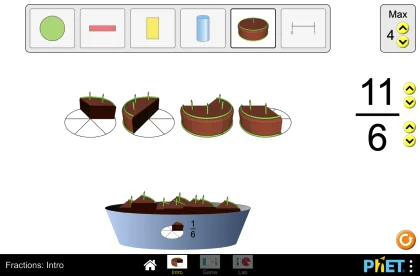 Fractions: Intro →Build a fraction in more than one representation.
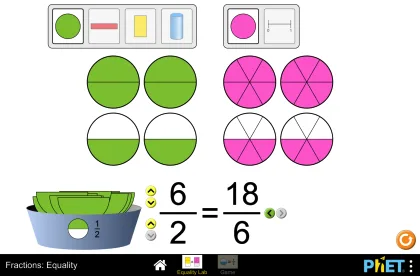 Fractions: Equality →Match equal amounts with different partitions.
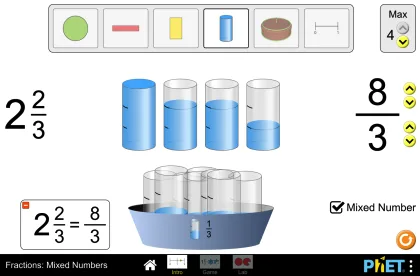 Fractions: Mixed Numbers →Explore amounts beyond one whole.
Match representations, build equal amounts and explore fractions greater than one.