Composition matters
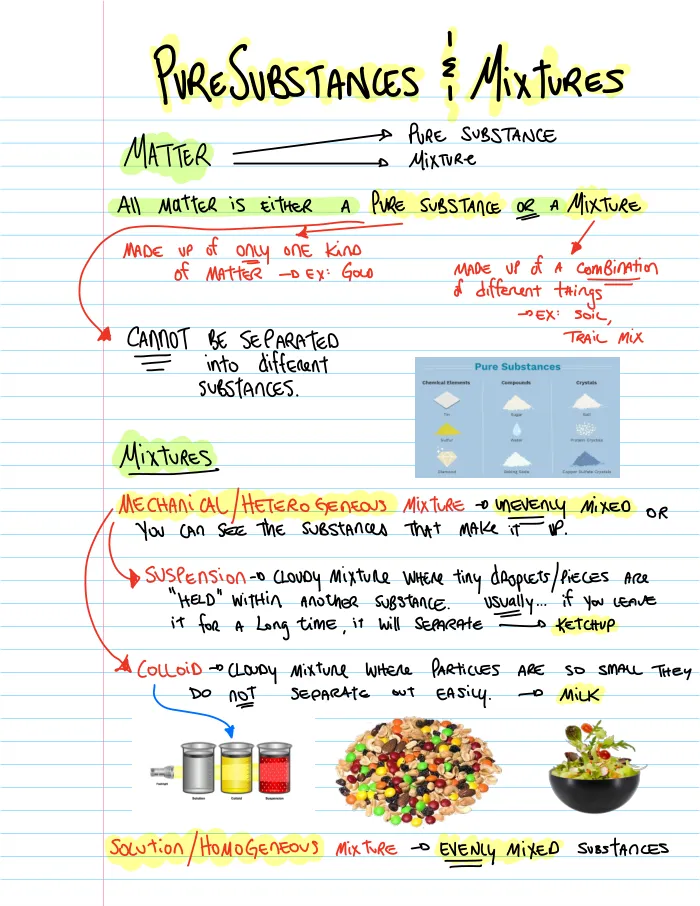
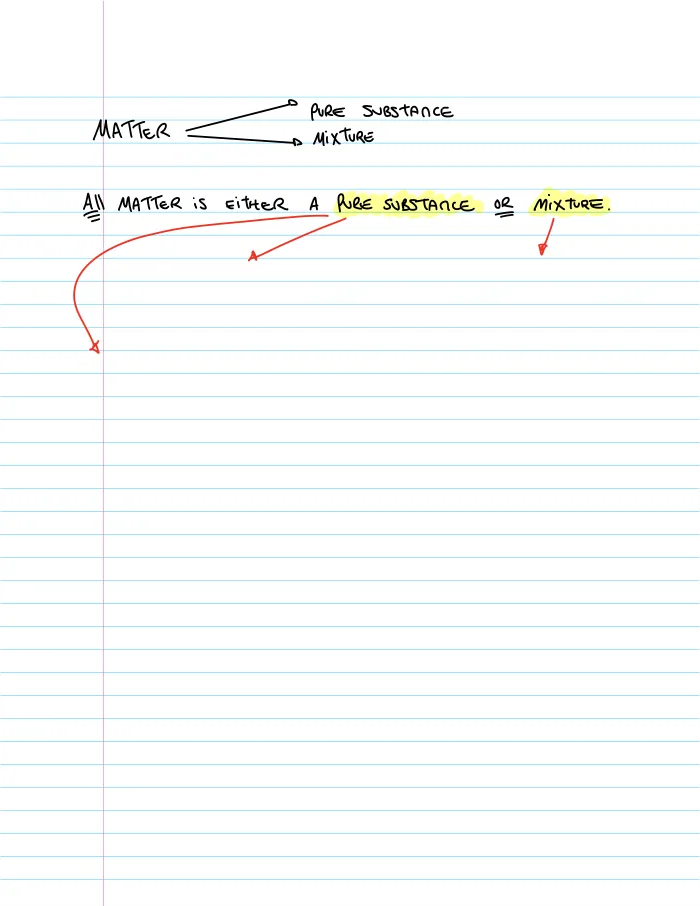
A pure substance has a characteristic chemical composition. A mixture contains multiple substances physically combined in proportions that can vary.
Use properties to classify and separate matter.
A pure substance has a characteristic chemical composition. A mixture contains multiple substances physically combined in proportions that can vary.
A solution is a homogeneous mixture. Salt water can be clear because dissolved salt is distributed throughout it. Muddy water is heterogeneous and suspended particles may settle.
Suspensions have particles that may settle or be caught by a suitable filter. Colloids have dispersed particles that remain spread through another substance; ordinary paper filtration usually does not separate them. Milk is an example of a colloid.
A paper filter can trap sand grains but dissolved salt passes through with water. Evaporation can leave non-volatile dissolved material behind; distillation can collect the evaporated water after condensation.
Choose a mixture, then predict what ordinary filtration will remove.
A simplified model of an ordinary paper filter. It does not test whether water is safe to drink.
It contained water and dissolved salt. Its clear appearance did not make it a pure substance.
Sand and salt are mixed with water. How could you separate them?
Which material can an ordinary paper filter trap?
Filter out the sand. The dissolved salt passes through with water. Evaporate the filtrate to recover the salt; distillation could also collect condensed water.
Design a separation sequence for a teacher-approved mixture of sand, salt and water. State what stays in the filter and what passes through, then explain how you might recover the salt.
Does removing visible particles prove the remaining water is safe to drink?
No. Ordinary filtration can remove some suspended particles while dissolved substances and some microorganisms remain. Clear-looking water is not evidence of safe drinking water; this classroom separation is not a drinking-water treatment.
Appearance cannot establish chemical composition or drinking-water safety.
Choose an answer, then use the feedback to refine your reasoning.