
Resistance to flow
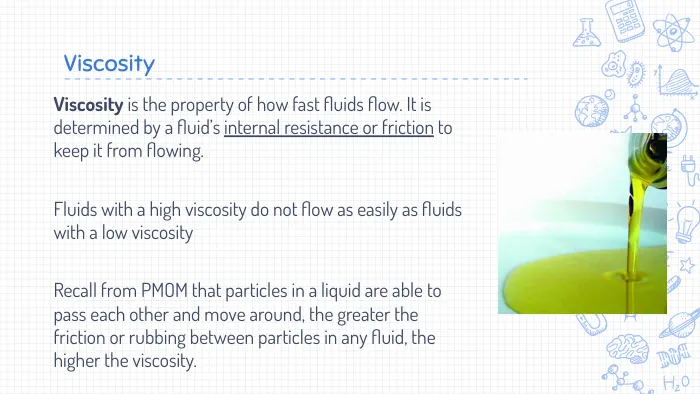
Viscosity describes a fluid’s resistance to flow. Flow rate describes volume passing a point per unit time and also depends on the opening, slope and pressure.
Measure flow and explain resistance.
Selected pages previewed; the PDF contains the complete set.
Viscosity describes a fluid’s resistance to flow. Flow rate describes volume passing a point per unit time and also depends on the opening, slope and pressure.
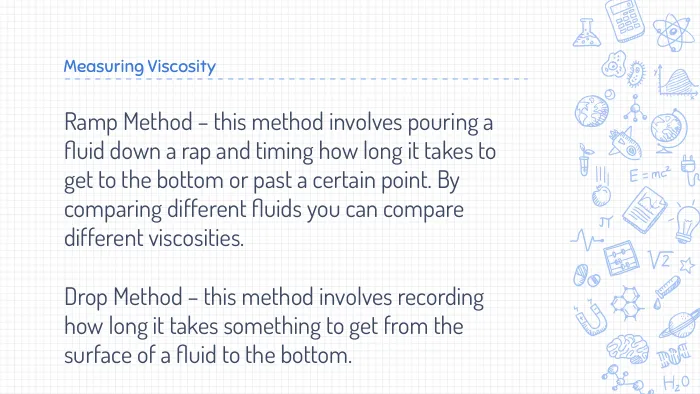
Use equal volumes, the same apparatus and distance, and a controlled temperature. Repeat measurements. A fixed volume taking longer to flow under the same conditions supports a comparison of resistance to flow.
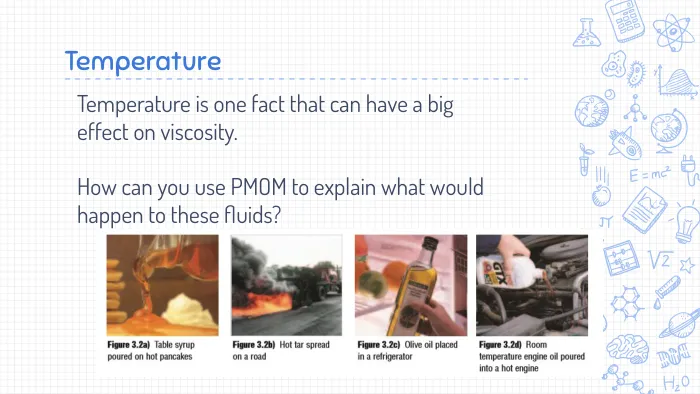
Many everyday liquids become less viscous when warmed. Gas behaviour need not follow the same pattern. Density and viscosity describe different properties.
Enter the volume collected and the elapsed time. Compare trials made with the same apparatus and conditions.
Average flow rate is volume ÷ time. Flow rate depends on the apparatus, pressure and temperature as well as viscosity.
Compare resistance to flow with flow rate. What would you need to keep the same in a fair test?
The Digital Classroom ExperienceOpen on YouTube →Their average rates are 5 mL/s and 2 mL/s. Under the same conditions B flows more slowly, supporting a higher-viscosity conclusion.
Trial A collects 80 mL in 20 seconds. Trial B collects 80 mL in 40 seconds. Compare the average rates.
Divide collected volume by time for each trial.
A: 80 ÷ 20 = 4 mL/s. B: 80 ÷ 40 = 2 mL/s. Under the same conditions B flows more slowly.
Compare two teacher-approved liquids using equal volumes, the same apparatus and temperature. Measure elapsed time, repeat trials and calculate average flow rates.
Why can’t you compare viscosity fairly if the openings or temperatures differ?
The opening, temperature, pressure difference and procedure can change flow rate independently of the liquid being compared. Keep these conditions the same, use equal amounts and repeat trials before drawing a conclusion about resistance to flow.
Density compares mass with volume; viscosity describes resistance to flow.
Choose an answer, then use the feedback to refine your reasoning.