Follow the land downhill and discover why upstream choices matter downstream.
GRADE 8 SCIENCE
Lesson notes
A watershed connects land to a common outlet. Water carries both materials and the effects of upstream decisions downstream.
Read the high ground first
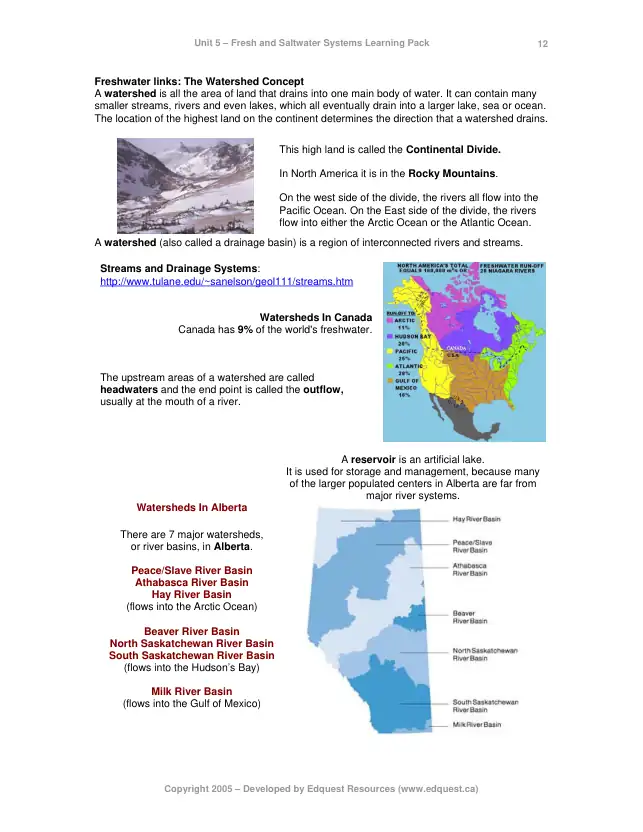
A drainage divide separates land draining toward different outlets. Water on opposite sides of the divide can enter entirely different river systems. A tributary is a smaller stream joining a larger one. Small watersheds fit inside larger drainage basins.
A watershed includes the land, not just the river channel.
Political boundaries and drainage boundaries do not necessarily match.
An outlet can be a stream junction, lake or river mouth, depending on the watershed being studied.
Erosion, transport and deposition
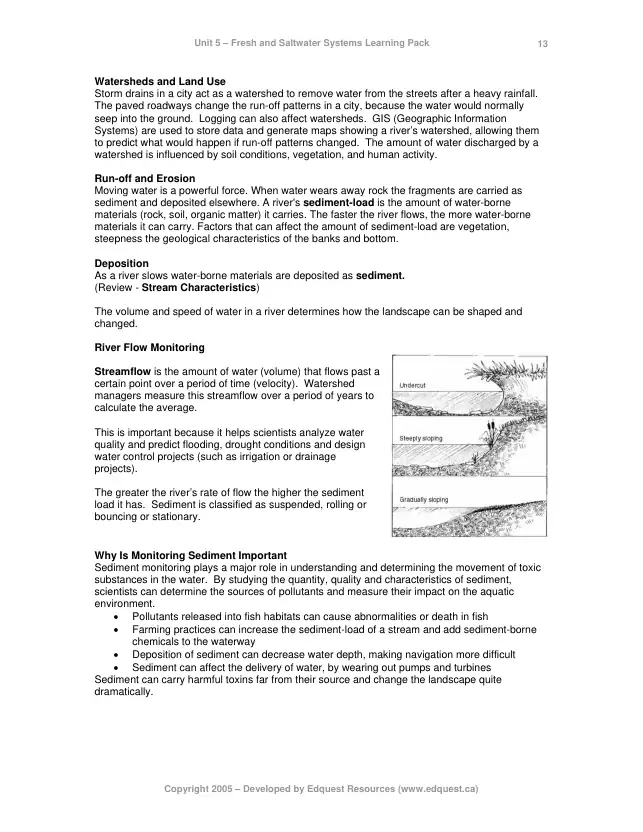
Erosion removes material from a place. Transport carries it elsewhere. Deposition leaves it behind. Water may carry dissolved substances, suspended fine particles and coarser material moving near the bed. What it carries depends on flow conditions and particle properties.
Fine clay can stay suspended while larger sand grains settle.
Slower or less energetic water often deposits material it could previously carry.
Dissolved salt is not removed simply because suspended sand settles.
SEE IT EXPLAINED
Why do rivers curve?
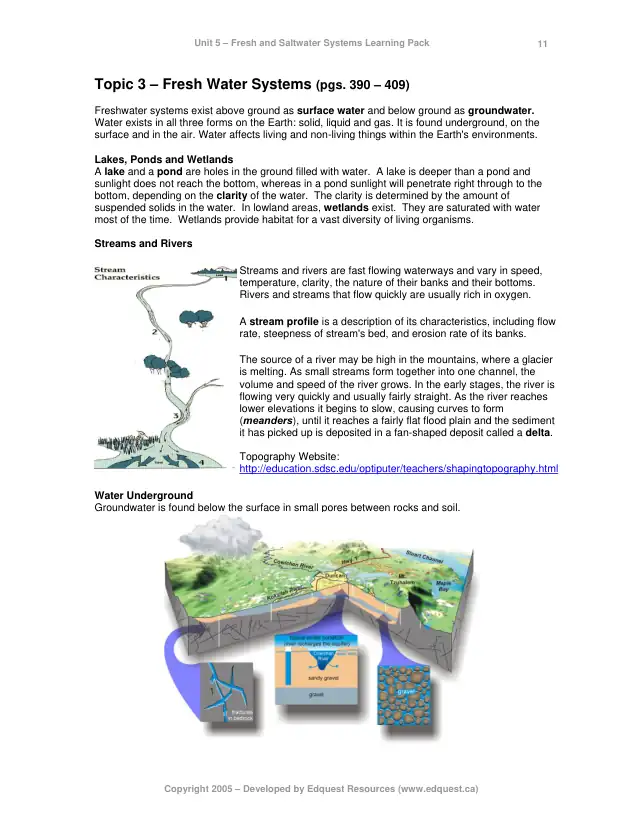
Compare the outside and inside of a bend. Find where erosion removes material and deposition adds it.
In many meanders, faster flow near the outside of a bend erodes the bank. Slower water on the inside deposits sediment, often forming a point bar. Over time the bend can migrate. If a shortcut cuts off a bend, an oxbow lake may remain.
The outside and inside of a bend can change in different ways at the same time.
River channels are dynamic; a map is a record of their position at a particular time.
Speed is not discharge
Velocity tells you how fast and in what direction water moves. Discharge tells you the volume passing a cross-section each second. A broad, deep, slow river can have a larger discharge than a narrow, shallow, fast stream.
For a simplified channel: discharge = cross-sectional area × mean velocity.
Area is measured in m²; velocity in m/s; discharge in m³/s.
One m³ is 1,000 litres. A change in channel shape can change speed without the same change in discharge.
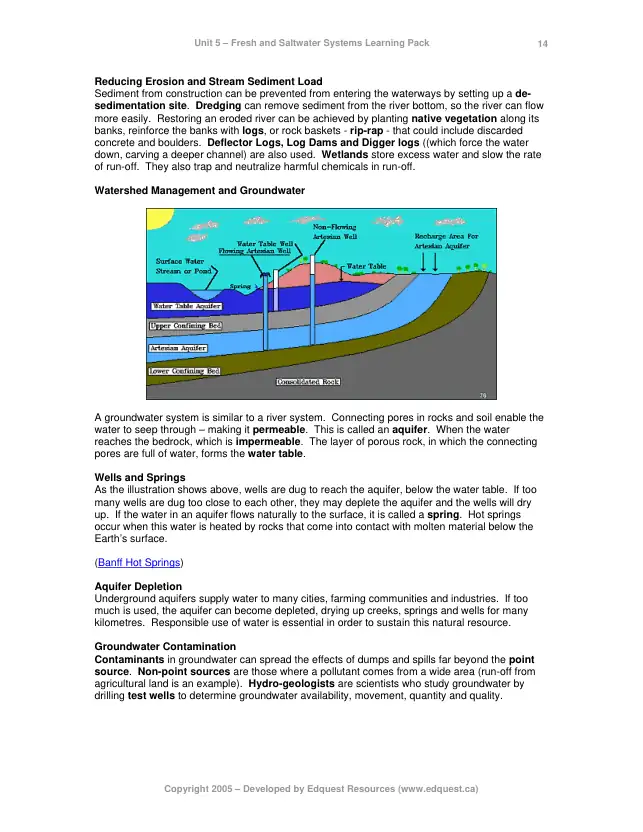
A watershed includes water you cannot see
Soil and groundwater can store water and release it gradually. Wetlands can slow some flows and trap some sediment. Roads, buildings, drainage systems and exposed soil can change how quickly rain reaches a channel and what it carries.
A floodplain is low land beside a river that can be inundated when water leaves the channel.
Flooding depends on rainfall, snowmelt, soil conditions, channel capacity and other factors—not paving alone.
An upstream change is a possible explanation to investigate, not automatic proof of a downstream cause.
Three jobs of moving water
Process
What changes?
Example
Erosion
Material is removed
An outside bank is worn away
Transport
Material changes location
Fine sediment moves in suspension
Deposition
Material is left behind
Sand accumulates on an inside bend
A WORKED EXPLANATION
Compare two channels
Channel A has an area of 4 m² and a mean speed of 2 m/s: Q = 4 × 2 = 8 m³/s.
Channel B has an area of 10 m² and a mean speed of 1 m/s: Q = 10 × 1 = 10 m³/s.
B is slower, but its larger cross-section carries more water each second.
These are ideal teaching examples. A real cross-section and velocity vary across a channel.
Relevant pages from the original review pack. Use the updated explanations and linked sources for estimates and terminology.
PREDICT · INVESTIGATE · EXPLAIN
One storm. Two landscapes.
Change rainfall and the proportion of hard surfaces. Compare runoff with infiltration over the same one-hectare catchment.
Illustrative event water budget: hard surfaces route 90% of rain to runoff; permeable ground routes 20%. The remainder infiltrates. Interception, evaporation, soil saturation and timing are omitted; these coefficients are not local measurements.
WATCH THE PHENOMENON
Read the landscape as a drainage system
Nutrien · Watershed animation
Upstream connects to downstream
Find the divide, the tributaries and the common outlet. Where would water from opposite sides of a ridge go?
Its ability to transport some sediment decreases. Sand may settle, although the exact result also depends on grain size, discharge and channel conditions.
Key connections
Drainage divide
Tributaries
Common outlet
Downstream effects
TRY IT
Try it yourself
How might an upstream construction site affect a downstream stream?
Give me a hint
Connect exposed soil to runoff and sediment.
Compare with a worked response
Rain can carry exposed sediment into drainage pathways. Downstream turbidity or habitat may change. Comparing measurements and controlling for other changes strengthens the claim.
TAKE IT FURTHER
Make the connection
A river is twice as wide but moves at half the speed. Must its discharge be the same?
Compare your reasoning
Not necessarily. Discharge depends on cross-sectional area as well as average velocity. Width alone does not tell you depth or the full area. For a simple rectangular model, Q = width × depth × mean speed.