A drop can take many routes—and it may remain in one place for a very long time.
GRADE 8 SCIENCE
Lesson notes
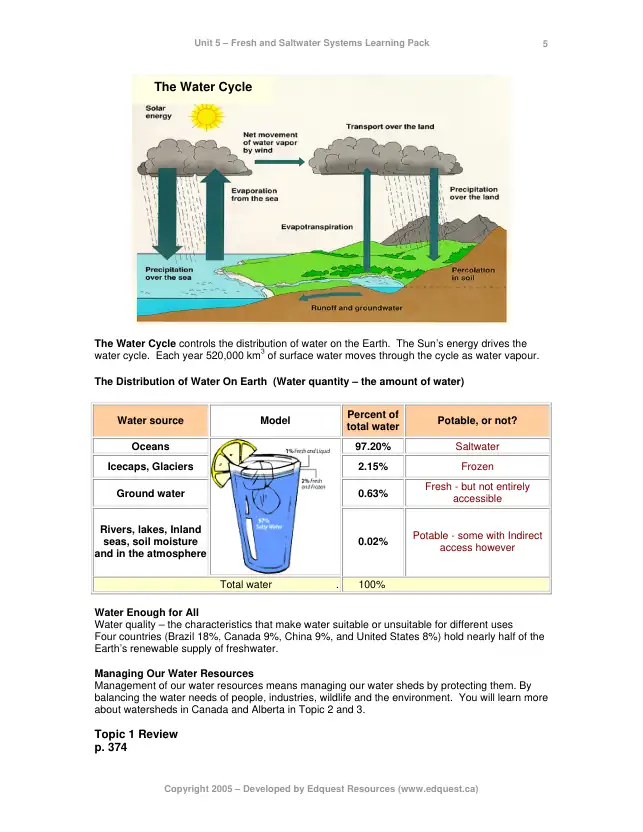
Water is recycled through a network of stores and transfers. Energy changes its state; gravity helps move it through the landscape.
A store is a place. A transfer is a process.
Water can be stored in oceans, lakes, rivers, glaciers, soil, groundwater, living things and the atmosphere. A transfer moves water between stores. Naming both ends of a transfer helps you explain a route instead of memorizing a circular picture.
Ocean → atmosphere: evaporation.
Atmosphere → land: precipitation.
Soil → plant → atmosphere: root uptake followed by transpiration.
Groundwater → stream: groundwater discharge.
Water changes state, but it is still H₂O
During a physical change of state, water molecules remain water molecules. Their arrangement and movement change. Evaporation can occur at a liquid’s surface below its boiling point. Water vapour is an invisible gas; a cloud is made of tiny liquid droplets, ice crystals or both.
Melting and evaporation absorb energy from the surroundings.
Freezing and condensation release energy to the surroundings.
Sublimation changes ice directly into water vapour.
SEE IT EXPLAINED
See the stores and transfers
Identify a store, a surface transfer and an underground transfer. Watch how interception differs from infiltration.
The Sun supplies energy that helps evaporate water. Air movement carries water vapour. Cooling can lead to condensation and cloud formation. Gravity pulls precipitation toward Earth and helps move runoff and rivers downhill. Groundwater responds to differences in elevation and water pressure.
Condensation is not the same as precipitation: droplets must grow or combine before they fall.
The water cycle has no required beginning, and a drop can skip many stores.
Some water goes below the surface
Infiltration is water entering the ground. It can move farther downward through connected spaces. Below the water table, the ground is saturated: its open pores and fractures are filled with water. An aquifer is a permeable geological material that can store and transmit useful quantities of groundwater.
Groundwater is usually water between particles or in fractures, rather than a large underground lake.
Some groundwater returns to a stream, spring or wetland.
The water table can rise or fall as recharge and withdrawals change.
Time matters
A drop may pass quickly through a small stream but remain in deep groundwater or ice for a long time. Residence time describes how long water stays in a store. A water-cycle diagram shows connections; it does not automatically show how much water moves or how fast it travels.
Paving can reduce local infiltration and increase rapid runoff.
Removing vegetation can change interception, transpiration and runoff.
Pumping groundwater faster than it is replenished can lower the water table.
Follow the change of state
Process
Change
Energy transfer
Melting
Solid → liquid
Energy absorbed
Freezing
Liquid → solid
Energy released
Evaporation
Liquid → gas
Energy absorbed
Condensation
Gas → liquid
Energy released
A WORKED EXPLANATION
From snow to a leaf
Snow is stored on a mountain. Warming supplies energy for melting.
Some meltwater infiltrates soil instead of running straight into a river.
Roots absorb soil water. Xylem carries it to leaves.
Transpiration transfers water vapour to the atmosphere. This is one possible route, not a required sequence.
Relevant pages from the original review pack. Use the updated explanations and linked sources for estimates and terminology.
PHET · PARTICLES & STATE CHANGES
Watch the particles as water changes state
Open the States screen and choose Water. Compare Solid, Liquid and Gas, then use the heating and cooling control. Watch the molecular arrangement as well as the thermometer.
Investigate
Start with water as a solid. Add energy, then remove it. Describe two differences between the liquid and the gas without saying the molecules become different substances.
Read the model
The moving symbols represent molecules. The drawing does not show their real size or every interaction. Use the state-change table in your notes to explain the energy transfers.
WATCH THE PHENOMENON
See water moving through the Earth system
NASA Goddard · Scientific animation
Trace stores and transfers
Find one store and two transfers. Identify where energy drives a change and where gravity moves water.
Some precipitation infiltrates the soil, reaches a saturated zone and later moves as groundwater toward a stream. It does not have to become immediate surface runoff.
Key connections
Store
Transfer
Energy / gravity
New store
TRY IT
Try it yourself
How can a tree connect soil water to the atmosphere?
Give me a hint
Trace uptake, transport and water loss.
Compare with a worked response
Roots absorb soil water; xylem carries water through the plant; transpiration transfers water vapour from leaves to the atmosphere.
TAKE IT FURTHER
Make the connection
Could a drop reach the ocean without first becoming surface runoff?
Compare your reasoning
Yes. Infiltrated water can become groundwater, move through connected pores and discharge into a river or directly toward the coast. It can also remain stored for a long time.