A glacier can flow downhill even while its terminus retreats. How?
GRADE 8 SCIENCE
Lesson notes
A glacier is moving land ice. Its size changes when accumulation and ablation do not balance, while its movement reshapes the land.
Snow becomes glacial ice
A glacier can form where snow remains through successive summers. New layers bury and compress older snow. The grains change and air spaces shrink, producing dense snow called firn and eventually glacial ice. A large enough mass deforms and flows under its own weight.
Alpine glaciers flow through mountain valleys.
Ice sheets spread outward over large land areas.
A seasonal snowbank is not automatically a glacier.
Moving does not mean melting
Ice can move through deformation within the glacier. Where conditions allow, sliding at the bed also contributes. Friction and valley shape affect motion. Different parts of a glacier do not all move at the same speed.
The ice moves downhill under gravity.
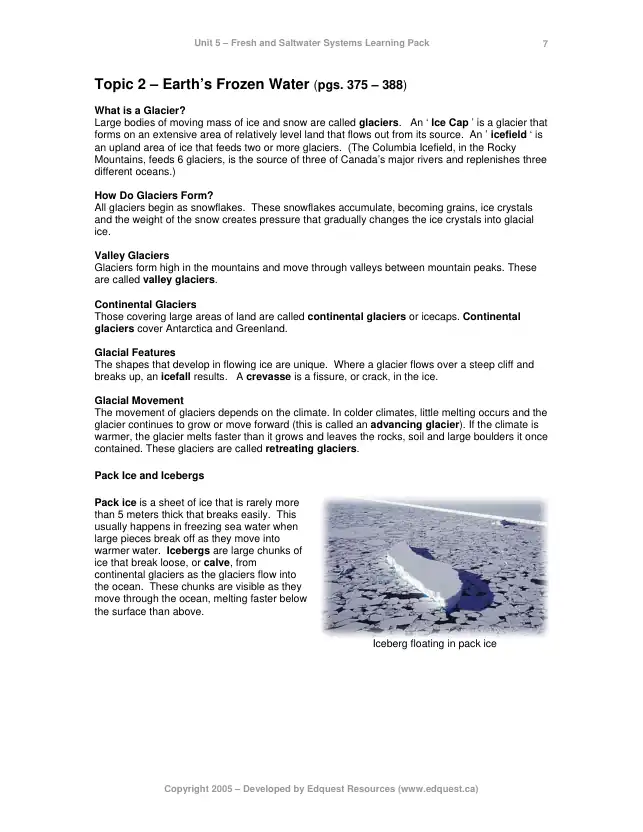
The terminus is the glacier’s end, not a particular permanently fixed piece of ice.
A retreating terminus does not mean all the ice has reversed direction.
SEE IT EXPLAINED
How does moving ice shape the land?
Identify abrasion, plucking and a deposited landform. Match one visual clue to the process in your notes.
Accumulation adds mass, especially through snowfall. Ablation removes mass through processes such as melting, sublimation and calving. Mass balance compares total gains and total losses over a stated period.
Positive balance: gains exceed losses.
Negative balance: losses exceed gains.
Zero balance: the mass is unchanged over that interval; previously lost mass has not been restored.
Ice is a tool for erosion and transport
Rock fragments embedded in moving ice can scrape and polish the bedrock. This is abrasion. Ice can also loosen and remove rock through plucking. Glaciers carry material within, beneath and on top of the ice.
Scratches called striations can provide clues to ice movement.
Long-term glacial erosion can widen and deepen a valley into a U-shaped profile.
A landform is evidence to interpret with its setting, not a complete history by itself.
Deposits tell part of the story
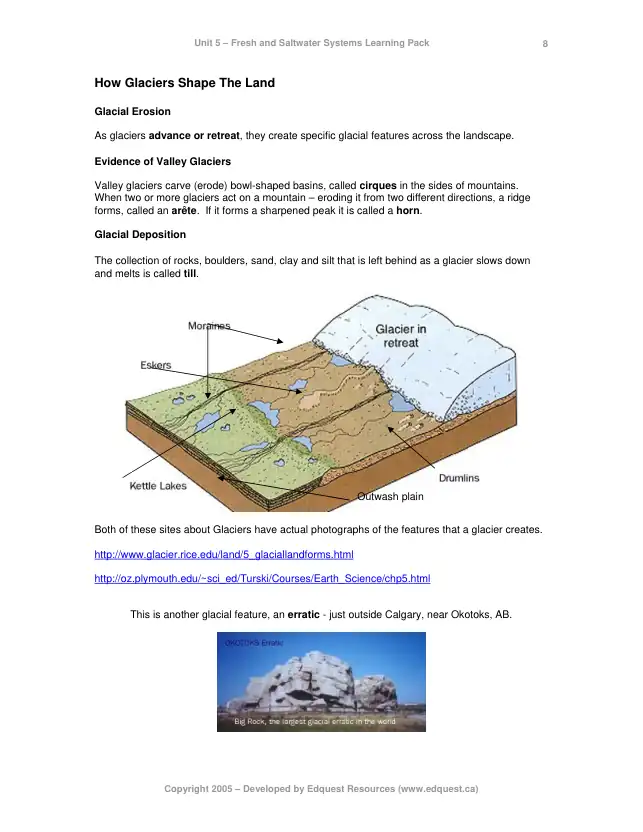
When ice melts, material it carried can be left behind. Till is an unsorted mixture deposited directly by ice. A moraine is an accumulation of glacial debris. Meltwater can sort and deposit sediment, producing different patterns from direct ice deposition.
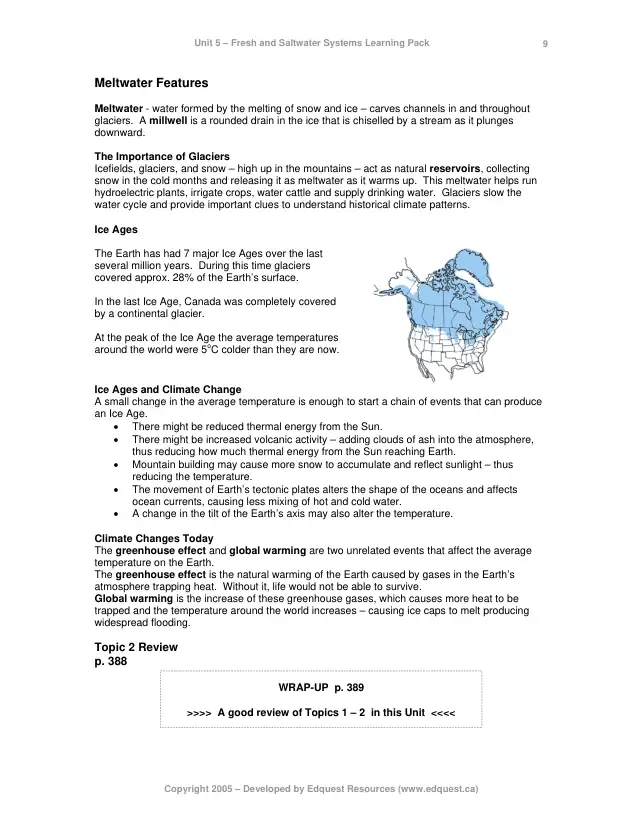
A large transported boulder unlike local bedrock may be a glacial erratic.
An end moraine can help identify a former ice-margin position.
Compare several clues before reconstructing a past glacier.
Weather, climate and freshwater
Weather describes short-term conditions. Climate describes patterns over longer periods. Glaciers respond to snowfall, temperature and other conditions over time. Meltwater can contribute to rivers, but long-term loss also reduces the stored ice available in the future.
Use repeated measurements at comparable times of year.
Land-ice loss adds water to the ocean; floating sea ice is a different situation.
One warm afternoon or one photograph cannot establish a long-term mass-balance trend.
Read the evidence
Feature
Possible evidence
Limit
Striations
Abrasion by debris in moving ice
Need setting and orientation
Moraine
Deposition near a past ice margin
Does not give an exact date alone
Dated image sequence
Changes in outline or visible features
Outline alone is not total ice mass
A WORKED EXPLANATION
Flowing forward while the end retreats
Imagine ice is continually flowing toward the end of a glacier.
If melting and calving remove ice there faster than new ice arrives, the end shifts uphill.
The terminus retreats even though individual pieces of ice still move downhill.
Distinguish the motion of the material from the position of the glacier’s boundary.
Relevant pages from the original review pack. Use the updated explanations and linked sources for estimates and terminology.
WATCH THE PHENOMENON
Watch decades of glacier change
NASA Goddard · Satellite time-lapse
Movement and retreat are different observations
Follow a visible stripe or feature in the ice, then watch the terminus. Use the dates: this is a sequence of satellite observations, not real-time motion.
Follow a stripe or rock feature from one dated image to the next. Its motion can show ice flowing down the valley.
02 · Margin change
Compare the glacier’s lower end with a fixed valley landmark. A retreating margin does not mean the ice is flowing uphill.
03 · Time scale
Read the dates. A decades-long sequence is stronger evidence of sustained change than one warm day.
Connect the observations to mass balance
A glacier gains mass through accumulation and loses mass through processes including melting and calving. For an ideal example, 12 units gained minus 17 units lost gives a balance of −5 units. A glacier starting with 100 units would have 95 units. These are teaching numbers, not measurements of the glacier in the film. A mass budget alone does not locate its lower end.
WORK THE REASONING
A model glacier gains 8 units and loses 11
Net change is 8 − 11 = −3 units. It lost mass over the interval. That result alone does not specify the speed or exact position of its terminus.
Key connections
Accumulation
Ice flow
Ablation
Mass balance
TRY IT
Try it yourself
Can ice flow downhill while the glacier’s end retreats?
Give me a hint
Compare the rate of ice arriving at the end with the rate of loss.
Compare with a worked response
Yes. The ice can flow downhill while the terminus retreats if loss near the end exceeds the ice supplied to it.
TAKE IT FURTHER
Make the connection
Why would “the glacier got smaller in July” be weak evidence for a long-term trend?
Compare your reasoning
Summer loss can be part of an annual cycle. Compare measurements from similar dates over multiple years and account for both accumulation and ablation. A longer record helps separate seasonal variability from persistent change.