Select a page to enlarge it. Open the PDF for the complete note set.
Different tests answer different questions
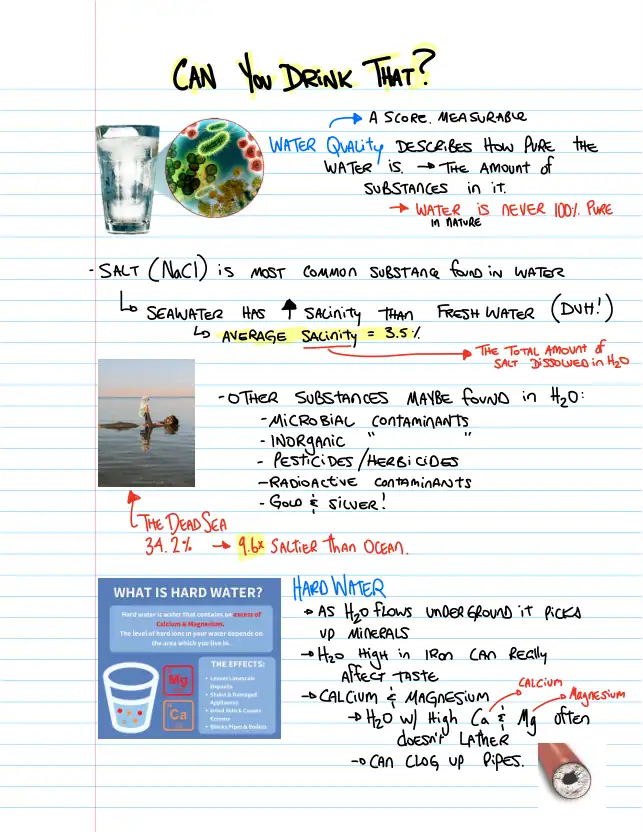
Turbidity describes cloudiness caused by suspended material. Salinity describes dissolved salts; hardness relates mainly to calcium and magnesium ions. Other tests investigate microbes or chemical substances.
Sampling affects the conclusion
Water quality varies with place, time, rainfall and human activity. Record the method, location, date and units; repeat samples where possible. One result supports only the claim the method can actually test.
Do not taste samples
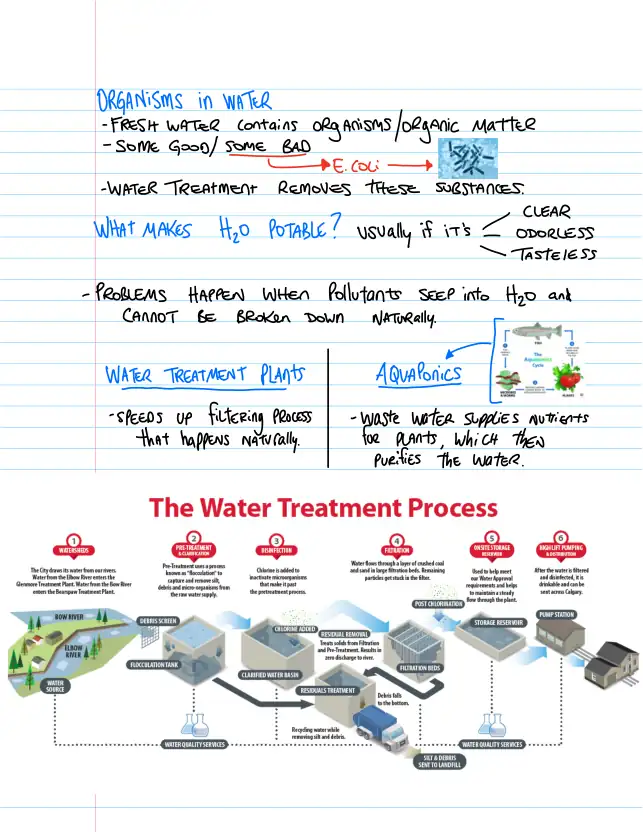
Clear, odourless water can contain harmful substances or organisms. A classroom filter does not establish potability. Observe approved samples under the teacher’s procedure and never drink them.
Words worth knowing
Turbidity
Cloudiness associated with suspended material; commonly measured in NTU.
Hardness
A property related mainly to dissolved calcium and magnesium.
Conductivity
A measure of how readily water conducts electric current; influenced by dissolved ions.
Contaminant
A substance or organism present where it may cause an unwanted effect.
Control variable
A factor kept consistent to make a comparison more informative.
PREDICT · INVESTIGATE · EXPLAIN
Open the field notebook
Compare upstream and downstream samples before and after rain. Select a test to reveal evidence; keep track of its units and limitations.
All values are fictional teaching data from one imagined stream. No real site or drinking-water result is represented. The notebook cannot establish safety.
WATCH THE PHENOMENON
Water-quality evidence from Alberta
albertatomorrow · Regional field science
Look for methods, context and limits
Identify one measured property, how samples are collected and why location or repetition matters. What question can that evidence answer?
This supports removal of some suspended particles. It does not prove that dissolved chemicals or all microbes have been removed; the sample is not certified drinkable.
Key connections
Question
Sampling plan
Measurement
Limited conclusion
TRY IT
Try it yourself
Why record recent rainfall when comparing stream samples?
Give me a hint
Consider how runoff and flow can change what is carried.
Compare with a worked response
Rainfall can change sediment, contaminants and dilution. Recording it helps explain differences between samples and identify other variables to investigate.
TAKE IT FURTHER
Make the connection
Does hard water necessarily mean contaminated water?
Compare your reasoning
No. Hardness describes dissolved calcium and magnesium, which can affect lather and scaling. Potability depends on many separate criteria. Neither hardness nor softness alone certifies drinking-water safety.