Select a page to enlarge it. Open the PDF for the complete note set.
Treatment uses multiple barriers
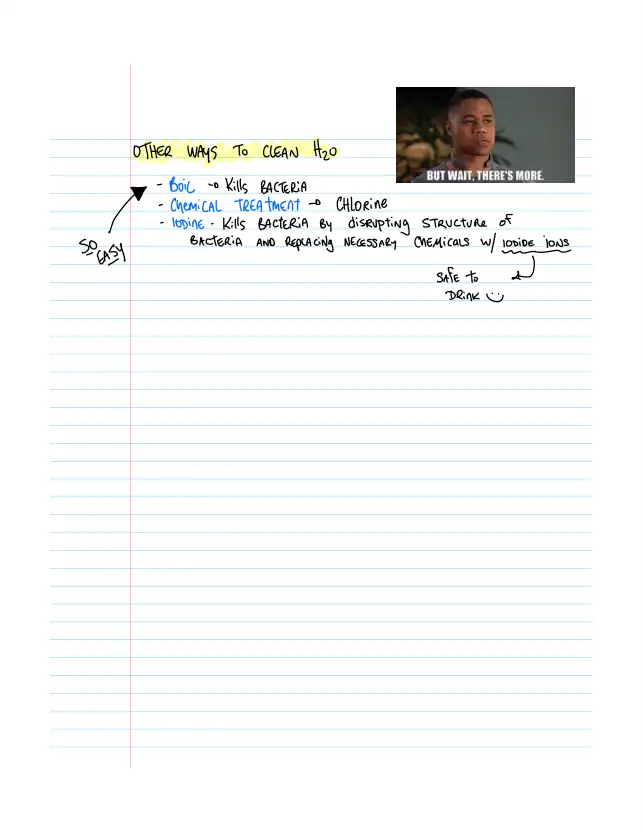
Depending on source water, treatment may use coagulation and flocculation to help particles form clumps, settling and filtration to remove material, and disinfection to target disease-causing organisms. Monitoring is part of the system.
A local connection
The City of Calgary describes intake, pre-treatment and clarification, disinfection, filtration, storage and distribution for its drinking-water system. This is a local example; different systems select processes for their own sources and requirements.
Choose the process for the problem
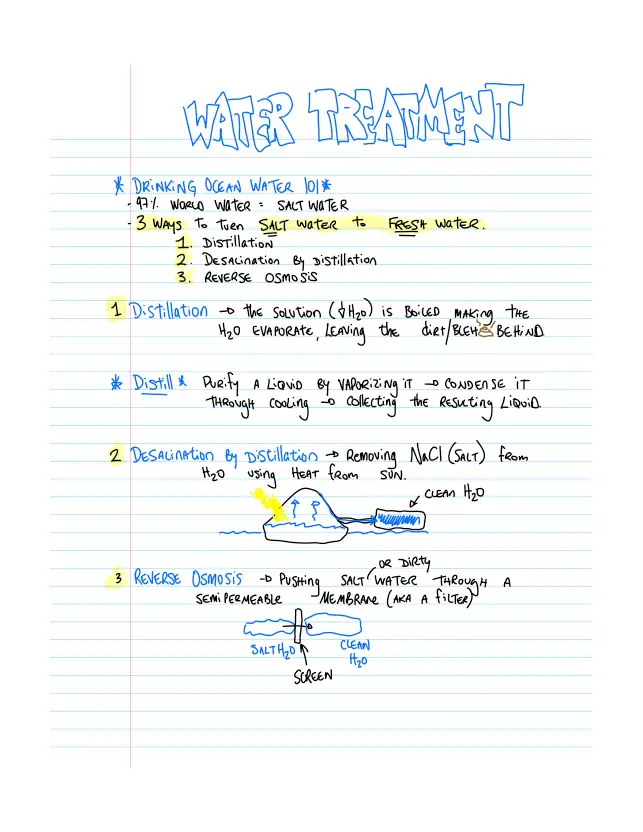
Ordinary filtration does not remove most dissolved salt. Distillation collects condensed water after evaporation; reverse osmosis uses pressure and a suitable membrane. Compare energy, waste streams, source protection and community priorities when evaluating choices.
Words worth knowing
Coagulation / flocculation
Processes that help small particles form larger clumps.
Disinfection
A process used to inactivate disease-causing organisms.
Desalination
Reducing dissolved salts in saline water.
Reverse osmosis
Pressure-driven separation through a suitable membrane.
Distillation
Vaporizing water and collecting the condensed vapour; many non-volatile substances remain behind.
PREDICT · INVESTIGATE · EXPLAIN
Choose a barrier for the problem
Compare particle removal, disinfection and salt separation. Trace what each process targets and what can remain.
A qualitative process model, not a design for making drinking water. Actual performance depends on equipment, operating conditions, monitoring and validated standards. Never drink classroom samples.
WATCH THE PHENOMENON
How do water treatment plants work?
Concerning Reality · Process explainer
Name the job of each barrier
Pause at a stage and identify its target. Distinguish removal of suspended particles from inactivation of microorganisms.
Dissolved salt passes with water through ordinary filter pores. A different process is needed to reduce dissolved salts.
Key connections
Source water
Targeted barriers
Monitoring
Distribution
TRY IT
Try it yourself
How can a community compare two water-supply options?
Give me a hint
Think beyond the volume produced.
Compare with a worked response
Compare quality, reliability, energy, cost, waste, ecosystem effects and community priorities using evidence. Science helps explain trade-offs; communities also weigh values.
TAKE IT FURTHER
Make the connection
Why is reverse osmosis not simply “a smaller kitchen strainer”?
Compare your reasoning
Dissolved ions travel with water through an ordinary strainer. A reverse-osmosis membrane separates water and much of the dissolved salt under pressure. The system uses energy and produces a concentrated reject stream that must be managed.