Conditions in the water help determine which organisms can live there.
GRADE 8 SCIENCE
Lesson notes
Aquatic organisms depend on a combination of physical conditions, chemical conditions, habitat and feeding relationships. A change can have indirect effects through the ecosystem.
An ecosystem is more than its water
An aquatic ecosystem includes living organisms and the non-living conditions around them. Important abiotic factors include temperature, light, salinity, dissolved oxygen, nutrients, flow and the type of bottom material. Biotic factors include food, competitors, predators and decomposers.
Different species have different tolerances.
Suitable temperature alone does not guarantee suitable habitat.
A change in one factor can interact with several others.
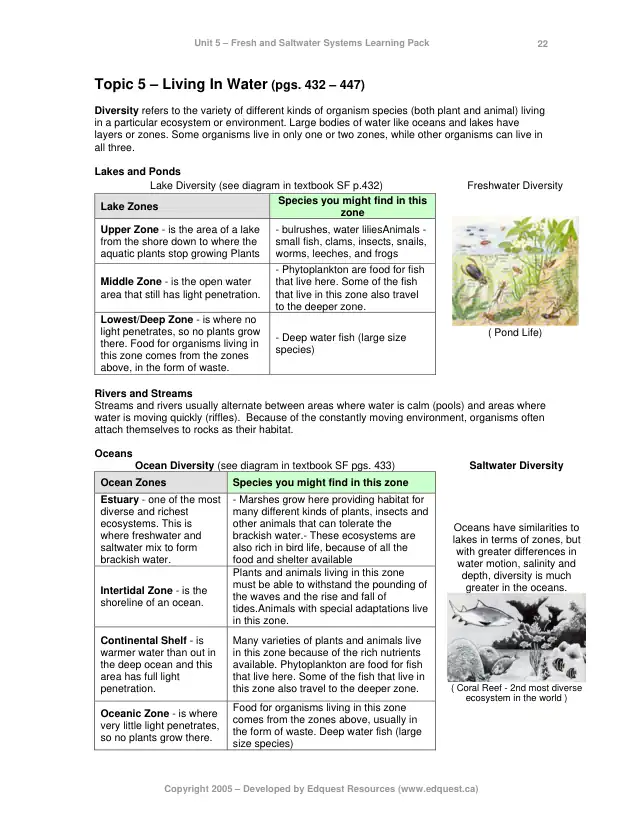
Water contains dissolved gases
Many aquatic organisms obtain oxygen dissolved in water. Gills provide a large exchange surface for some animals, while other organisms use different structures. Oxygen enters through exchange with the atmosphere and photosynthesis; respiration and decomposition use it.
Cold freshwater generally holds more dissolved oxygen at saturation than warm freshwater.
An actual oxygen level also depends on mixing, photosynthesis, respiration and other conditions.
Clear water can still have too little oxygen for a particular organism.
Light supports many food webs
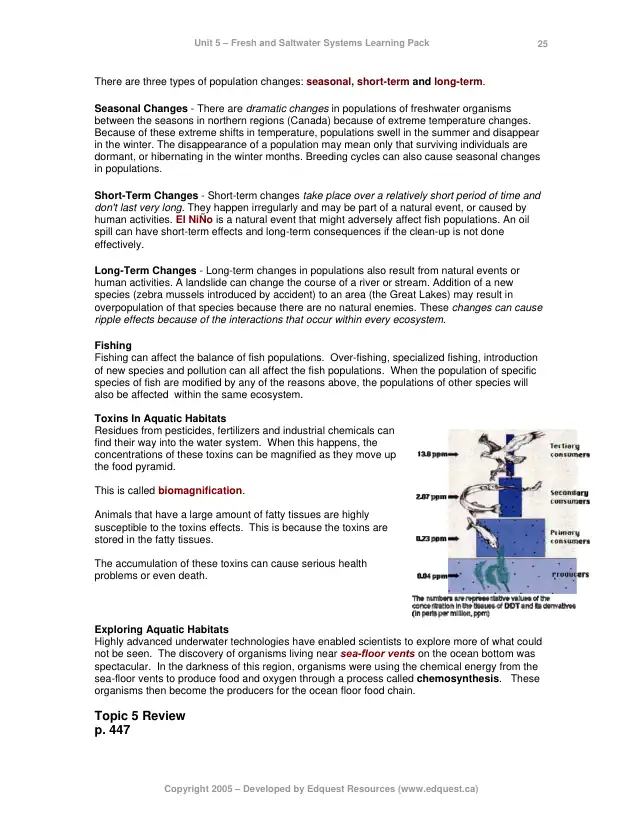
A producer makes organic food from non-living materials using an energy source. In sunlit water, algae and aquatic plants use light. Consumers obtain food by eating other organisms or their material. Decomposers, including bacteria and fungi, break down dead material and wastes. These are feeding roles, not labels for how important an organism is.
Producer example: algae use light, carbon dioxide and water to make organic matter.
Consumer example: a water flea eats algae; a small fish can eat the water flea. A feeding arrow points from the food toward its eater.
Decomposer example: bacteria break down dead algae. Their respiration can consume dissolved oxygen.
Matter can be reused as nutrients. Usable energy enters, transfers through the web and is eventually dispersed as heat; it does not cycle back to the Sun.
Depth changes the habitat
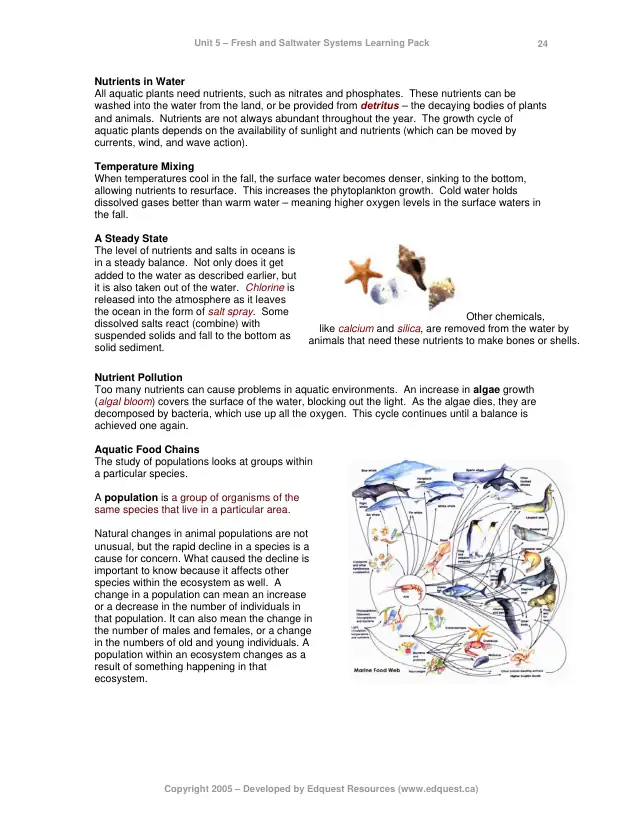
Less sunlight reaches greater depths or passes through turbid water. Photosynthesis is therefore limited to places with enough light. Deep-water communities may depend on organic matter sinking from above. Some deep-ocean systems use chemical energy instead of sunlight as their main energy source.
The depth of useful light varies with conditions; it is not one fixed depth in every lake or ocean.
Pressure increases with depth. Temperature, food supply and oxygen can also vary.
Features such as camouflage, buoyancy control or specialized feeding structures can help organisms in particular habitats.
SEE IT EXPLAINED
Life in the deep ocean
Find an adaptation connected to darkness, food supply or pressure. Distinguish surviving in darkness from producing food by photosynthesis.
Water moves across selectively permeable membranes by osmosis. Freshwater and marine organisms face different water-and-salt balance challenges. Gills, kidneys and other structures can help regulate exchange. An organism suited to one salinity may not survive a sudden move to another.
Connect salinity with concentration differences, rather than assuming all fish have identical needs.
Some species tolerate a wide salinity range, while others do not.
Too many nutrients can lead to less oxygen
Extra nutrients can stimulate algal growth when other conditions allow. Dense growth can shade plants. Later, decomposition of dead organic matter uses dissolved oxygen. If demand exceeds oxygen resupply, animals may be stressed, leave or die.
Not every algal bloom is toxic.
A green appearance alone does not identify a cause.
Pair biological observations with measurements over suitable times and locations.
Organisms can be evidence
A community of aquatic invertebrates can help scientists interpret conditions over time. Some organisms tolerate certain disturbances better than others. Use local identification methods and compare similar habitats; one insect or one species list cannot certify water quality.
A chemical sample represents a particular time and place.
A biological community may reflect exposure over a longer interval.
Using several kinds of evidence gives a stronger explanation.
Conditions and possible effects
Change
Possible effect
Evidence to collect
Less light
Less photosynthesis at depth
Light / turbidity and plant distribution
More organic matter decaying
Greater oxygen demand
Oxygen through time, temperature, flow
Salinity changes
Stress on organisms with narrow tolerances
Salinity and organism observations
A WORKED EXPLANATION
Why sample oxygen before dawn?
Photosynthesis adds oxygen when sufficient light is available.
Respiration continues during the day and at night.
In some productive waters, oxygen can be lower late at night or near dawn than at midday.
A single noon sample might miss that pattern. Repeated measurements can test it.
Nutrients enter. Runoff can add nitrogen and phosphorus.
Growth increases. Excess nutrients can support more algae when other conditions allow.
Organic matter decomposes. Bacteria and other decomposers use dissolved oxygen during respiration.
Oxygen demand can exceed supply. Low oxygen can stress or kill aquatic organisms. Nutrient input does not guarantee the same outcome in every water body.
Check the explanation: Why can extra nutrients lead to less oxygen even though algae photosynthesize? Include what happens after algae die.
WORK THE REASONING
Fish decline after an algal bloom
Investigate dissolved oxygen over suitable times and places. Consider decomposition as one possible mechanism, and compare other explanations before claiming cause.
Key connections
Water conditions
Organism tolerances
Food web
Ecosystem change
TRY IT
Try it yourself
Why combine chemical samples with observations of aquatic organisms?
Give me a hint
Think about the time period each kind of evidence represents.
Compare with a worked response
A sample describes particular conditions when and where it was taken; a community can reflect exposure over longer periods. Together they support a stronger interpretation.
TAKE IT FURTHER
Make the connection
How could a sample taken at noon miss an oxygen problem that occurs near dawn?
Compare your reasoning
Photosynthesis adds oxygen in daylight while respiration uses oxygen day and night. Oxygen can be lower late at night or before dawn. Repeated measurements across a day are stronger than a single noon sample.