Most water is salty
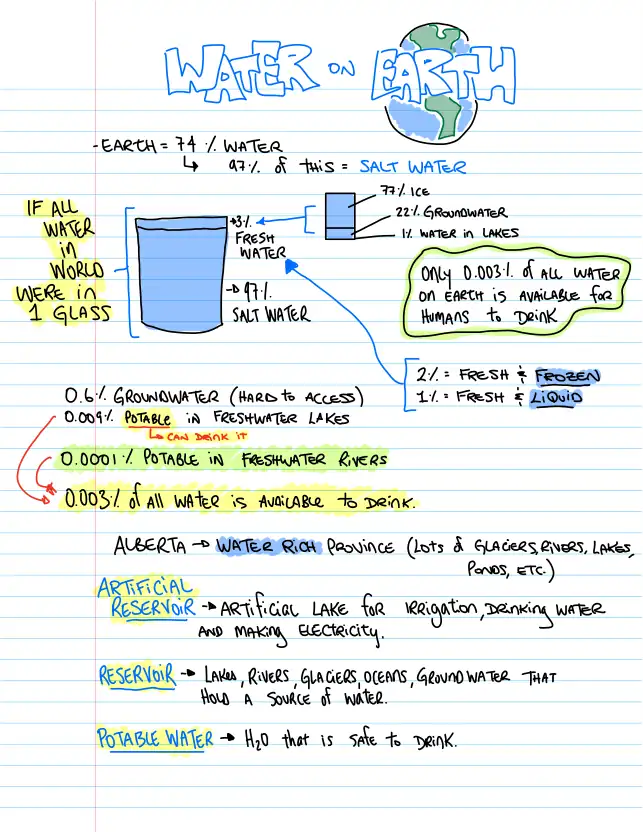
Oceans hold most of Earth’s water. Freshwater is a much smaller share, and much of it is stored as ice or groundwater. Lakes and rivers are important to people and ecosystems, but hold only a small part of the total.
Why can a water-rich planet still face water shortages?
Select a page to enlarge it. Open the PDF for the complete note set.
Oceans hold most of Earth’s water. Freshwater is a much smaller share, and much of it is stored as ice or groundwater. Lakes and rivers are important to people and ecosystems, but hold only a small part of the total.
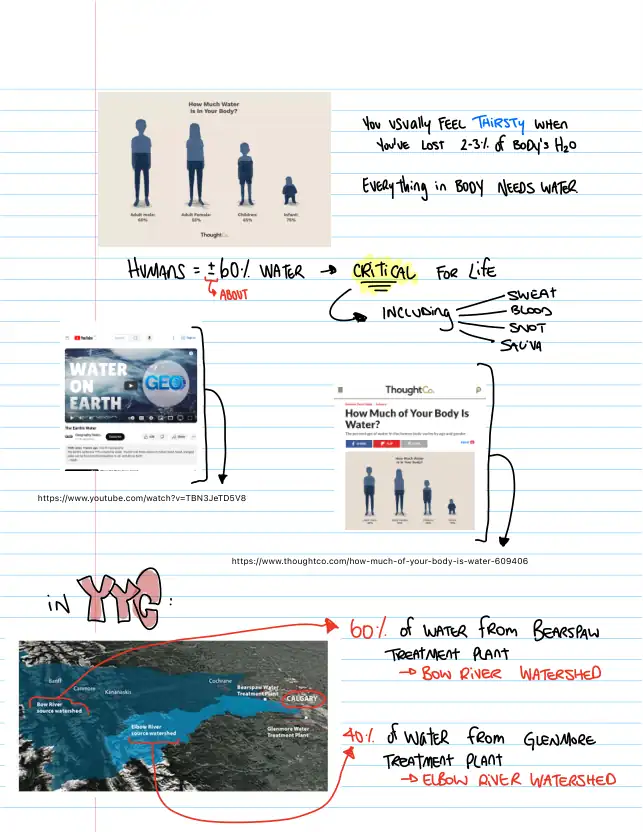
Water may be far from the people or ecosystems that need it, frozen, difficult to access, polluted or unavailable at the right time. A region’s supply also changes with weather, season, infrastructure and competing needs.
Freshwater has relatively low salinity compared with seawater. Potable water is suitable for drinking. Clear, fresh water may still contain harmful organisms or chemicals, so appearance alone cannot prove safety.
Change the whole you are measuring. Compare percentages of all water with percentages of freshwater.
Rounded USGS estimates: 97.5% saline, 2.5% fresh; freshwater is about 68.7% ice, 30.1% groundwater and 1.2% surface/other. These describe storage, not drinking-water safety.
TED-Ed · Animation
Separate the total amount of freshwater from water that can reach people when and where it is needed. The film’s projections reflect its 2018 publication.
A fictional planet has 100 L of water, including 4 L of freshwater and 1 L of accessible freshwater. The accessible amount is 1% of total water but 25% of its freshwater. These are teaching numbers, not estimates for Earth.
A graph says 70% of freshwater is frozen. Is that 70% of all water?
Identify what the percentage is out of.
No. The whole is freshwater, a subset of all water. Multiply by the freshwater share only if the total-water percentage is needed.
Why could two regions with the same annual rainfall have different water availability?
Compare seasonal timing, population, storage, water quality, infrastructure and ecosystem needs. A yearly total hides when and where the water arrives.
Read further: USGS · Where is Earth’s water? →