
Three different quantities
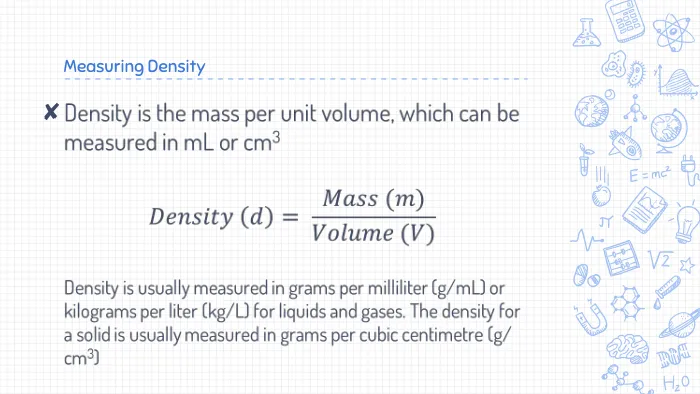
Mass measures amount of matter; volume measures space occupied. Density is mass divided by volume. One millilitre equals one cubic centimetre.
Compare mass per unit volume.
Selected pages previewed; the PDF contains the complete set.
Mass measures amount of matter; volume measures space occupied. Density is mass divided by volume. One millilitre equals one cubic centimetre.
A heavier object is not necessarily denser: both mass and volume matter. Samples of the same uniform material have approximately the same density under the same conditions.
Subtract container mass when measuring liquid. A fully submerged irregular solid’s displaced water volume can indicate its volume if it does not dissolve or absorb water.
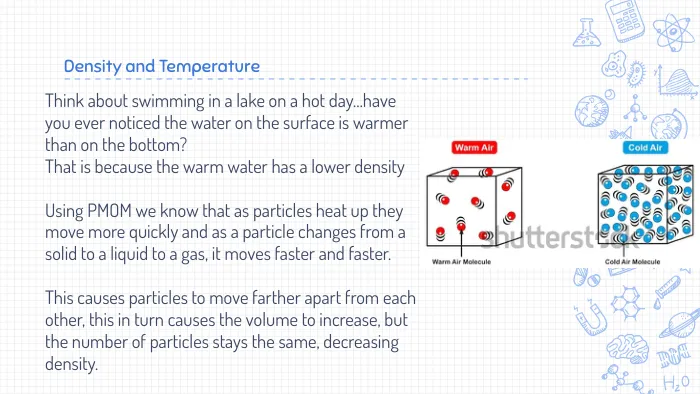
For a fixed mass, expansion increases volume and lowers density. Many fluids expand when warmed, but there are exceptions: water expands when it freezes, so ice is less dense than liquid water.
Compare blocks of different mass and volume. Use the scale and water displacement.
Change the mass of a sealed 100 mL object, then compare the surrounding fluids. Predict whether it floats and how much is submerged.
Sealed object, fixed volume 100 mL, no absorption or surface-tension effects. At equal density it can remain submerged; in real settings small differences matter. Diagram dimensions are schematic.
On Compare, try Same Mass and Same Volume. Predict the ordering of densities before measuring.
Use a measured mass and volume to explain a density. The simulation uses kg/L, numerically equal to g/mL.
Change the sample mass and volume. Predict the density before checking.
A uniform sample is assumed. This calculator does not predict floating unless fluid density and object shape are also considered.
Pause at an example and identify the mass, volume and units before calculating.
The Digital Classroom ExperienceOpen on YouTube →Density = 90 ÷ 30 = 3 g/cm³. Include the unit and state what was measured.
An empty beaker is 50 g. With 40 mL of liquid it is 110 g. Find the liquid’s density.
First subtract the empty beaker’s mass; then divide by liquid volume.
Liquid mass = 110 − 50 = 60 g. Density = 60 g ÷ 40 mL = 1.5 g/mL.
Design a measurement for a teacher-approved irregular solid using displacement. Record initial and final water levels, then use the difference as the object’s volume if it is fully submerged and does not absorb or dissolve.
How would an air bubble trapped on the object affect the measured displaced volume?
A trapped air bubble adds to the measured displaced volume without being part of the solid. If the mass measurement is unchanged, dividing it by an overestimated volume underestimates the calculated density.
A large foam block can have more mass than a small steel bead and still have lower density.
Choose an answer, then use the feedback to refine your reasoning.