Force spread over area
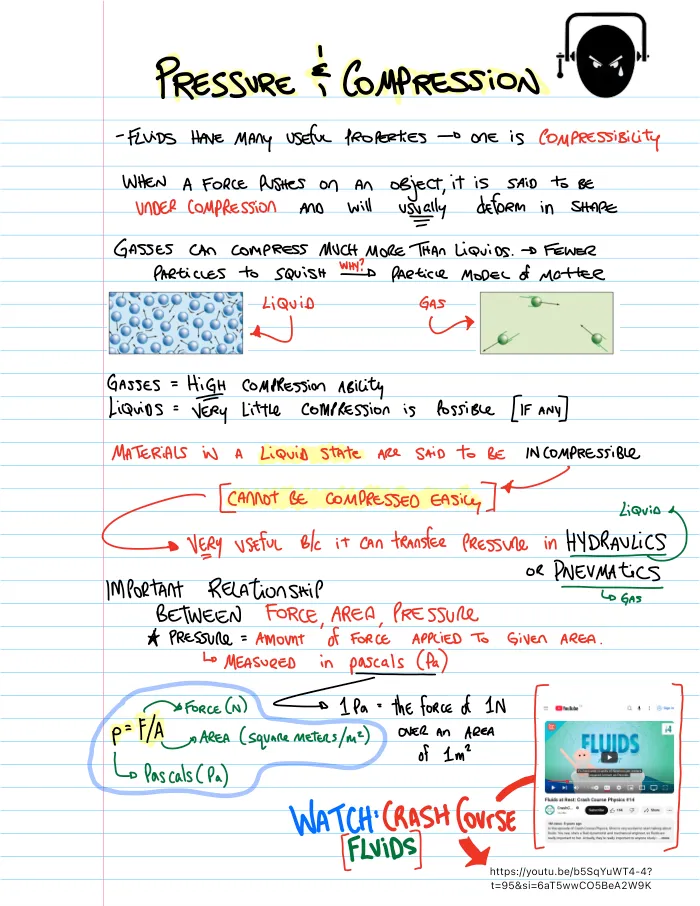
Pressure = force ÷ area. One pascal is one newton per square metre. For the same force, a smaller contact area produces greater pressure.
Spread a force, compress a fluid and explore depth.
Pressure = force ÷ area. One pascal is one newton per square metre. For the same force, a smaller contact area produces greater pressure.
Gas particles are separated by relatively large spaces, so trapped gas compresses readily. Liquids can compress slightly but are often treated as nearly incompressible in classroom hydraulic models.
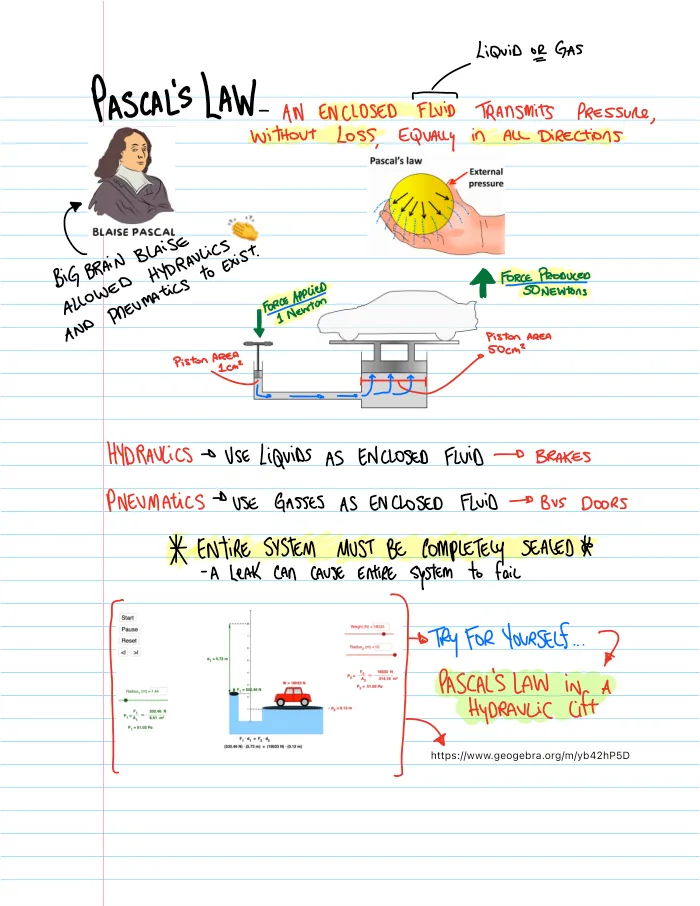
For trapped gas compressed slowly at approximately constant temperature, reducing its volume increases pressure. Heating it or allowing gas to escape changes that comparison. Fluid pressure at a point acts in all directions.
Move the pressure gauge through a fluid. Change depth or fluid density and compare.
Measure pressure at two depths while keeping fluid density and gravity the same. Then compare equal depths.
Explain why pressure increases with depth. This explores pressure in a fluid; the calculator below explores force spread over contact area.
Keep the force the same and change the contact area. Predict how the pressure changes.
Pressure here is average force per area, assuming the force acts perpendicular to the surface.
Connect pressure and buoyancy to the lesson. This moves beyond Grade 8 in places; focus on the relationships and skip unfamiliar algebra if needed.
Crash Course Physics · extensionOpen on YouTube →The pressures are 400 Pa and 2,000 Pa. Reducing area fivefold increases pressure fivefold when force stays constant.
A 120 N force acts over 0.4 m², then over 0.2 m². Compare the average pressures.
Use pressure = force ÷ area for each contact area.
The pressures are 300 Pa and 600 Pa. Halving the area doubles the pressure when the force stays constant.
Use the pressure lab to compare the same force on two areas. Record both results, including units, and describe the relationship when area is halved.
Which quantity must stay fixed to isolate the effect of area?
Keep the perpendicular force fixed while changing contact area. Since pressure is force divided by area, halving the area doubles the average pressure. For a depth comparison in the PhET model, keep fluid density, gravity and surface pressure fixed instead.
Low compressibility helps confined liquids transmit an applied pressure change in hydraulic devices.
Choose an answer, then use the feedback to refine your reasoning.