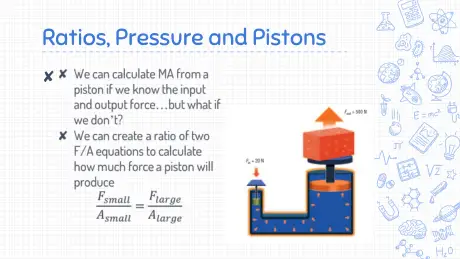
Pressure is force divided by area. A confined fluid transmits an applied pressure change through the fluid. For a slow ideal hydraulic comparison at the same height, F₁/A₁ = F₂/A₂. Equal pressure changes do not imply equal forces on pistons of different areas.
Use consistent area units for a ratio.
The pascal is one newton per square metre. Convert cm² to m² if calculating pressure in pascals.
The larger piston gains force but loses travel
With an effectively incompressible liquid and no leaks, the displaced volumes balance: A₁d₁ = A₂d₂. A piston five times larger in area can produce five times the force ideally, but moves one fifth as far.
Do not confuse diameter ratio with area ratio.
The ideal input and output work are equal; real seals, valves and friction create losses.
A jack needs more than two pistons
A bottle jack uses a lever, a small pump piston, check valves, a reservoir and a larger lifting piston. Repeated handle strokes move more liquid to the lifting side. The release valve allows controlled lowering.
The check valves control direction of fluid flow.
Never work under a load supported only by a hydraulic jack; real lifting requires rated equipment and proper supports.
Air behaves differently from oil
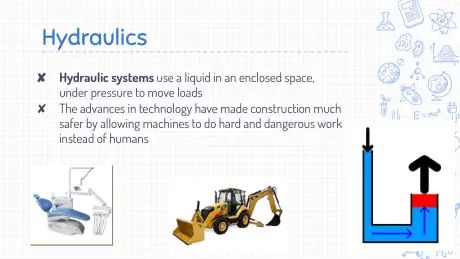
Pneumatic systems use gases, which compress substantially. Hydraulic systems commonly use liquids with much smaller compressibility. Compressibility affects response and energy storage. Both systems require controls and pressure-rated components.
Compressed air can provide spring-like behaviour.
A classroom comparison is not a pressure-vessel construction plan.
MEASURE · CALCULATE · EXPLAIN
Pascal’s law: force and travel together
Change one measurement, predict the result, then compare the calculated account. These are editable teaching measurements, not a physical simulation.
WATCH THE PHENOMENON
Inside a hydraulic jack
Deconstructed · Mechanism in action
Watch with a prediction
Find the lever, pump piston, check valves and release valve. Follow one complete pumping stroke before explaining the larger lifting force.
Input piston area = 2 cm²; output area = 10 cm². Area ratio = 5.
A 20 N input gives an ideal output force of 20 × 5 = 100 N.
If the input piston moves 10 cm, the output moves 2 cm.
Input work = 20 × 0.10 = 2 J. Output work = 100 × 0.02 = 2 J.
TRY IT
Predict, then explain
If a piston’s diameter doubles, by what factor does its area increase?
Compare your reasoning
Area increases by 4 because circle area is proportional to diameter squared. Under equal applied pressure, its ideal force is four times as large.
TAKE IT FURTHER
Test the idea
Compare a syringe containing air with one containing water only under teacher-approved low-pressure conditions. Predict the difference before pressing.