GRADE 8 SCIENCE · MATTER IN MOTION

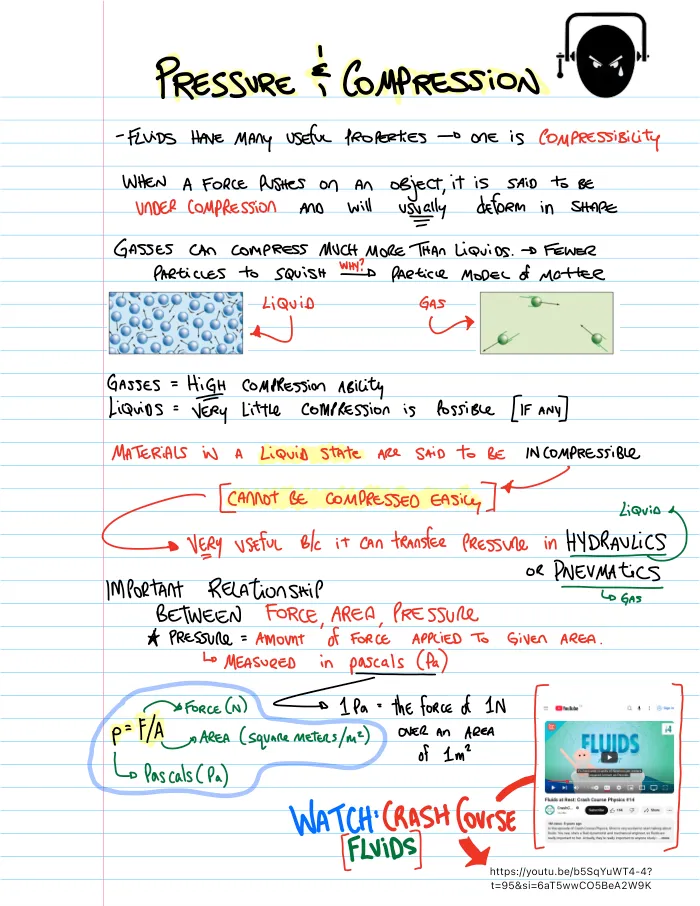
Hydraulics & fluid pressure

Follow pressure through a closed fluid system.

Class notes

Open PDF →

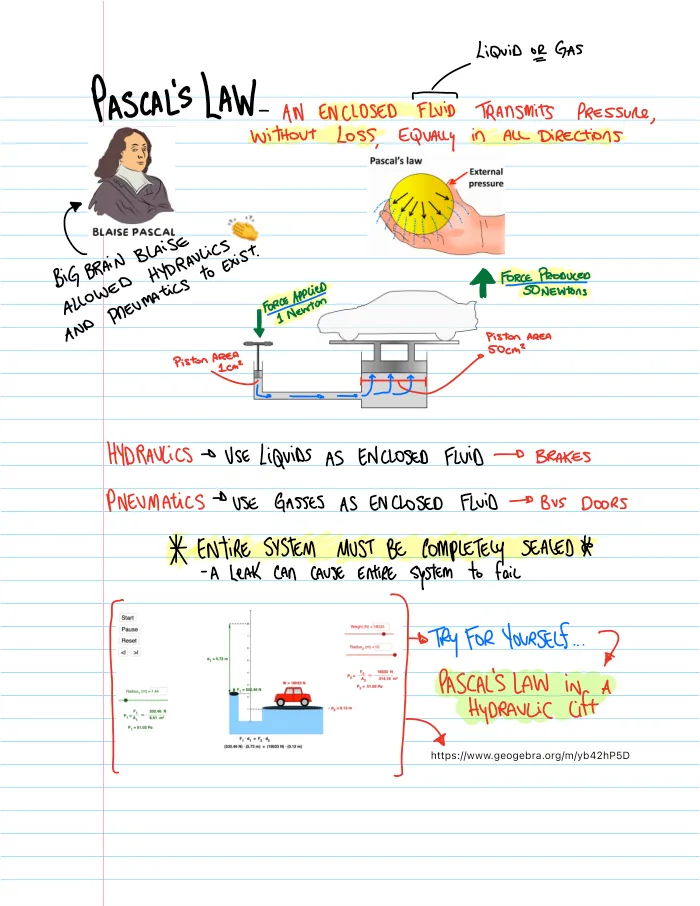
Pascal’s law: transmit a pressure change

Pascal’s law states that a pressure change applied to a confined fluid is transmitted throughout the fluid. Hydraulic devices use a connected, enclosed liquid to do this. Liquids compress very little in the ideal model.

Larger area, larger force

In an ideal hydraulic system, input force ÷ input piston area equals output force ÷ output piston area. The same pressure acts over more area at a larger piston, producing more force. Five times the piston area gives five times the force; the pressure has not been multiplied.

Follow the distance as well

An ideal closed system transfers the same liquid volume at each piston: input area × input distance = output area × output distance. A larger output piston moves a shorter distance, so the device does not create energy.

PASCAL’S LAW · FORCE & MOVEMENT

Inside a hydraulic lift

Change the output piston area. Predict the force and distance trade-off before reading the result.

Blue is liquid; gold marks the pistons. Move the input piston with the travel slider. Ideal liquid with no compression, friction or height-related pressure difference; widths are schematic.

THINK IT THROUGH

A 20 N force acts on a 2 cm² input piston. The output area is 10 cm².

Reveal the reasoning

The applied pressure is 20 ÷ 2 = 10 N/cm². The ideal output force is 10 × 10 = 100 N. The output area is five times larger, so the output distance is one fifth of the input distance in the ideal closed model.

TRY IT

Try it yourself

A 30 N force acts on a 3 cm² piston connected to a 12 cm² output piston. Find the ideal output force.

Give me a hint

Calculate input pressure first, then multiply by output area.

Compare with a worked response

Input pressure = 30 ÷ 3 = 10 N/cm². Ideal output force = 10 × 12 = 120 N. The output distance is one quarter of input distance in the ideal closed model.

TAKE IT FURTHER

Investigate & explain

Use the ideal model to compare two piston areas. Keep the input force fixed, change the output area and explain how output force and displacement change together.

What happens to the model if air is trapped in the liquid?

Compare your reasoning

Air is much more compressible than the liquid. Some input movement first compresses the trapped gas, making the response less immediate and changing the movement predicted by the ideal incompressible-fluid model. Real systems also have friction and leakage.

Common question: Equal pressure means equal force on both pistons.

Force equals pressure multiplied by area. At the same pressure, a larger area produces a larger force.

CHECK YOUR UNDERSTANDING

Put the ideas to work

Choose an answer, then use the feedback to refine your reasoning.

1. A pressure of 5 N/cm² acts on 8 cm². What force results?

2. Why does the larger piston move less?

3. What does a trapped air bubble change?

BUILD FLUENCY

Practice with measurements

Practice feedback is not a school mark.

What are you curious about?

Search lessons, class notes and interesting questions.