GRADE 8 SCIENCE · MATTER IN MOTION

Particles, states & fluids

Make particle behaviour visible.

Class notes

Open PDF →

Matter has a particle story

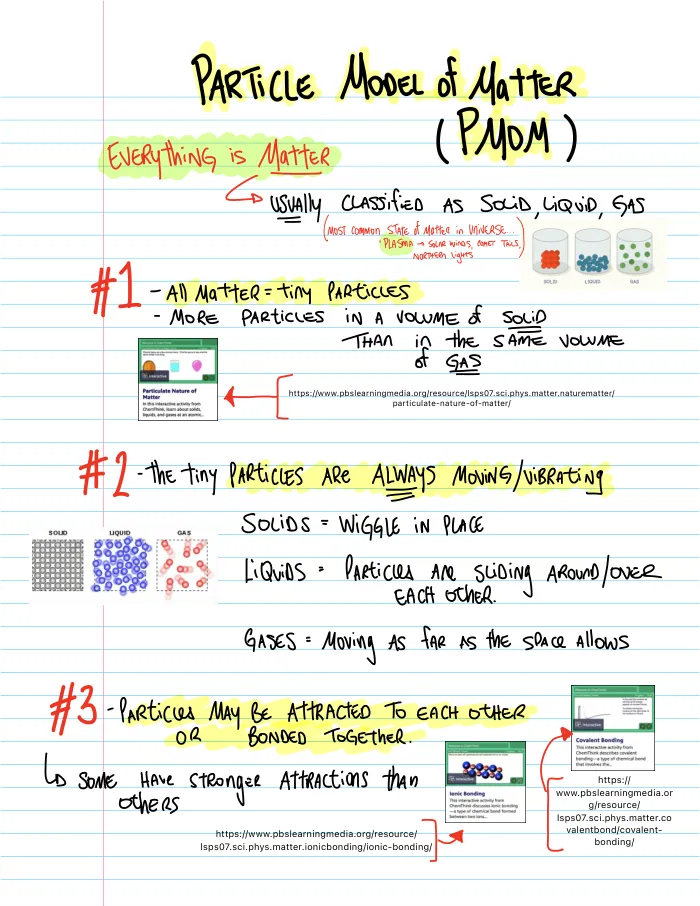
Matter has mass and occupies space. The particle model represents matter as tiny moving particles with spaces and attractions between them. It helps connect observations to explanations; its dots do not show actual sizes or colours.

What makes a fluid?

Solid particles vibrate around positions. Liquid particles remain close but can move past one another. Gas particles are much farther apart and move throughout a container. Liquids and gases are fluids because they flow.

Heating and expansion

Warming generally increases average particle motion. During expansion, average spacing can increase; the particles themselves do not need to grow. During a change of state, added energy can change the arrangement without increasing temperature.

PHET · EXPLORE A MODEL

Watch matter change state

Compare solid, liquid and gas. Watch the particles as you change the temperature.

Investigate

Choose one substance. Predict how heating changes its particle arrangement, then test your prediction.

Make the connection

Explain the difference between particle motion and the size of a particle.

WATCH & CONNECT

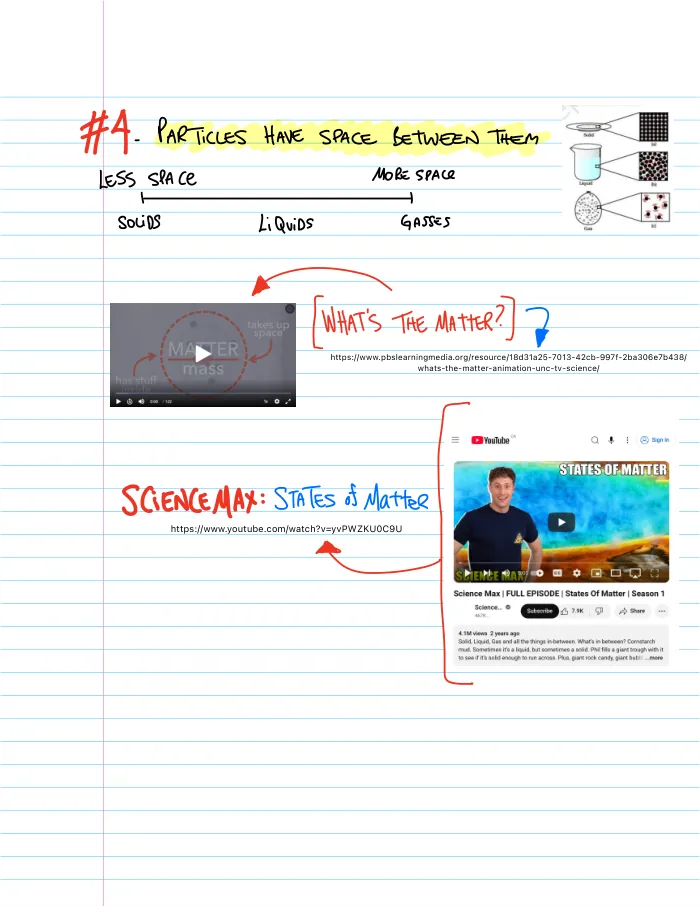
States of Matter

Watch with a question: how do the demonstrations show changes in particle arrangement? This is a full episode; pause and revisit the model in the lesson.

Science MaxOpen on YouTube →
THINK IT THROUGH

Why can air in a sealed syringe be compressed?

Reveal the reasoning

The same gas particles can occupy less total space as the spaces between them decrease. The particles do not need to shrink.

TRY IT

Try it yourself

A sealed syringe of air is pushed in. What changes in the particle model?

Give me a hint

Think about the spaces between particles, not their size.

Compare with a worked response

The same particles occupy a smaller volume because the space between them decreases. Their individual size does not need to change.

TAKE IT FURTHER

Investigate & explain

Predict how the spacing of particles in a sealed sample of gas changes when its volume is reduced. Use the model to distinguish particle size from the space between particles.

What does this model show well, and what does it leave out?

Compare your reasoning

The particle model explains how a gas changes volume through changes in spacing and motion. Its dots do not show actual particle colours or sizes, and a flat drawing cannot show all the motion and interactions in three dimensions.

Common question: Only liquids are fluids.

Gases also flow. A liquid has an approximately fixed volume; a gas expands to fill its container.

CHECK YOUR UNDERSTANDING

Put the ideas to work

Choose an answer, then use the feedback to refine your reasoning.

1. Which pair consists of fluids?

2. When a metal rod expands on warming, what happens in the model?

3. Why is air considered a fluid?

What are you curious about?

Search lessons, class notes and interesting questions.