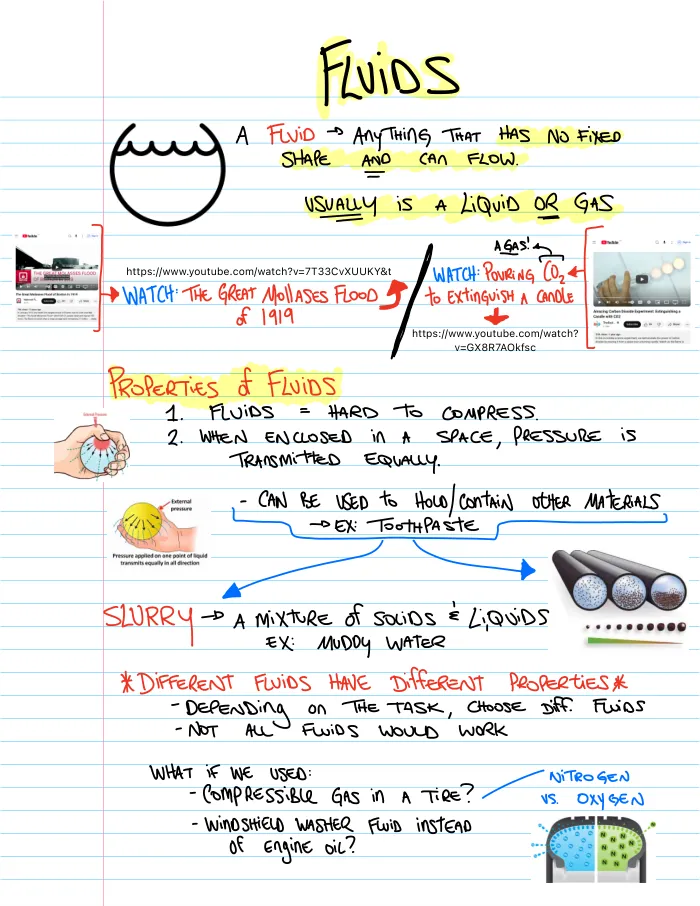
Choose a property for a job
A lubricant needs appropriate flow properties; a pneumatic tire uses a compressible gas; a hydraulic system uses a confined liquid to transmit pressure. Explain which property meets the need.
Turn fluid properties into useful designs.
A lubricant needs appropriate flow properties; a pneumatic tire uses a compressible gas; a hydraulic system uses a confined liquid to transmit pressure. Explain which property meets the need.
Ask how changing one variable affects a measurable response. Keep relevant conditions the same, repeat trials, record units and consider unexpected results.
Use only teacher-approved materials and follow the label and classroom procedure. Never identify a substance by tasting it or mix unknown cleaners. Appearance and flow do not establish safety.
Select a technology, change its control and connect the visible change to the explanation.
An air-filled tire deforms under load. The gas inside occupies less space and its pressure can increase, helping the tire support the load.
Connect the model: The piston isolates gas compression. It is not a drawing of a tire’s internal structure.
A pressure change applied to a confined liquid is transmitted throughout the liquid. In the ideal model, F₁ ÷ A₁ = F₂ ÷ A₂.
The same pressure acts over a larger output piston area, so the output force is larger. A piston with five times the area provides five times the force.
The trade-off: The output moves a shorter distance. An ideal lift multiplies force, not energy; real lifts also lose energy through friction.
An appropriate oil film can keep rough solid surfaces apart, reducing direct contact, friction and wear.
Why viscosity matters: The oil must flow to the moving parts and maintain a useful film under operating conditions. “Thicker” does not automatically mean “better”; temperature, load and the device matter.
The oil separates the surfaces, but the fluid still resists motion.
The result cannot isolate the effect of temperature. Repeat with the same opening, volume and other relevant conditions.
A warmed syrup test also used a wider opening. Can it establish the effect of temperature alone?
How many factors changed?
No. Both temperature and opening changed. Repeat with the same opening, volume and other relevant conditions so temperature is the variable being compared.
Select a fluid technology. Identify the need, useful property, evidence you would collect, constraints and a possible trade-off. Compare one alternative against the same criteria.
Does a lower effort force alone prove that a device is more energy efficient?
No. A smaller input force may act through a longer distance. Compare useful energy output with energy input, including losses, to assess efficiency. A device can multiply force without creating energy.
Repeat trials and compare results with measurable success criteria and limitations.
Choose an answer, then use the feedback to refine your reasoning.