GRADE 8 SCIENCE · FOLLOW THE LIGHT

Refraction & apparent position

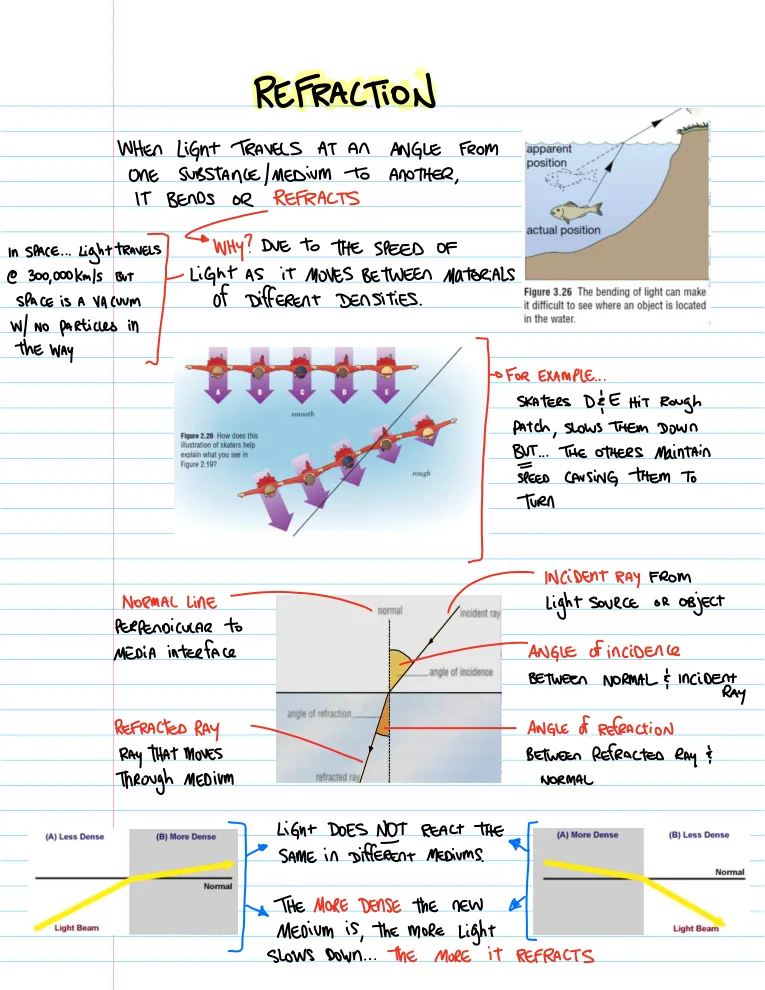
Connect a change in speed at a boundary with a change in the direction of light.

Class notes

Open PDF →

Select a page to enlarge it. The PDF contains the complete set.

Direction depends on the optical properties

At an oblique boundary from air to water, light slows and bends toward the normal. From water to air, it bends away when a transmitted ray exists. Use refractive index rather than assuming mass density alone predicts every material’s optical behaviour.

Normal incidence is a special case

A ray entering along the normal changes speed but not direction. Refraction therefore does not mean that every crossing must produce a visible bend. Both angles are measured from the normal.

An apparent position comes from interpretation

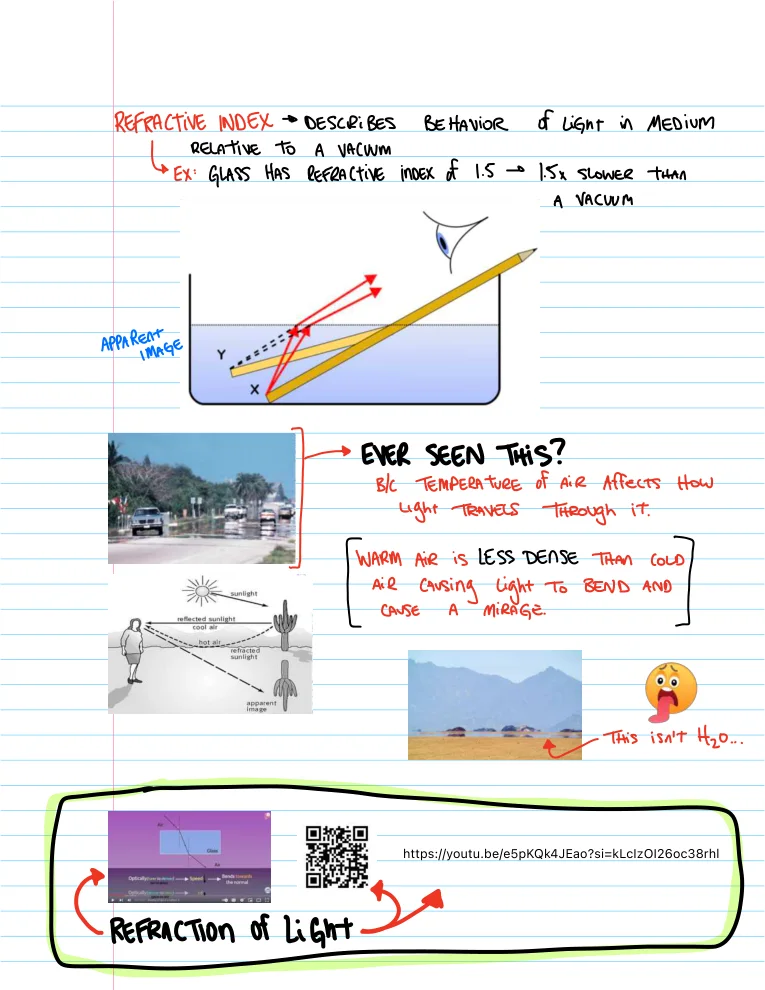
Light from an underwater object refracts before reaching an observer in air. A straight backward extension of the incoming ray places the apparent object in a different location. This helps explain a pencil’s apparent bend and a pool’s apparent shallowness.

Some boundaries return the whole ray

From a higher to lower refractive index, a sufficiently large incident angle produces total internal reflection. This is important in optical fibres. A mirage involves light passing through layers with differing refractive indices; the scene is not a puddle that is actually present.

Words worth knowing
Medium
Material or region through which light travels.
Refractive index
A measure comparing light speed in vacuum with its speed in a medium.
Total internal reflection
Complete reflection at a boundary when the conditions do not allow a transmitted ray.
Learning goal

Predict bending relative to the normal and explain apparent displacement without moving the object.

WATCH THE PHENOMENON

Guide light with a stream of water

Physics Girl · Demonstration

Look for the boundary reflections

Explain how repeated internal reflections can guide light along a curved route. Angles in our lesson are measured from the normal.

Open on YouTube →
PHET · EXPLORE A MODEL

Follow light across a boundary

Change materials and the incoming angle. Use the normal and the angle tools to compare the paths.

Investigate

Keep the materials fixed. Compare 0° and 45° incidence, then swap the materials. Explain the direction of bending.

Use the evidence

Sketch one before-and-after comparison. Label what you changed and what stayed the same. Use the lesson’s vocabulary to explain the result.

Explore the simplified ray model

Flat-boundary ray model using refractive indices 1.00 (air) and 1.333 (water). Snell’s law computes the path; using that equation is optional extension work. A partially reflected ray is omitted except during total internal reflection. Colours identify paths, not changes in light colour.

FOLLOW THE REASONING

Work it through

Predict a ray from air into water at 45° to the normal.

  1. Water has a higher refractive index than air.
  2. The transmitted ray bends toward the normal.
  3. Its refracted angle is smaller than 45°; the model computes about 32°.

Explain why a pencil looks displaced.

  1. Draw the real path from underwater pencil to surface to eye.
  2. At the boundary, the ray changes direction.
  3. Extend the ray reaching the eye backward as a dashed line.
  4. Distinguish apparent position from the actual pencil.
TRY IT

Try it yourself

A ray enters water from air at an angle. State toward or away for its bending relative to the normal and explain your reasoning.

Give me a hint

Compare the refractive indices.

Compare with a worked response

It bends toward the normal.

At zero degrees to the normal, does its direction change? State yes or no and explain your reasoning.

Give me a hint

The ray is perpendicular to the boundary.

Compare with a worked response

Its speed changes, but its direction does not.

TAKE IT FURTHER

Make the connection

Does the fish move when the viewing direction changes?

Compare your reasoning

No. The paths reaching the eye change. Apparent position is an interpretation of those paths; it is not the physical position of the fish.

Common question: “Refraction physically bends the pencil.”

The light path changes; the pencil does not. The image can shift while the object stays straight.

CHECK YOUR UNDERSTANDING

Put the ideas to work

Commit to an answer, then use the feedback to check your reasoning.

1. Which reference is used for refraction angles?

2. Total internal reflection can occur from…

3. Why does a pool appear shallower?

What are you curious about?

Search lessons, class notes and interesting questions.