GRADE 8 SCIENCE · FOLLOW THE LIGHT

Concave & convex mirrors

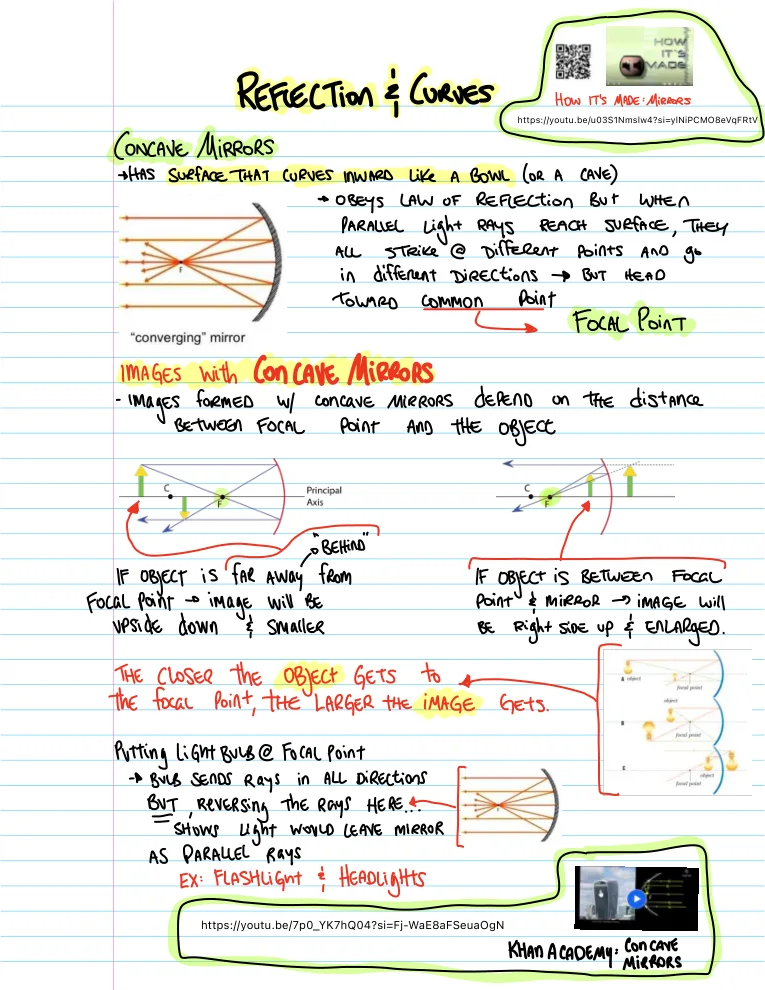
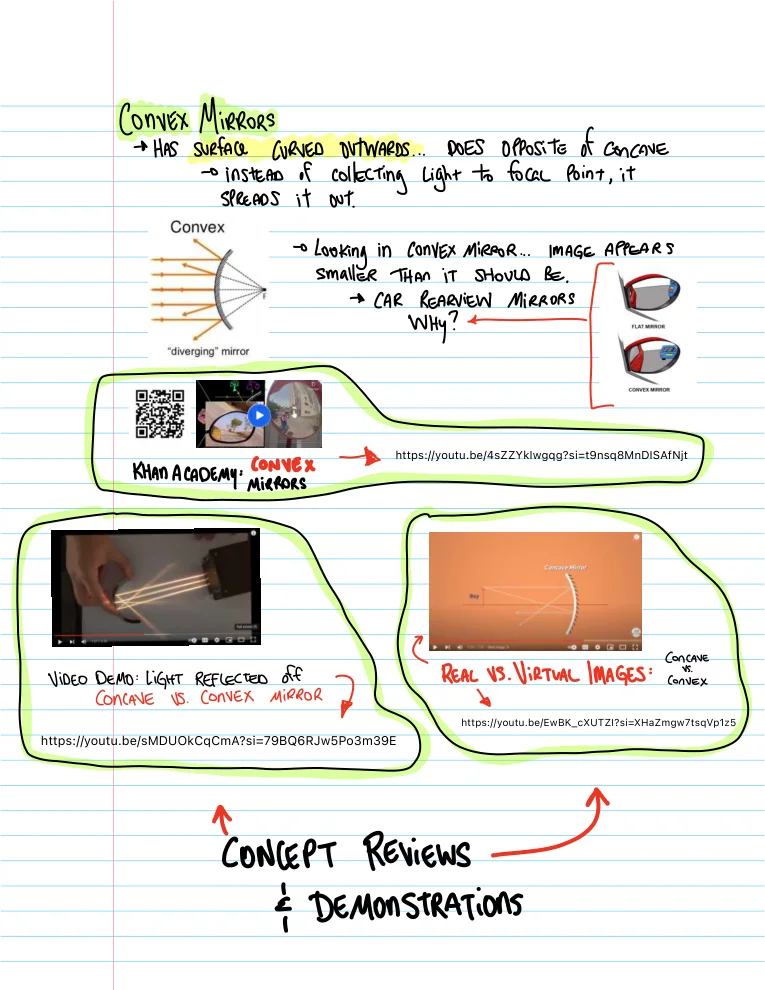
A curved surface changes the pattern of reflected rays. Image properties depend on both shape and object position.

Class notes

Open PDF →

Select a page to enlarge it. The PDF contains the complete set.

Parallel rays reveal the shape

A concave mirror can bring nearby-axis parallel rays toward a real focal point in front of it. A convex mirror spreads these rays so they appear to originate from a virtual focal point behind it. These are ideal, paraxial descriptions; real mirrors can produce aberrations.

Convex mirrors widen a view

For a real object in front of an ideal convex mirror, the image is upright, virtual and smaller. Security and vehicle mirrors use this behaviour to show a wider field of view. Smaller images can make distance judgments less intuitive.

Concave mirrors do not always magnify

For an object beyond the focal point, a concave mirror forms a real, inverted image. Its size depends on distance: beyond twice the focal length it is smaller, at twice the focal length it is the same size, and between one and two focal lengths it is larger.

Inside the focal point, the image changes

A concave mirror with an object closer than its focal point produces an upright, enlarged virtual image. This is useful for close viewing. At the focal position, reflected rays are parallel in the ideal model, so no finite image position exists.

Words worth knowing
Concave mirror
Reflecting surface curves inward.
Convex mirror
Reflecting surface bulges outward.
Focal point
For parallel rays near the axis, the point where reflected rays meet or appear to originate.
Learning goal

Predict qualitative image properties for concave and convex mirrors using focal-point reasoning.

WATCH THE PHENOMENON

The spoon-reflection puzzle

Physics Girl · Demonstration

Watch the image change

Predict the image for the inside and outside of the spoon. Identify the change that moves an image from inverted to upright.

Open on YouTube →
PHET · EXPLORE A MODEL

Compare curved mirrors

Choose the Mirror screen. Compare a concave and a convex mirror; move the object across the focal position.

Investigate

Keep the shape fixed first. Compare the image with the object beyond 2F, between F and 2F, and inside F.

Use the evidence

Sketch one before-and-after comparison. Label what you changed and what stayed the same. Use the lesson’s vocabulary to explain the result.

Explore the simplified ray model

Ideal paraxial spherical mirror. The signed mirror equation predicts image distance and size; the diagram is a position map, not a full ray construction. At f, reflected rays are parallel.

FOLLOW THE REASONING

Work it through

Choose a mirror for a shop corner.

  1. The goal is a broad field of view, not a life-size image.
  2. A convex mirror gives an upright, smaller virtual image.
  3. Its image behaviour makes it suitable for monitoring a larger area.

A concave mirror has focal length 10 cm; the object is at 15 cm.

  1. 15 cm lies between f = 10 cm and 2f = 20 cm.
  2. Predict a real, inverted, enlarged image.
  3. Moving the object inside 10 cm changes the prediction to virtual, upright and enlarged.
TRY IT

Try it yourself

A shop needs a wider field of view. State concave or convex and explain your reasoning.

Give me a hint

Think of a security mirror.

Compare with a worked response

A convex mirror provides an upright, smaller image over a wider view.

A concave mirror has f = 8 cm and an object at 4 cm. State real or virtual for its image and explain your reasoning.

Give me a hint

The object is inside the focal point.

Compare with a worked response

The image is virtual, upright and enlarged.

TAKE IT FURTHER

Make the connection

Why would a close-up makeup mirror use a different shape?

Compare your reasoning

A concave mirror with the face inside its focal distance makes an upright, enlarged virtual image. It serves a different purpose from a convex wide-view mirror.

Common question: “Concave means the image is always larger and upright.”

That description applies only to a real object inside the focal point in the ideal model. Outside the focal point, the image is inverted and real.

CHECK YOUR UNDERSTANDING

Put the ideas to work

Commit to an answer, then use the feedback to check your reasoning.

1. A convex mirror gives a real object an image that is…

2. At 3f from a concave mirror, the image is…

3. At f in the ideal concave model…

What are you curious about?

Search lessons, class notes and interesting questions.