GRADE 8 SCIENCE · FOLLOW THE LIGHT

Lenses & image formation

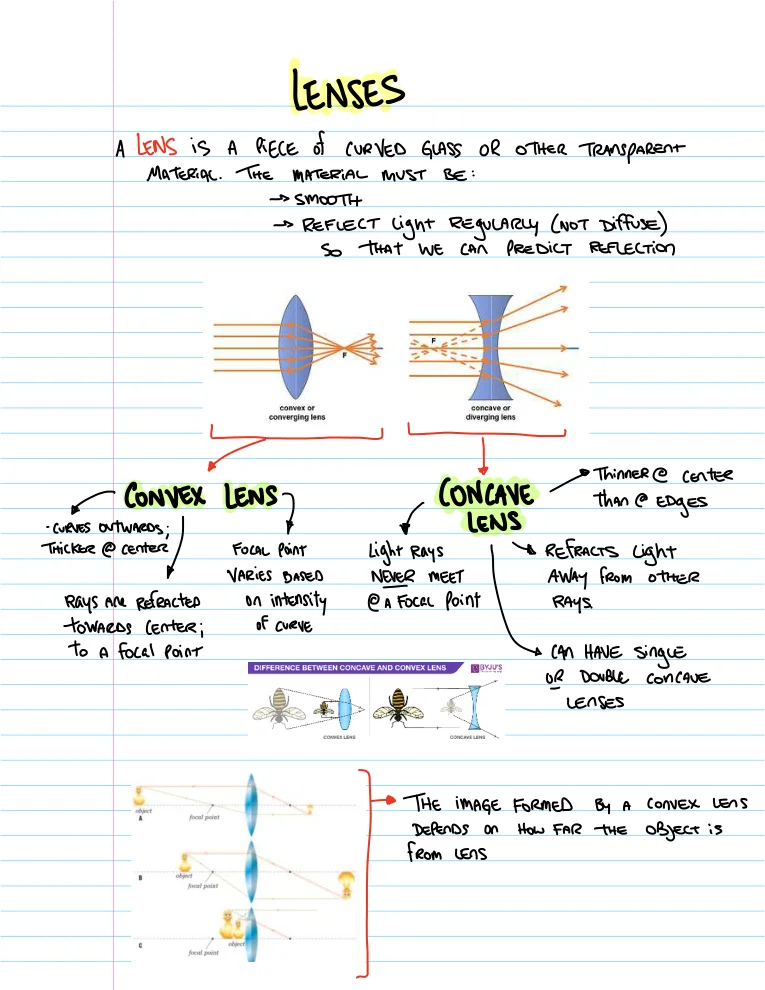
Compare converging and diverging lenses, then move an object to discover why a convex lens does not always produce the same image.

Class notes

Open PDF →

Select a page to enlarge it. The PDF contains the complete set.

Lenses redirect light by refraction

A lens transmits and refracts light at its surfaces. It is not a curved mirror. In air, a typical convex lens is thicker at the centre and converges parallel rays; a typical concave lens is thinner at the centre and diverges them. The surrounding medium matters.

Follow two rays from one object point

For a thin converging lens, a ray parallel to the axis leaves toward the far focus. A ray through the optical centre continues approximately straight. Where actual rays meet is the image point. Repeat for other points to build an image. Dashed backward extensions are not actual light travelling backward.

A convex lens has several regimes

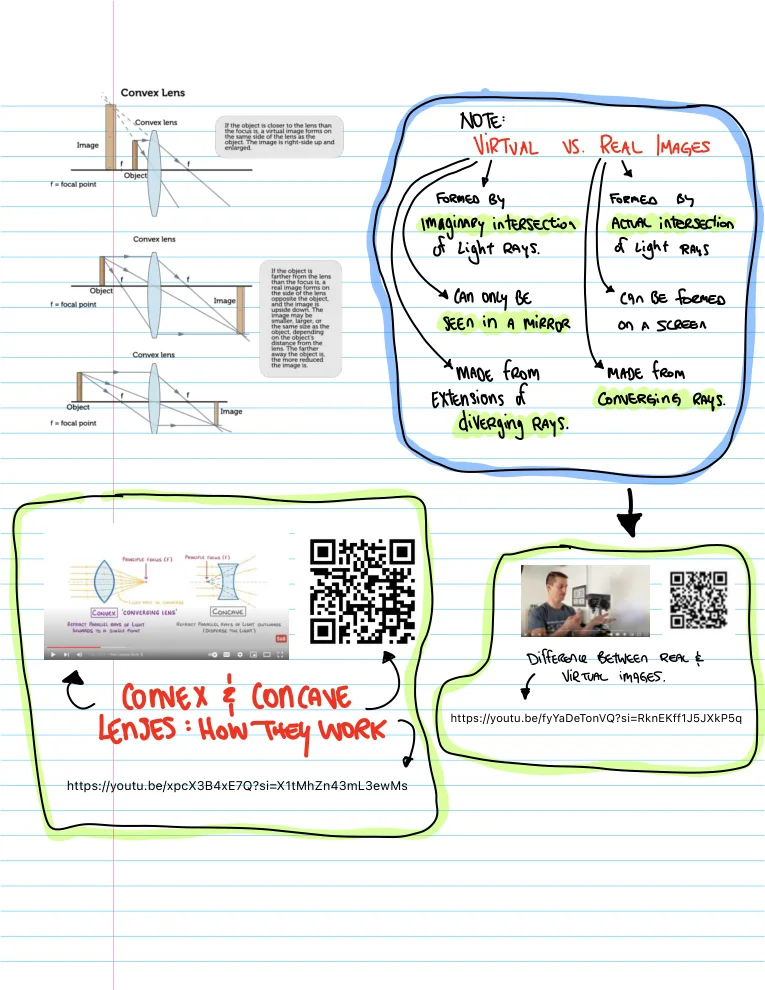
For an object beyond f, the ideal thin-lens image is real and inverted. Beyond 2f it is reduced; at 2f it has equal size; between f and 2f it is enlarged. Inside f it is upright, enlarged and virtual—the magnifying-glass arrangement. At f there is no finite image in the ideal model.

A diverging lens behaves differently

For a real object, an ideal diverging lens in air gives an upright, reduced virtual image on the object side. A focal point on a drawing does not mean all actual rays pass through it. Check whether the convergence is real or inferred from extensions.

Words worth knowing
Converging lens
Brings nearby-axis parallel rays toward a real focus in the usual glass-in-air situation.
Diverging lens
Spreads rays so they appear to come from a virtual focus.
Real image
Forms where actual rays meet and can be caught on a screen.
Virtual image
Forms where backward ray extensions meet.
Learning goal

Relate focal length and object position to real/virtual, upright/inverted and enlarged/reduced images.

WATCH THE PHENOMENON

Can you catch an image on a screen?

INTEGRAL PHYSICS · Lab demonstration

Watch an actual image form

Compare the projected image with the virtual image. Connect object position, orientation and a screen’s ability to catch the image.

Open on YouTube →
PHET · EXPLORE A MODEL

Build an image with a lens

Use the Lens screen to move the object and compare converging and diverging lenses.

Investigate

Predict the image before moving the object. Test whether a screen can catch it, then explain the difference between real and virtual.

Use the evidence

Sketch one before-and-after comparison. Label what you changed and what stayed the same. Use the lesson’s vocabulary to explain the result.

Explore the simplified ray model

Ideal thin lens in air; paraxial rays. Distances are model units. Solid lines show light paths; dashed lines are backward extensions. F marks a focal point. At f, outgoing rays are parallel.

FOLLOW THE REASONING

Work it through

A converging lens has f = 6 cm. Place the object at 12 cm.

  1. 12 cm equals 2f.
  2. Predict a real, inverted image with equal size.
  3. The thin-lens model places the image at 12 cm on the other side.

Move the same object to 3 cm from the lens.

  1. 3 cm is inside f = 6 cm.
  2. The outgoing rays diverge; their backward extensions meet on the object side.
  3. The image is upright, enlarged and virtual. It cannot be captured directly on a screen at that apparent position.
TRY IT

Try it yourself

A real image forms where actual rays meet. Can it be caught on a screen? State yes or no and explain your reasoning.

Give me a hint

Think about a projector.

Compare with a worked response

Actual rays arrive at the image location.

A converging lens has f = 6 cm and object distance 3 cm. State real or virtual and explain your reasoning.

Give me a hint

The object lies inside the focal length.

Compare with a worked response

The image is upright, enlarged and virtual.

TAKE IT FURTHER

Make the connection

Why would a diverging lens alone not make a real image of a distant scene on a sensor?

Compare your reasoning

For a real object, an ideal diverging lens makes outgoing rays diverge. The virtual image lies on the object side and cannot be caught directly on a sensor behind the lens.

Common question: “A convex lens always makes things look larger.”

Image size and orientation depend on object position. A camera can form a reduced real image; a magnifying glass can form an enlarged virtual image.

CHECK YOUR UNDERSTANDING

Put the ideas to work

Commit to an answer, then use the feedback to check your reasoning.

1. Which process primarily makes a transparent lens focus light?

2. A converging lens with an object beyond 2f forms a…

3. A diverging lens with a real object forms a…

What are you curious about?

Search lessons, class notes and interesting questions.