GRADE 8 SCIENCE · FOLLOW THE LIGHT

Plane mirrors & the law of reflection

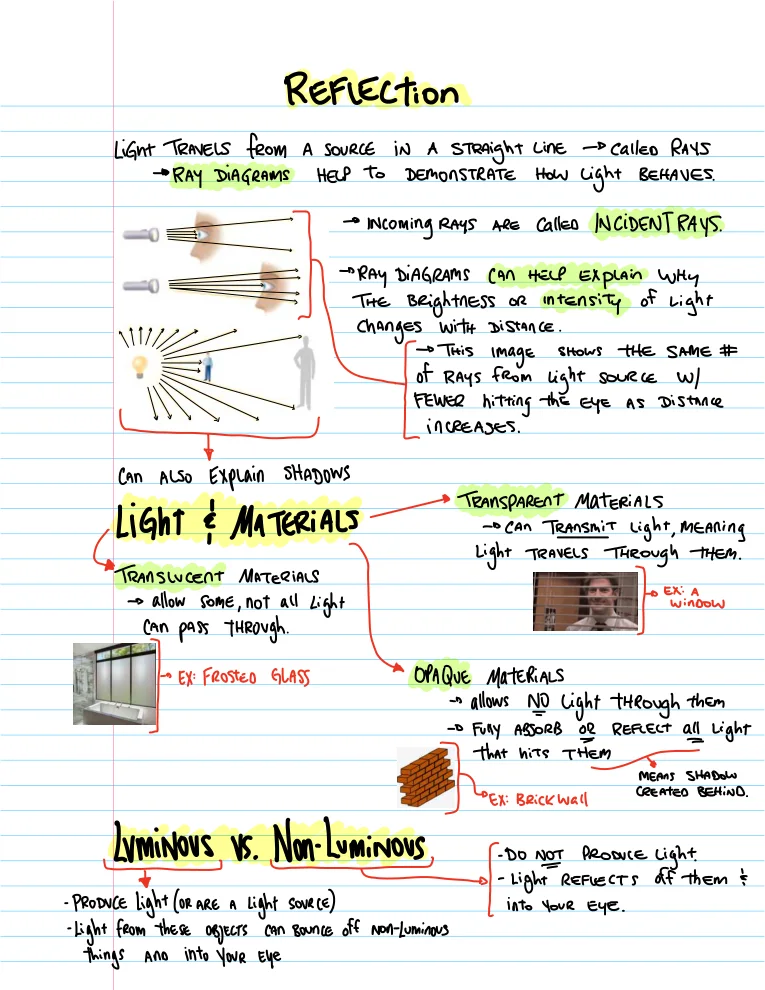
Construct the reflected ray and explain why a flat-mirror image appears behind the glass.

Class notes

Open PDF →

Select a page to enlarge it. The PDF contains the complete set.

Build the normal first

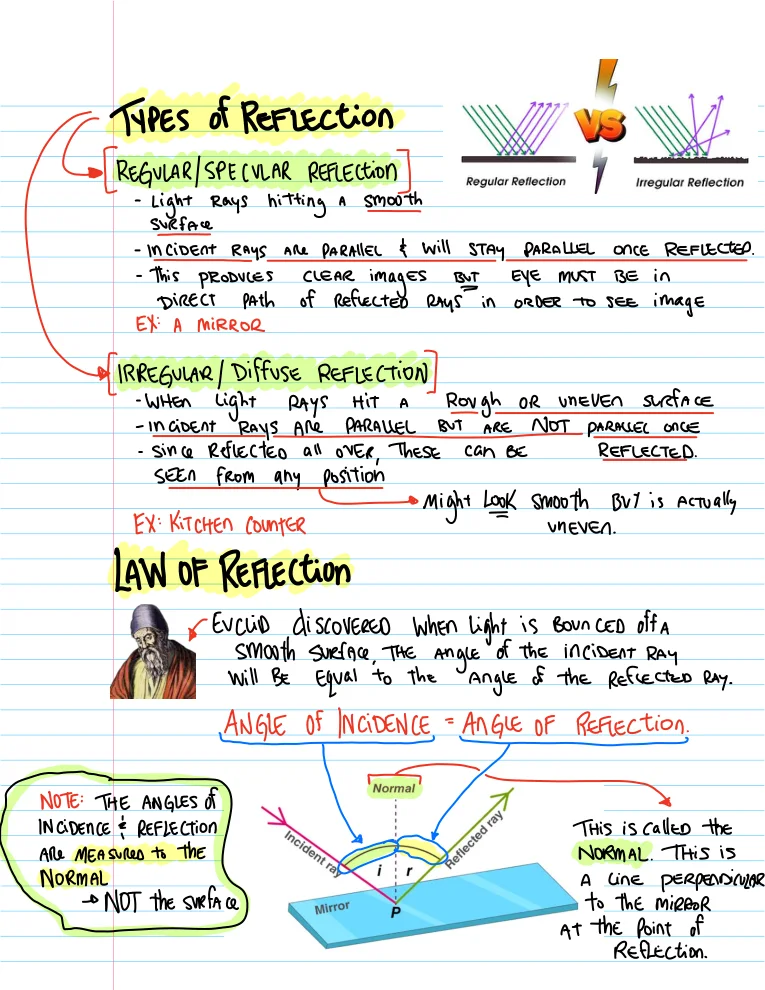
Draw the reflecting surface, mark the point of incidence, and construct a perpendicular normal there. Measure the incident angle between the ray and this normal. The normal is a reference line, not a physical ray, so draw it differently.

Reflect with equal angles

For a smooth plane mirror, the angle of reflection equals the angle of incidence. Draw the outgoing ray on the opposite side of the normal with an arrow away from the mirror. If the incident ray is 25° to the mirror surface, it is 65° to the normal.

Locate the image using backward extensions

Reflected light travels into the eye in front of the mirror. Extending those rays backward locates an apparent source behind the mirror. Use dashed extensions to distinguish them from real light paths. For an ideal plane mirror, the image is upright, the same size as the object, and equally far behind the mirror as the object is in front.

Explain what an observer can see

A mirror does not send every reflected ray toward every observer. Move the observer and the rays that enter the eye change. A plane mirror reverses the front–back direction relative to its surface; the everyday left–right description depends on how we compare ourselves with the image.

Words worth knowing
Normal
A line perpendicular to a surface at the point of incidence.
Incident angle
Angle between the incoming ray and the normal.
Virtual image
An image at a location from which rays appear to come; the rays do not actually meet there.
Learning goal

Measure angles from the normal and distinguish a virtual image from a point where real rays meet.

WATCH THE PHENOMENON

What does a mirror actually reverse?

Physics Girl · Demonstration

Predict before the sign is turned

Compare turning an object to face a mirror with what the mirror itself reverses. Use front–back reasoning.

Open on YouTube →
LIVE RAY TRACING · PHYDEMO

Build a route with mirrors

Move the optical components and follow the resulting light paths. The scene is ready to explore below.

Drag a mirror endpoint to tilt it. Watch which rays still reach the bottom opening. Reset before comparing a second change.

Explain what changed

Explain why equal reflection angles matter at both mirrors.

FOLLOW THE REASONING

Work it through

A ray is 20° to the mirror surface. Find its reflection angle.

  1. The normal is 90° to the surface.
  2. Incident angle = 90° − 20° = 70°.
  3. Reflection angle = 70° to the normal, or 20° to the surface.

A candle is 30 cm in front of a plane mirror.

  1. The virtual image is 30 cm behind the mirror.
  2. The object-to-image distance is 30 + 30 = 60 cm.
  3. The image is not projected onto a screen behind the mirror.
TRY IT

Try it yourself

A ray is 35° to the normal. What is its reflection angle in degrees?

Give me a hint

The two angles use the same reference.

Compare with a worked response

The reflected angle equals 35°.

An object is 12 cm in front of a plane mirror. How far behind the mirror is its image, in cm?

Give me a hint

The two distances from the mirror are equal.

Compare with a worked response

The image is 12 cm behind the mirror.

TAKE IT FURTHER

Make the connection

Sketch the route through two mirrors. Where should the arrowheads point?

Compare your reasoning

From the viewed object toward the upper mirror, then down to the lower mirror, then into the eye. At both mirrors, measure equal incident and reflected angles from the normal.

Common question: “The image is behind the mirror because light passes through and meets there.”

The image position is found with backward extensions. The actual reflected light remains on the observer’s side of the reflecting surface.

CHECK YOUR UNDERSTANDING

Put the ideas to work

Commit to an answer, then use the feedback to check your reasoning.

1. A ray is 15° to the surface. Its angle to the normal is…

2. A plane-mirror image is…

3. An object is 8 cm from the mirror. Object-to-image separation is…

What are you curious about?

Search lessons, class notes and interesting questions.