

GRADE 8 SCIENCE · MAKE THE MECHANISM VISIBLE

Work, distance & power

Calculate energy transferred by a force, then distinguish it from how quickly the transfer happens.

Class notes

All 16 note pages

Select a page to enlarge it.

Use the scientific meaning of work

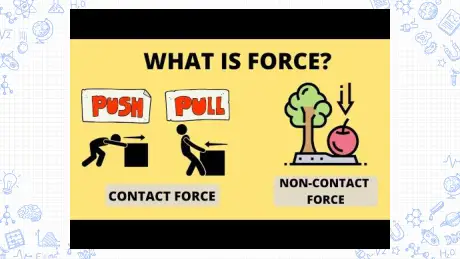
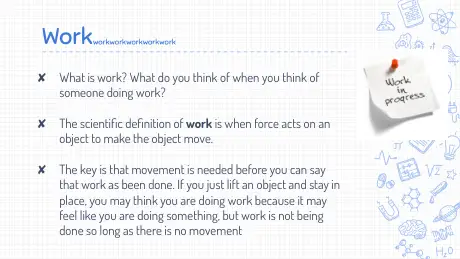
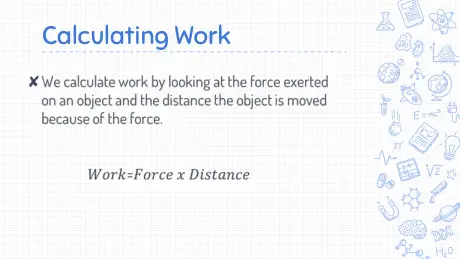
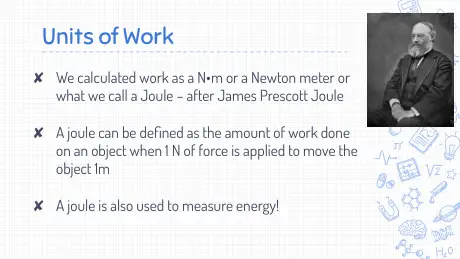
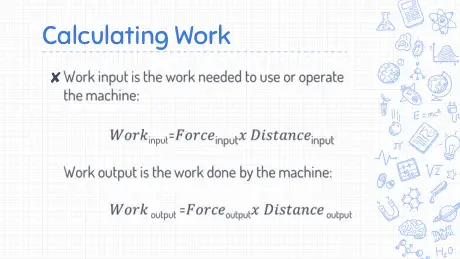
Work is energy transferred when a force acts through a displacement. For a constant force parallel to the movement, W = F × d. A newton multiplied by a metre is a joule. Use metres, not centimetres, in that calculation.

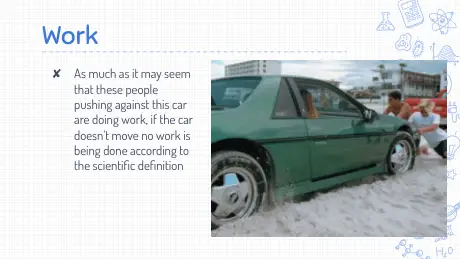
  • Pushing hard on a wall that does not move does no mechanical work on the wall in this model.
  • Your body can still use energy while holding a load still.

Keep the direction in view

Only the component of force along displacement contributes to work on that object. This lesson’s calculations use forces parallel to movement. A perpendicular force does no work through that displacement.

  • When a load is raised steadily, work against gravity is weight × vertical rise.
  • Walking horizontally while supporting a bag does not make its upward support force act along the horizontal path.

Power is a rate

Power = work ÷ time. One watt means one joule transferred each second. Two motors can do the same useful work but have different power if they take different times.

  • More power does not necessarily mean more total energy for a particular task.
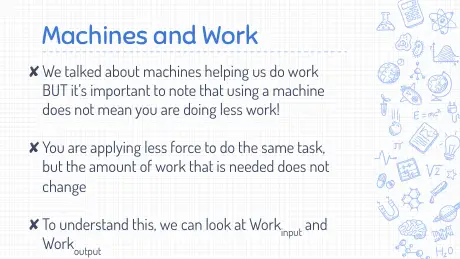
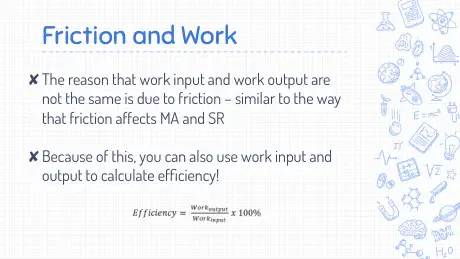
  • Compare useful output power with input power when evaluating a motor.

Plan a useful measurement

Measure the force while moving at a steady speed, the displacement in the force direction, and the time. Repeated trials help reveal variation. Explain any assumptions instead of presenting a calculated value as a perfect measurement.

MEASURE · CALCULATE · EXPLAIN

Work and power: change the measurements

Change one measurement, predict the result, then compare the calculated account. These are editable teaching measurements, not a physical simulation.

WATCH THE PHENOMENON

Let’s get to work

Science North · Mechanism in action

Watch with a prediction

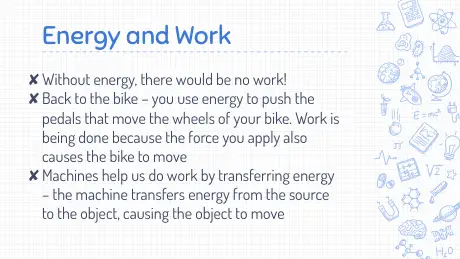
Identify which force and displacement belong in W = F × d. Distinguish a steady lift from simply holding a heavy object.

Open on YouTube →
WORK THE REASONING

Raise a load steadily

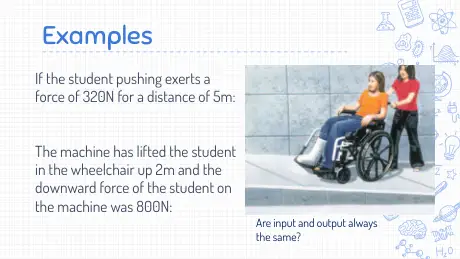
  1. A 200 N load rises 1.5 m in 5 s.
  2. Useful work = 200 × 1.5 = 300 J.
  3. Useful output power = 300 ÷ 5 = 60 W.
  4. This does not tell us input energy or motor efficiency; those require additional evidence.
TRY IT

Predict, then explain

A 40 N force moves a cart 3 m in 6 s, parallel to the movement. Find work and average power.

Compare your reasoning

W = 40 × 3 = 120 J. P = 120 ÷ 6 = 20 W.

TAKE IT FURTHER

Test the idea

Describe one everyday situation that feels tiring but transfers no mechanical work to a stationary object.

Apply it to the design challenge →
CHECK YOUR UNDERSTANDING

Put the mechanism to work

1. Which is a unit of work?

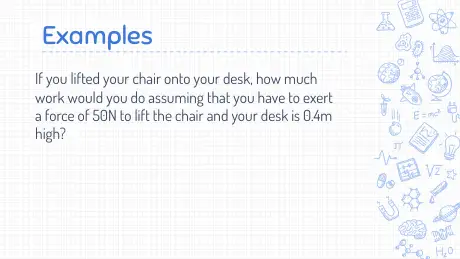
2. A 50 N parallel force acts over 2 m. Work is…

3. The same work is completed in half the time. Power…

Read further: OpenStax · Simple Machines →

What are you curious about?

Search lessons, class notes and interesting questions.