GRADE 8 SCIENCE · MAKE THE MECHANISM VISIBLE

Gears, sprockets & rotation

Trace how tooth counts change rotational speed, direction and torque.

Class notes

All 7 note pages

Select a page to enlarge it.

Name the driver and the driven gear

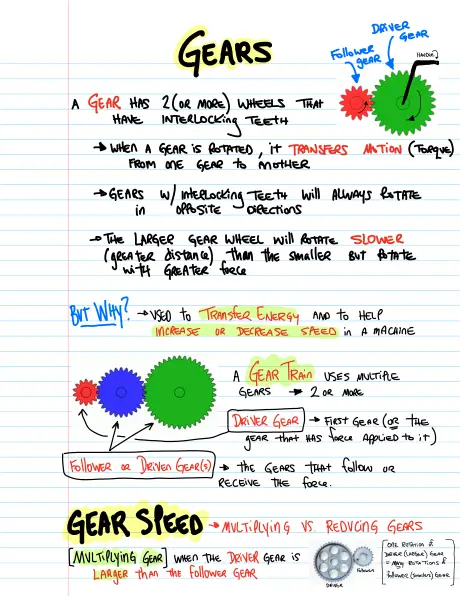
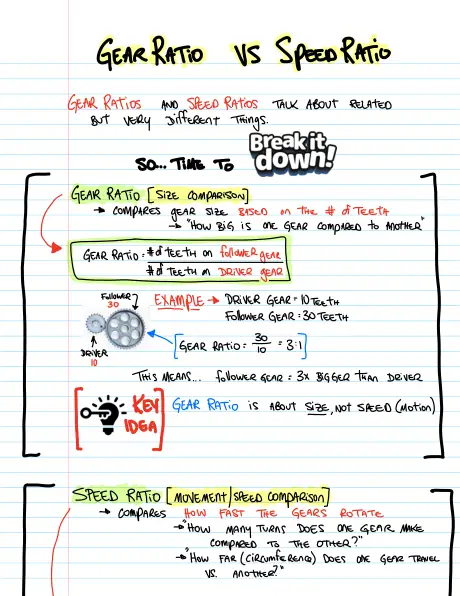
The driver receives the input rotation. The driven gear is turned by it. Two directly meshing external gears rotate in opposite directions. Matching teeth transfer motion at the contact: a larger gear takes longer to complete one turn.

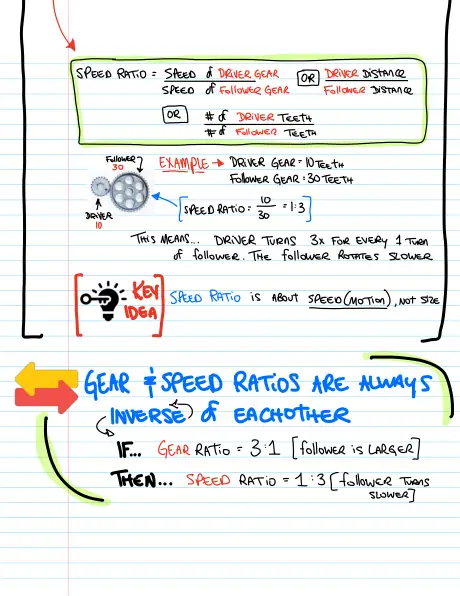
  • A driver with 12 teeth advances a 36-tooth gear by one third of a turn per driver turn.
  • The gears must have compatible teeth; a diagram does not establish that any two physical gears will mesh.

Write the ratio order explicitly

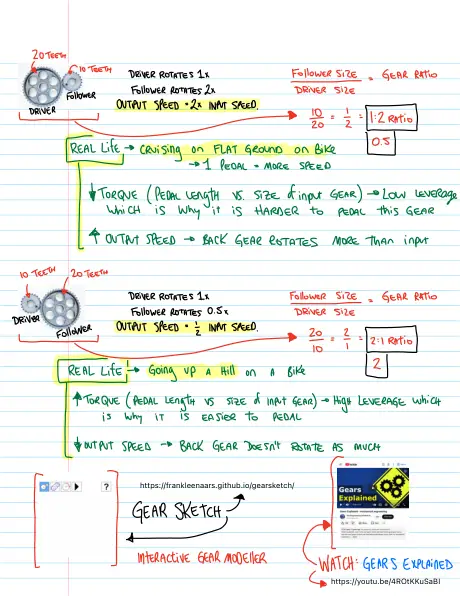
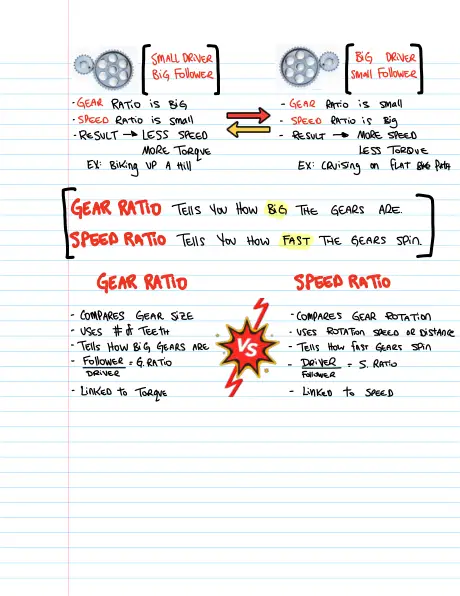
For this lesson, tooth-count ratio = driven teeth ÷ driver teeth. Driven rpm = driver rpm × driver teeth ÷ driven teeth. A larger driven gear turns more slowly; ideally it can provide greater torque at its shaft.

  • A 12-tooth driver at 90 rpm turns a 36-tooth driven gear at 30 rpm.
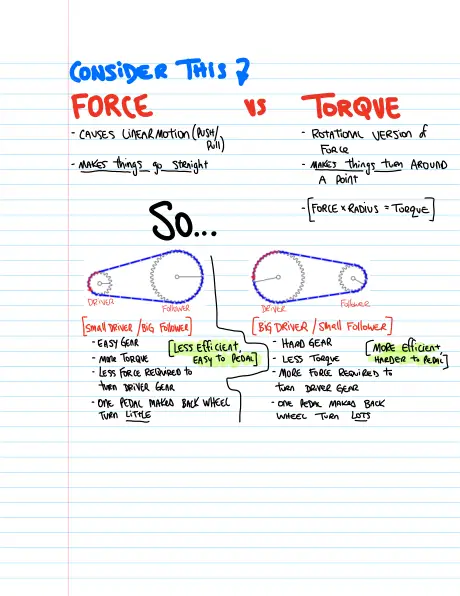
  • Torque is a turning effect. It is not the same as a straight-line force unless an arm is also specified.

Chains and idlers change the arrangement

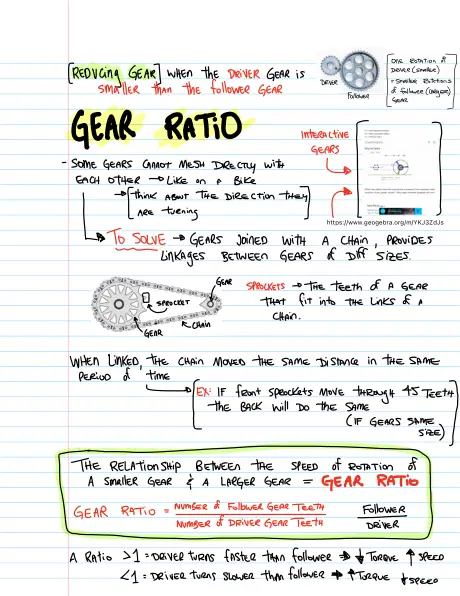
An uncrossed chain makes front and rear sprockets turn in the same direction. In a simple gear train, an idler can change direction or bridge a gap without changing the overall ratio between the first and last gear. Compound gears on a shared shaft are different: their stage ratios can multiply.

  • Do not treat all extra gears as extra mechanical advantage.
  • A bicycle also includes crank length and wheel radius; a sprocket ratio alone is not the whole bicycle’s force advantage.

Select a useful trade-off

A small front chainring with a larger rear sprocket helps a cyclist climb: fewer wheel turns per crank turn and a greater torque ratio at the rear shaft. A high gear gives more wheel turns but requires more pedal effort for the same conditions.

GeoGebra · bicycle gears · Austin Harvey

Change a bicycle transmission

Use the front and rear sprocket sliders. Compare one pedal turn with rear-wheel motion. Keep wheel radius fixed while changing one sprocket. Use the animation control if the model is paused.

rf is front sprocket radius, rb is rear sprocket radius, rw is wheel radius and pr is pedal rotation time. A chain joins the sprockets; this is not a model of tyre grip or hill resistance.

Compare directly meshing gears
GeoGebra · iStem Gears · John Springall

Compare tooth counts and rotation

Change the driver and follower settings. Compare their speeds and rotation directions. Keep the input speed fixed while changing tooth counts.

Check the model labels. This compares meshing gears, unlike the chain-and-sprocket bicycle above.

WATCH THE PHENOMENON

Gears: speed or turning effect?

Lrn Fzx – Learn Physics · Mechanism in action

Watch with a prediction

Identify the driver. Predict which gear turns faster before the animation shows it, then connect the tooth counts with the ratio.

Open on YouTube →
WORK THE REASONING

A 15-tooth driver turns a 45-tooth gear

  1. Driver speed = 120 rpm. Tooth-count ratio = 45 ÷ 15 = 3.
  2. Driven speed = 120 × 15 ÷ 45 = 40 rpm.
  3. Directly meshing gears turn in opposite directions.
  4. For an ideal lossless steady transmission, the driven torque is three times the input torque; real losses reduce that gain.
TRY IT

Predict, then explain

A 40-tooth driver turns a 20-tooth driven gear at an input of 60 rpm. Predict the output.

Compare your reasoning

Output = 60 × 40 ÷ 20 = 120 rpm. The directly meshing driven gear turns in the opposite direction; its ideal torque is lower.

TAKE IT FURTHER

Test the idea

Compare the bicycle model with meshing gears. Explain why the rotation directions differ.

Apply it to the design challenge →
CHECK YOUR UNDERSTANDING

Put the mechanism to work

1. A larger driven gear usually gives…

2. Two meshing external gears turn…

3. An uncrossed bicycle chain drives its sprockets…

Read further: OpenStax · Simple Machines →

What are you curious about?

Search lessons, class notes and interesting questions.