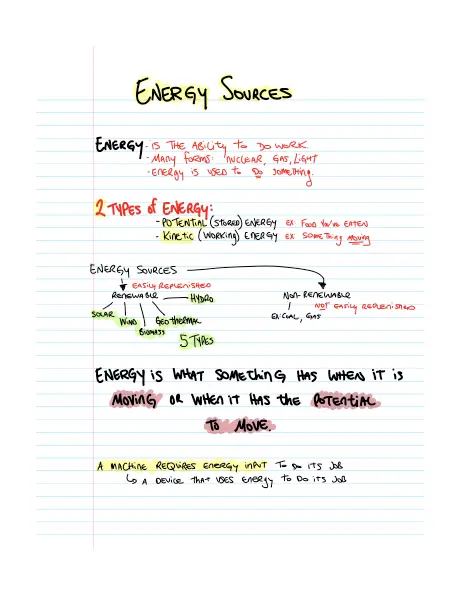
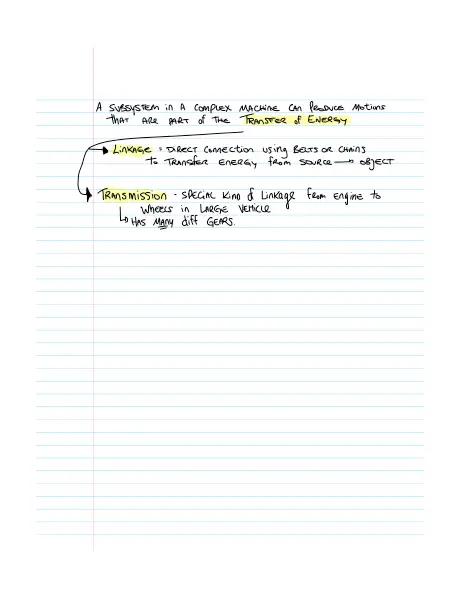
Kinetic energy is associated with motion. Gravitational potential energy depends on position in a gravitational field. Elastic potential energy can be stored when a spring or band is deformed. A moving mechanism can transfer energy between these stores and its surroundings.
A lifted mass can release gravitational potential energy as it falls.
A battery stores chemical energy; electricity is a way energy is transferred through a circuit.
Follow a complete chain
For a battery-powered motor lifting a load, chemical energy is transferred electrically to the motor, then mechanically to the load. The load gains gravitational potential energy; the motor and surroundings also warm.
A generator transfers mechanical energy into electrical energy.
Name the useful output before deciding what counts as less useful.
Source and form are not synonyms
Wind, flowing water, sunlight, fuels and food can supply energy to a system. Renewable resources can be replenished on human time scales under suitable management. Non-renewable fuels are consumed much faster than they form. Neither label means impact-free.
Wind turns a turbine; a generator can then provide electrical energy.
Compare availability, storage, environmental impacts and the job to be done.
Keep an energy account
Energy does not disappear when a mechanism slows. Friction can increase thermal energy in the parts and surroundings. A diagram showing only useful motion leaves out part of the account.
Choose a system boundary: the moving object alone is different from the object plus track and surroundings.
The total input must be accounted for by output, storage changes and other transfers.
PhET · Energy Forms and Changes
Build an energy-transfer system
Open Systems. Connect a source, a converter and a user. Turn on energy symbols. Try the bicycle and generator, then compare another source. Follow both useful transfers and heating.
The symbols are a model for tracking energy; they are not particles of a substance. An unsuitable source–converter combination may not operate.
WATCH THE PHENOMENON
Where does energy come from?
TED-Ed · Mechanism in action
Watch with a prediction
Follow one transformation. Explain why energy can move between stores and surroundings without being created by the machine.
The raised mass initially has gravitational potential energy relative to a chosen reference height.
As it falls, energy is transferred through motion and the mechanism.
A generator can transfer energy electrically to a lamp.
Light and heating are outputs. The useful fraction depends on the chosen purpose.
TRY IT
Predict, then explain
Where does the energy go when a skater slows because of friction?
Compare your reasoning
Some kinetic and gravitational potential energy becomes thermal energy in the skater, track and surroundings. Total energy is conserved for a sufficiently complete account.
TAKE IT FURTHER
Test the idea
Build two source–changer–user chains. Explain why a source may work well with one converter but not another.