











GRADE 8 SCIENCE · MAKE THE MECHANISM VISIBLE

Pulleys, ramps & distance trade-offs

Compare two ways to reduce the force needed to lift the same load.

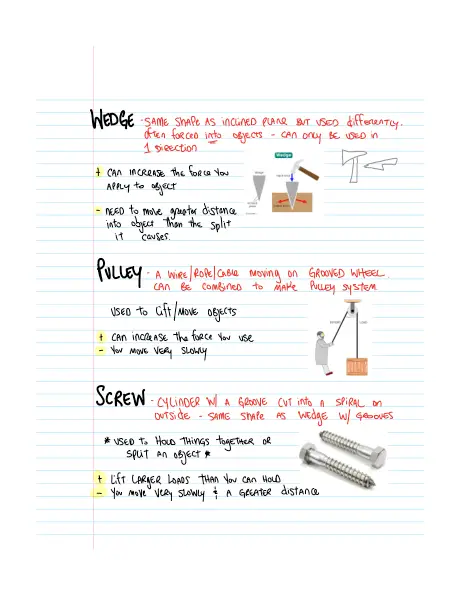
Fixed and moving pulleys do different jobs

A fixed pulley mainly changes the direction of the pull. A moving pulley can share the moving load between supporting rope segments. In an ideal continuous rope over frictionless pulleys, the tension is the same throughout.

  • Count the rope segments pulling upward on the moving block, not every visible rope or wheel.
  • Include the weight of the moving pulley block when it is significant.

Follow both ends of the rope

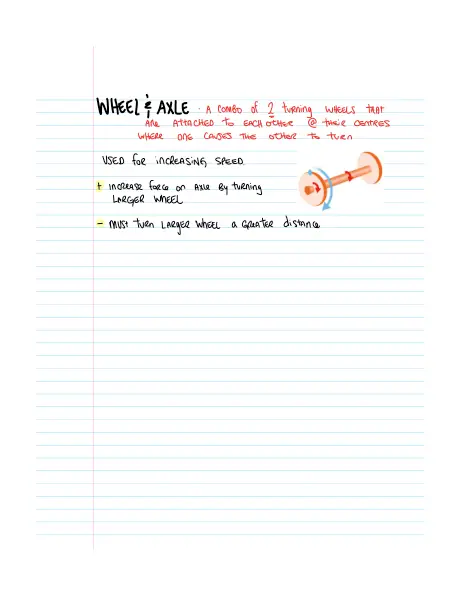
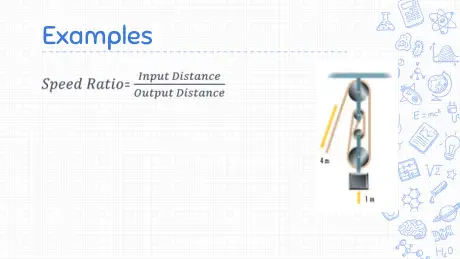
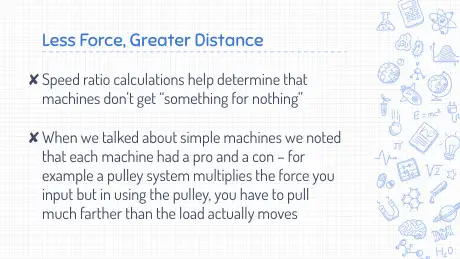
If four rope segments support an ideal moving block, the input force is one quarter of the total supported weight. Raising the block 0.5 m requires pulling about 2 m of rope. A smaller force comes with more input distance.

  • A rope segment that only changes pull direction may not add another supporting force.
  • Real friction increases the effort above the ideal prediction.

A ramp spreads the rise over a longer path

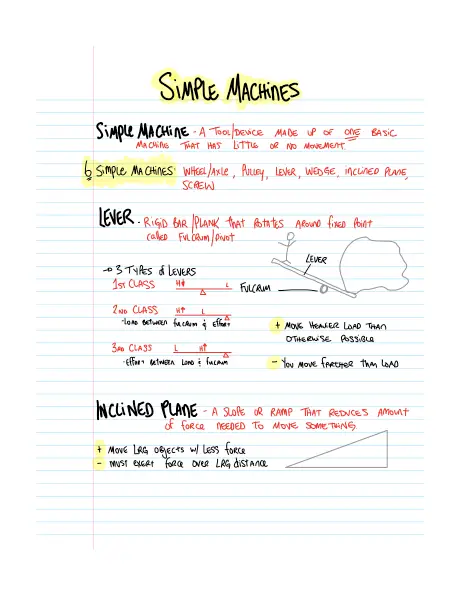
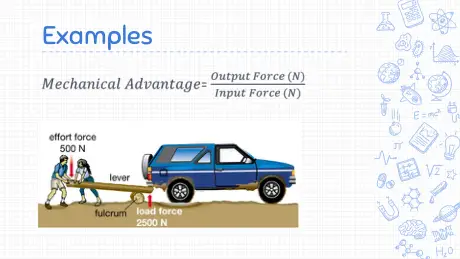
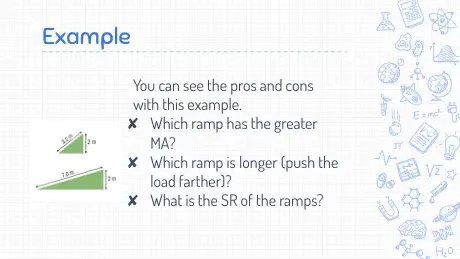
For a frictionless ramp at steady speed, input work equals the increase in gravitational potential energy. Ideal mechanical advantage is ramp length divided by vertical height. The ramp length is measured along the slope, not horizontally.

  • For the same height, a longer ramp can require less parallel force.
  • A real rough ramp may require additional work against friction.

Test a fair comparison

Keep load and lifting height fixed. Measure force with a spring scale, input travel and output rise. Compare the complete lift rather than one instant. A load that speeds up adds another energy change to consider.

Walter Fendt · Pulley System

Raise the load and read the spring scale

Choose a pulley arrangement. Move the load with the mouse and press to reveal the spring balance. Change the load and moving-pulley weight, then compare the pull with the number of supporting strands.

This app caps the spring scale at 10 N and can adjust out-of-range inputs. Read the displayed values after each change. It is an ideal pulley model, not safe lifting guidance.

WATCH THE PHENOMENON

Why snatch blocks work

SmarterEveryDay · Mechanism in action

Watch with a prediction

Count the strands supporting the moving load. Compare a direction change with a force advantage. Watch the explanation rather than copying the lifting setup.

Open on YouTube →
WORK THE REASONING

Lift 80 N with four supports

  1. Neglect rope and moving-pulley mass and all friction.
  2. Input force = 80 N ÷ 4 = 20 N.
  3. For a 0.5 m rise, pull 4 × 0.5 m = 2 m of rope.
  4. Input work = 20 × 2 = 40 J; output work = 80 × 0.5 = 40 J.
TRY IT

Predict, then explain

An ideal ramp is 3 m long and rises 0.75 m. What is its distance ratio?

Compare your reasoning

3 ÷ 0.75 = 4. For a steady frictionless lift, the force advantage is also 4.

TAKE IT FURTHER

Test the idea

Compare a fixed pulley with a moving-pulley system. Explain why counting the wheels alone can give the wrong answer.

Apply it to the design challenge →
CHECK YOUR UNDERSTANDING

Put the mechanism to work

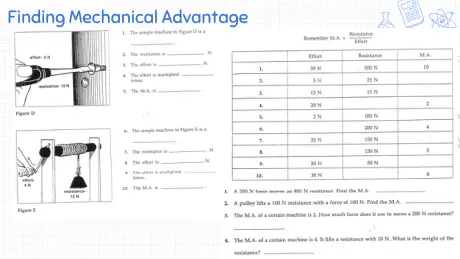
1. Four supporting strands hold 100 N in an ideal system. The pull is…

2. A 4:1 ideal system raises a load 1 m. Input rope travel is…

3. The length in a ramp ratio is measured…

Read further: OpenStax · Simple Machines →

What are you curious about?

Search lessons, class notes and interesting questions.