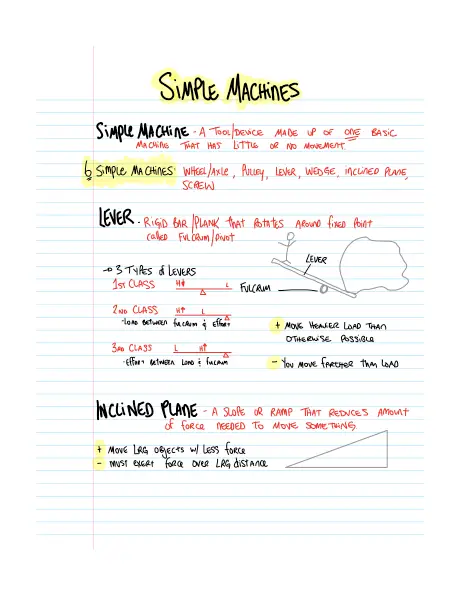
A lever turns about a fulcrum. The effort force is the input; the load force is the resistance being moved or balanced. An arm is a perpendicular distance from the pivot to the line of action of a force.
For a horizontal board and vertical forces, measure along the board from the pivot.
A force acting directly through the pivot has no turning effect about that pivot.
Balance both size and distance
A larger force has a larger turning effect at the same arm. A longer perpendicular arm has a larger effect at the same force. For a balanced ideal lever, effort force × effort arm equals load force × load arm.
Equal masses do not balance if their arms differ.
Using masses in a balance comparison works when both experience the same gravitational field.
Three arrangements; different advantages
In a first-class lever, the fulcrum is between effort and load. In a second-class lever, the load is between fulcrum and effort. In a third-class lever, the effort is between fulcrum and load. Third-class levers often provide greater output movement or speed rather than a larger output force.
Examples: a seesaw, a wheelbarrow and tweezers.
Do not assume every first-class lever multiplies force: the arm lengths decide.
Respect the model
Simple calculations may neglect lever weight, pivot friction and bending. A real tool must withstand the load. Use small, teacher-approved loads for classroom investigations; do not use people or hands as supports.
PhET · Balancing Act
Build a balance, then predict a change
Open Balance Lab. Put unequal masses on opposite sides and move them until the board balances. Use the rulers to compare mass × distance. Remove the supports to test your prediction.
The balance board is an idealized lever. Use distance from the pivot rather than the gap between objects.
WATCH THE PHENOMENON
Mechanical advantage of levers
Science North · Mechanism in action
Watch with a prediction
Identify all three lever classes, then compare the effort and load arms. Pause before each demonstration to predict what will change.