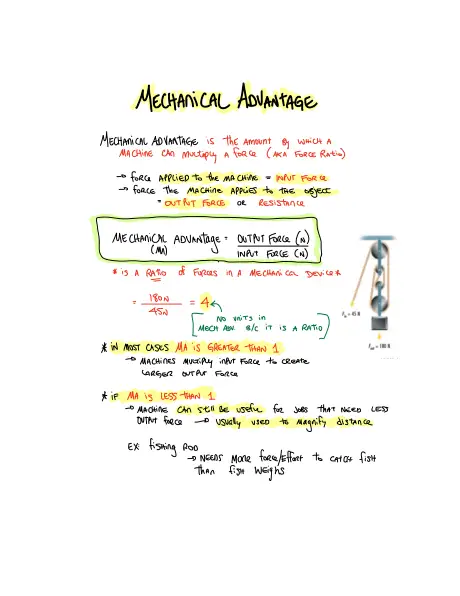
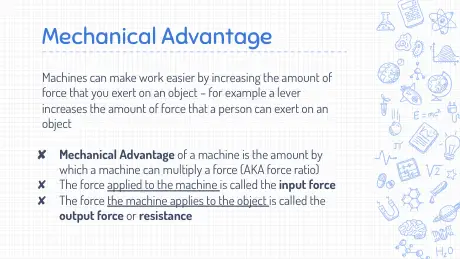
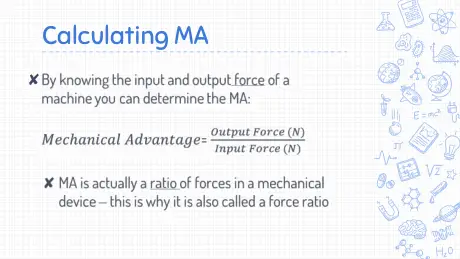
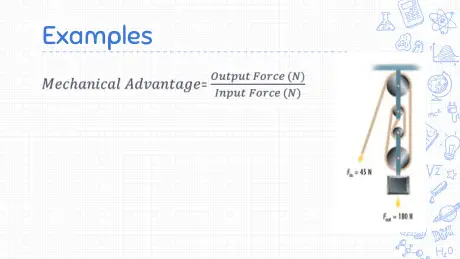
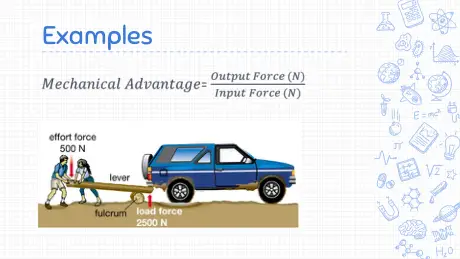
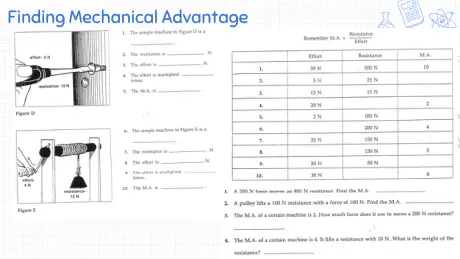
Mechanical advantage, MA, is output force divided by input force. The forces must describe the same machine operating under comparable conditions. Use newtons for both; the units cancel.
An output of 240 N from an input of 60 N gives MA = 4.
MA is not energy, work or a percentage.
Use the movement ratio carefully
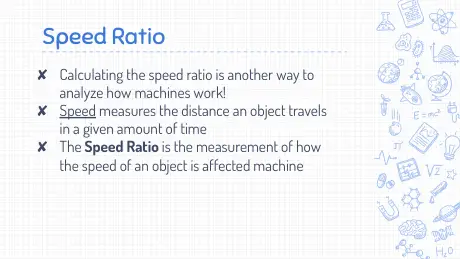
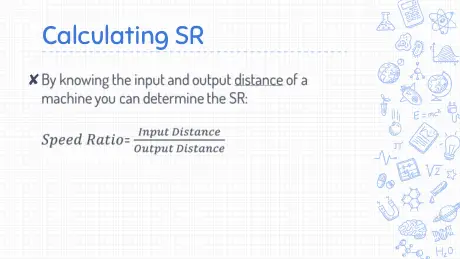
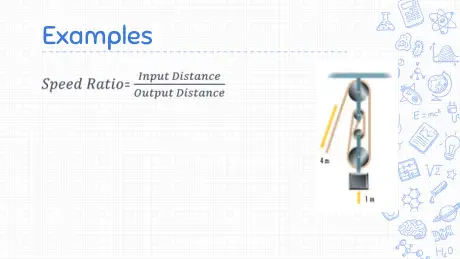
In these notes, speed ratio, SR, means input distance divided by output distance over the same time interval. It also equals input speed divided by output speed for a steady mechanism. Label the numerator and denominator.
If the effort moves 2 m while the load moves 0.5 m, SR = 4.
Do not substitute masses for distances, or silently invert the ratio.
Separate ideal prediction from measurement
An ideal machine with negligible losses has MA = SR. Real measured MA is usually lower for the same geometric motion ratio because more input is needed to overcome losses. Geometry can predict an ideal ratio; a force measurement tests actual performance.
For a steady machine: efficiency = MA ÷ SR × 100%.
Apply that relation only when the measured forces and distances refer to the same operation.
Less than one can still be useful
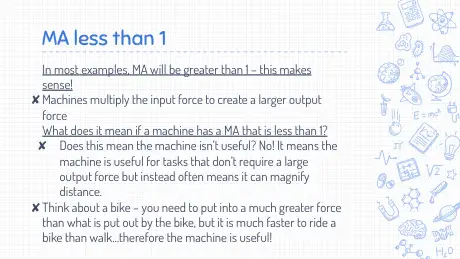
An MA below 1 means the output force is smaller than the input force. A mechanism may instead provide greater output travel, greater speed or precise positioning. A bicycle high gear and many sporting levers trade force for movement.
MEASURE · CALCULATE · EXPLAIN
One lift. Four measurements. Three ratios.
Change one measurement, predict the result, then compare the calculated account. These are editable teaching measurements, not a physical simulation.
WATCH THE PHENOMENON
Connect force advantage with distance
The Organic Chemistry Tutor · Mechanism in action
Watch with a prediction
Choose one worked lever or ramp example. Record the two forces and the two travel distances; identify which ratios are being compared.