A mechanical system is a set of interacting parts that transfers forces and motion to do a job. A machine may change the size or direction of a force, the speed of movement, or the distance moved. Identify its input, the process inside it and the useful output before naming the parts.
A hand-operated can opener is a machine even though it has no electric motor.
The system boundary tells you which parts and energy transfers you are considering.
Six tools behind many mechanisms
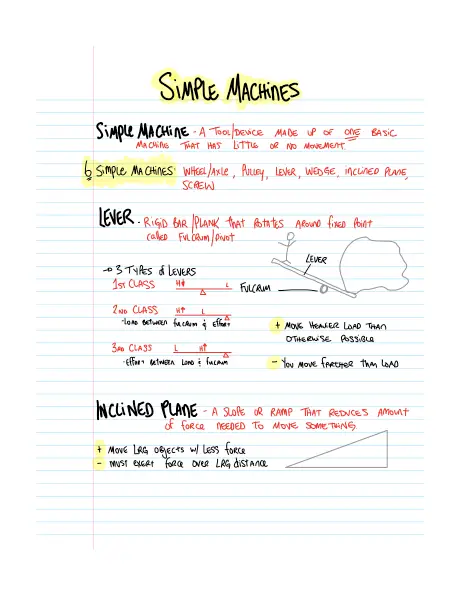
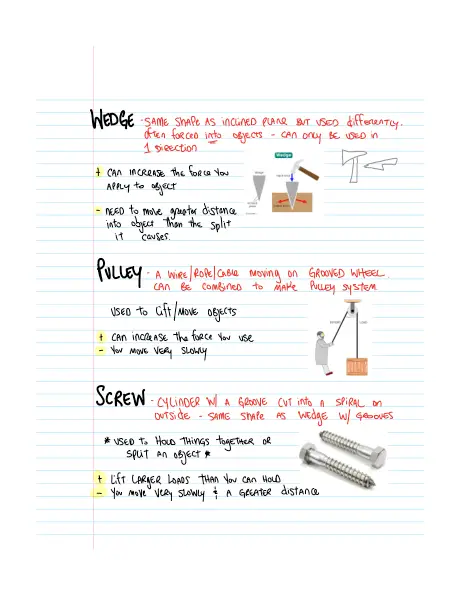
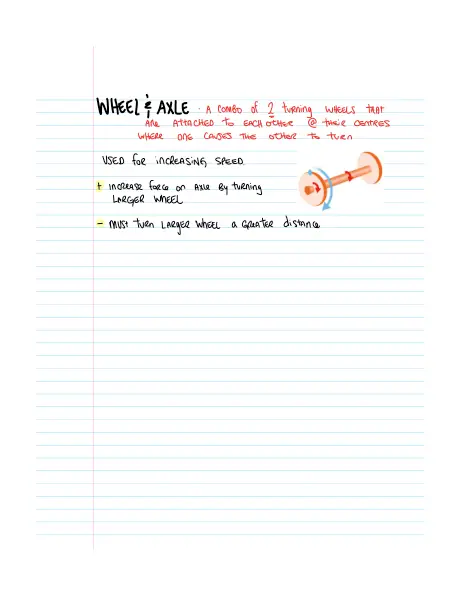
Levers, pulleys, wheels and axles, inclined planes, wedges and screws are simple machines. Compound machines combine them. A wheelbarrow combines a lever with a wheel and axle; a pair of scissors combines levers with wedges.
A wedge moves into material; a ramp gives a load a sloping path.
A screw is related to an inclined plane wrapped around a cylinder.
Easier force does not mean free energy
An ideal machine can trade a smaller input force for a greater input distance. It cannot supply more work than it receives. Real machines also transfer some input energy into heating, sound or other less useful outputs.
Compare the same load and the same final height when evaluating two lifting methods.
Convenience, control and a useful direction of force can matter even without force multiplication.
Describe rather than just label
Trace the action: the hand pushes a handle; the handle turns a shaft; the shaft turns a wheel. This explanation identifies interactions. A list of parts alone does not explain how the system works.
Inputs can be forces, motion and energy. Outputs may include both a useful effect and unwanted effects.
A good mechanism must also be safe, reliable and suitable for its user.
PhET · Forces and Motion: Basics
Investigate forces before combining mechanisms
Choose Net Force. Compare equal and unequal pulls. Then identify the system being pulled and the direction of the net force.
An object at rest with balanced forces has no change in motion. Zero net force does not mean that no forces act.
WATCH THE PHENOMENON
Mechanical advantage and simple machines
The Organic Chemistry Tutor · Mechanism in action
Watch with a prediction
Follow the lever and ramp examples. Name the force that becomes smaller and the distance that becomes larger. Some later calculations extend beyond this unit.
The operator lifts the handles: an effort force acts through a distance.
The load sits between the wheel axle and the hands. The axle acts as the lever pivot in a simple lifting analysis.
Long handles can reduce the effort force needed to support the same load.
The hands travel farther than the load for a small rotation; the wheel also helps the whole system roll.
TRY IT
Predict, then explain
Why can a machine be useful when its mechanical advantage is 1?
Compare your reasoning
It can change the force direction or make the action easier to control without multiplying force. An ideal fixed pulley can let a person pull downward to lift a load upward.
TAKE IT FURTHER
Test the idea
Choose a kitchen tool. Identify its input, useful output, two interacting parts and one limitation.