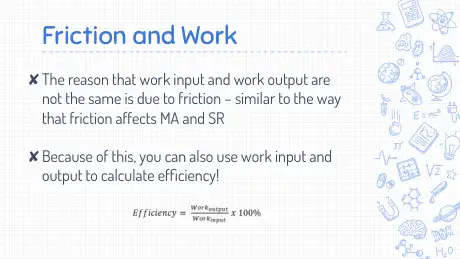
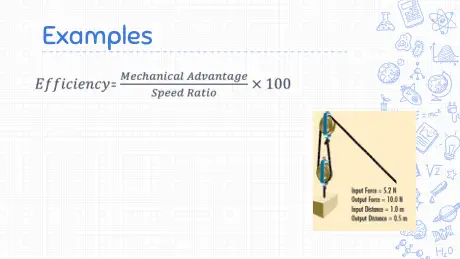
Efficiency = useful output energy ÷ input energy × 100%. A motor that receives 500 J and delivers 350 J of useful mechanical work is 70% efficient. Its remaining 150 J is transferred to other outputs or stores.
Useful is defined by the job: heating is useful in a heater but often unwanted in a lifting motor.
Compare like units and use the same operating interval.
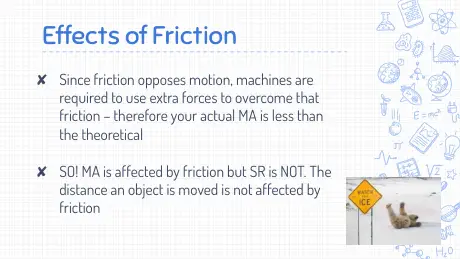
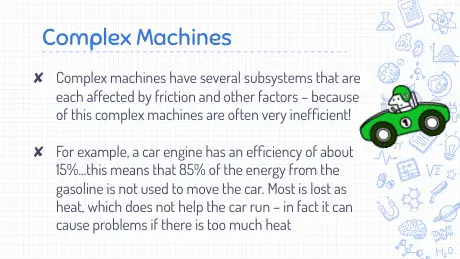
Friction changes the account
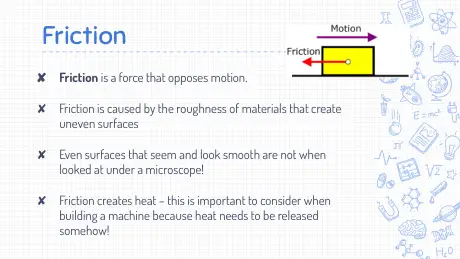
Friction opposes relative sliding and can transfer mechanical energy into thermal energy. Lubrication and bearings can reduce some losses, but real devices also have other constraints. Friction can be essential: a bicycle needs tyre grip and controlled braking.
Do not describe energy as destroyed.
A design that removes all friction would not automatically be safe or useful.
Compare measurements with predictions
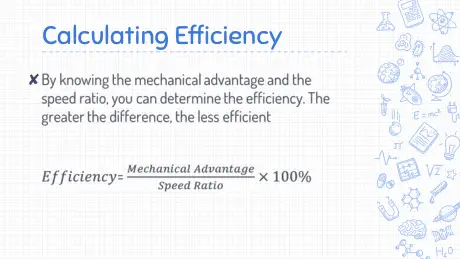
An ideal geometric ratio describes a lossless prediction. Measurements of force and work describe the real operation. For a steady machine, actual MA divided by SR gives efficiency as a decimal.
A value above 100% for a simple passive machine signals an incomplete energy account or measurement/calculation error.
A practical investigation needs uncertainty, repeated trials and a clear boundary.
Improve the whole design
A highly efficient device may still be slow, costly or unsuitable for the user. Compare efficiency with power, reliability, safety and maintenance. Explain a trade-off using evidence instead of choosing the biggest number automatically.
PhET · Energy Skate Park
Watch friction change the energy stores
Choose a screen with friction and energy displays. Start the skater from a fixed height. Compare friction off and on using the energy bars or pie chart. Reset to the same height for a fair comparison.
The skater is not a literal model of every machine. Use it to track conversion to thermal energy, then apply that account to a mechanism.
MEASURE · CALCULATE · EXPLAIN
Audit the input and useful output
Change one measurement, predict the result, then compare the calculated account. These are editable teaching measurements, not a physical simulation.
WATCH THE PHENOMENON
Efficiency and simple machines
The Science Classroom · Mechanism in action
Watch with a prediction
Record the input energy and useful output for one example. Account for the difference before calculating a percentage.