GRADE 8 SCIENCE · FOLLOW THE LIGHT

Waves, photons & model limits

Use wavelength and frequency to describe light, and identify what a wave diagram does—and does not—represent.

Related class notes

Open PDF →

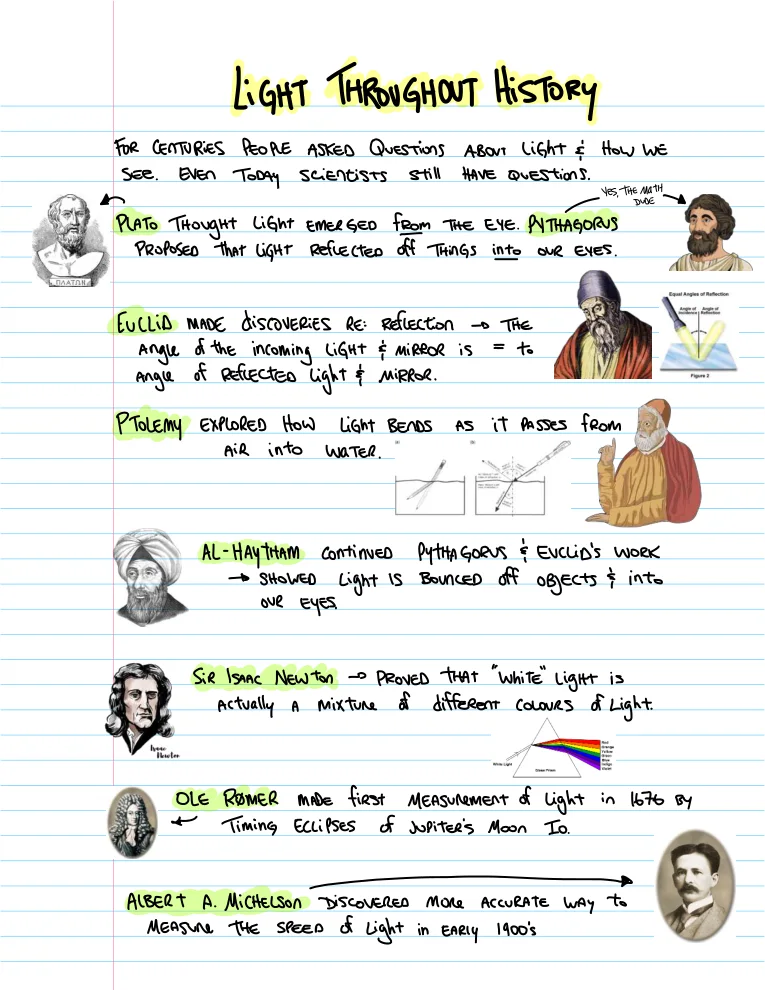
An extension of the models introduced in the history notes.

Read the diagram correctly

A wave plot can show how an electric field varies with position. It is not a picture of a light particle moving up and down along the drawn curve. Measure wavelength horizontally between neighbouring crests or troughs, not from crest to adjacent trough.

Connect frequency and wavelength under a stated condition

For a wave of speed v, v = frequency × wavelength. At a fixed speed, increasing frequency decreases wavelength. In vacuum, all electromagnetic radiation travels at the same speed c. When light crosses into another medium, frequency stays the same while speed and wavelength change.

Separate brightness from colour

In a simple monochromatic comparison, frequency is associated with spectral colour; changing field amplitude affects intensity. Real colour perception can involve mixtures of wavelengths. Increasing brightness is not the same as increasing frequency.

Choose the model for the question

Rays explain many directions and image locations. Waves account for interference and diffraction; diffraction becomes important when sizes are comparable to wavelength. Photons describe quantized energy exchange. These are complementary ways to predict observations, not three unrelated types of light.

Words worth knowing
Wavelength
Distance between equivalent successive points, such as neighbouring crests.
Frequency
Number of cycles per second, measured in hertz (Hz).
Amplitude
Maximum size of the oscillation relative to its reference level.
Photon
A quantum of electromagnetic radiation.
Learning goal

Describe wavelength, frequency and amplitude and compare ray, wave and photon models.

WATCH THE PHENOMENON

The original double-slit experiment

Veritasium · Experiment

An observation the ray model cannot explain alone

Compare the observed bright and dark pattern with the prediction of two independent light strips. Then try the Slits screen below.

Open on YouTube →
PHET · EXPLORE A MODEL

Test the wave model against a pattern

Choose Slits, switch to the light source and turn on the screen. Compare one slit with two.

Investigate

Change slit separation while keeping wavelength fixed. Then keep the slits fixed and change wavelength. Explain what the ray model alone leaves out.

Use the evidence

Sketch one before-and-after comparison. Label what you changed and what stayed the same. Use the lesson’s vocabulary to explain the result.

Explore the simplified wave model

The curve represents an oscillating field, not a photon’s path or moving matter. Wavelength is measured in a vacuum; the visible range is approximate.

FOLLOW THE REASONING

Work it through

At fixed speed, frequency doubles. What happens to wavelength?

  1. Use v = f × wavelength.
  2. Keeping v unchanged means wavelength must be divided by two.
  3. Do not predict that frequency and wavelength both double.

Light enters water from air. Does its frequency change?

  1. The oscillation frequency is set by the source and remains continuous across the boundary.
  2. Speed decreases in water, so wavelength decreases.
  3. A change of medium is not, by itself, a change in source frequency.
TRY IT

Try it yourself

At fixed speed, frequency doubles. State half or double for the new wavelength and explain your reasoning.

Give me a hint

Keep the product speed = frequency × wavelength constant.

Compare with a worked response

Doubling one factor halves the other.

When light crosses from air into water, does its frequency change? State yes or no and explain your reasoning.

Give me a hint

The source frequency remains continuous.

Compare with a worked response

Its speed and wavelength change; its frequency does not.

TAKE IT FURTHER

Make the connection

Light enters glass. Which stays the same: frequency, speed or wavelength?

Compare your reasoning

Frequency stays the same across a stationary boundary. Speed and wavelength change together according to v = fλ.

Common question: “A wave drawing shows a photon following a wiggly road.”

The curve represents an oscillating quantity, such as electric field, against position or time. It is not a literal track of a photon.

CHECK YOUR UNDERSTANDING

Put the ideas to work

Commit to an answer, then use the feedback to check your reasoning.

1. Wavelength is measured between…

2. At fixed speed, higher frequency means…

3. Which model naturally explains interference?

What are you curious about?

Search lessons, class notes and interesting questions.