GRADE 8 SCIENCE · FOLLOW THE LIGHT

Colour & the visible spectrum

Compare coloured light with coloured materials. Explain why mixing lights differs from mixing paints.

Related class notes

Open PDF →

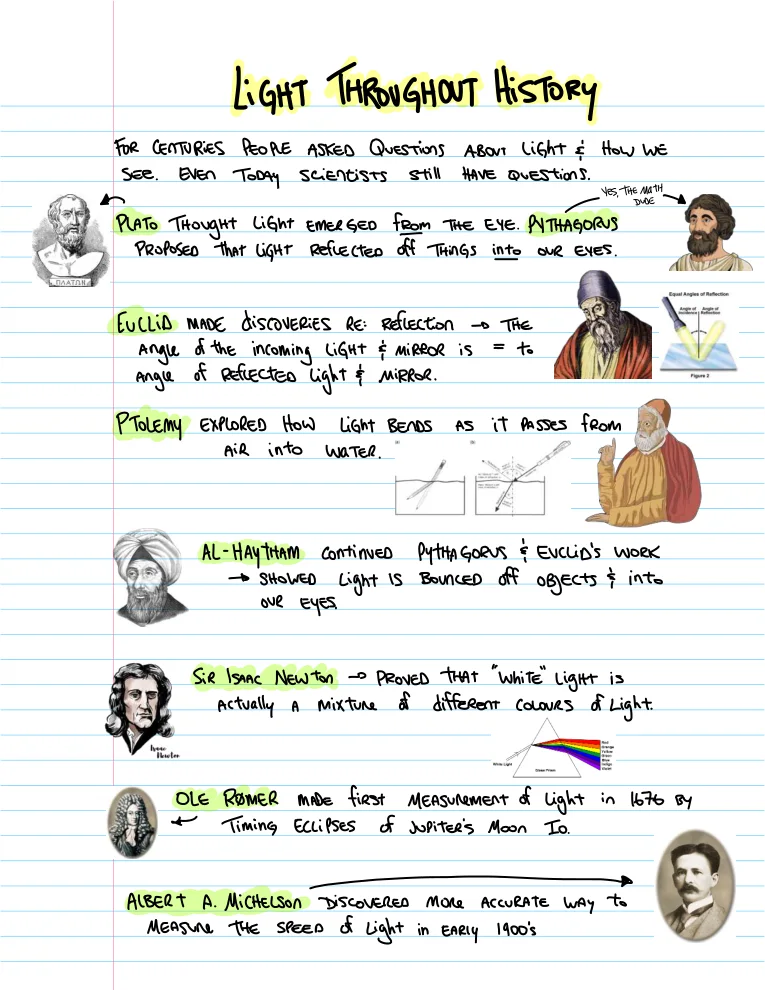
Newton’s prism work in the history notes is the starting point for this extension.

White light can contain many wavelengths

A prism can spread white light into a visible spectrum because different wavelengths refract by different amounts. The spectrum is continuous; named colour bands are a convenient description, not hard boundaries in nature. Visible light is only a small part of the electromagnetic spectrum.

A material’s appearance depends on illumination

A red object under white light reflects red wavelengths more strongly than many others. Under light with little red content, it can look dark. The object does not necessarily produce red light. Transmission through a coloured filter also selectively changes the light that reaches the observer.

Mixing light adds incoming contributions

Ideal red, green and blue light channels can combine to produce many perceived colours. Red plus green gives yellow; green plus blue gives cyan; red plus blue gives magenta. All three at suitable balanced intensities appear white. This is an RGB display model, not a claim that the light has become one new wavelength.

Paint works differently

Pigments absorb parts of the light illuminating them. Mixing pigments changes which wavelengths remain after absorption and scattering. A recipe for mixing beams of light should not be used as a recipe for mixing paint. Human colour perception also depends on the visual system and context.

Words worth knowing
Spectrum
A range of electromagnetic wavelengths.
Dispersion
Separation of wavelengths because they refract by different amounts.
Additive mixing
Combining light from different sources.
Selective absorption
Some wavelengths are absorbed more strongly than others.
Learning goal

Relate visible colour to light reaching the eye and distinguish additive light mixing from selective absorption.

WATCH THE PHENOMENON

What is colour?

Physics Girl · Demonstration

Light, objects and perception

Explain why an object’s colour depends on both the incoming light and the observer, rather than a colour label alone.

Open on YouTube →
PHET · EXPLORE A MODEL

Mix light and filter a spectrum

Compare RGB light mixing with a single light source and a coloured filter.

Investigate

Predict red plus green, then test it. In the single-bulb view, explain which light a filter transmits and which it removes.

Use the evidence

Sketch one before-and-after comparison. Label what you changed and what stayed the same. Use the lesson’s vocabulary to explain the result.

Explore the simplified RGB model
Mix light on a screen

Ideal additive RGB display model. The swatch represents a perceived mixture, not a single wavelength.

FOLLOW THE REASONING

Work it through

Predict red plus green light on a screen.

  1. Use additive mixing because the sources supply light.
  2. The combination is perceived as yellow.
  3. Do not transfer the prediction directly to red and green paint.

Predict a red object under blue illumination.

  1. Ask which wavelengths reach the object.
  2. If little red light arrives, little can be reflected from it.
  3. The object can appear dark; its appearance depends on the illumination as well as its material.
TRY IT

Try it yourself

Red and green light together produce which perceived colour in the ideal RGB model?

Give me a hint

This is light mixing, not paint mixing.

Compare with a worked response

The additive combination is yellow.

Does a red object necessarily emit its own red light? State yes or no and explain your reasoning.

Give me a hint

Separate a source from a reflecting object.

Compare with a worked response

It can appear red by selectively reflecting incoming light.

TAKE IT FURTHER

Make the connection

Predict a red object’s appearance under only blue illumination.

Compare your reasoning

An ideal red surface that absorbs blue would appear dark. Real materials are not perfect filters, so the exact appearance depends on their reflectance and the illumination.

Common question: “A prism creates the colours from colourless light.”

The incident white light already contains a range of wavelengths. The prism separates their paths.

CHECK YOUR UNDERSTANDING

Put the ideas to work

Commit to an answer, then use the feedback to check your reasoning.

1. RGB light channels at balanced full intensity appear…

2. A coloured object’s appearance depends on…

3. A prism separates wavelengths through…

What are you curious about?

Search lessons, class notes and interesting questions.