GRADE 8 SCIENCE · FOLLOW THE LIGHT

Light sources & lighting energy

Compare ways of producing light and calculate energy use without confusing power with energy.

Related class notes

Open PDF →

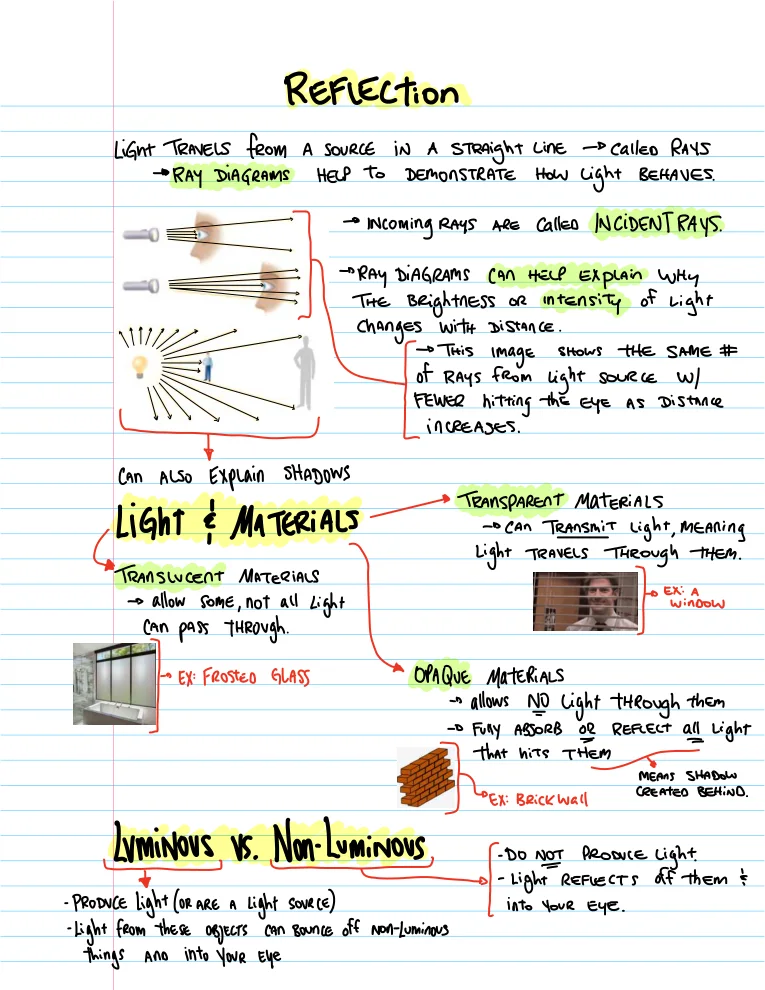
Start with luminous sources in the reflection notes, then explore energy use.

Sources use different processes

A hot filament can emit visible light through incandescence. LEDs emit through processes in semiconductor materials. Fluorescent lamps use ultraviolet radiation to excite a coating that emits visible light. Chemiluminescence comes from a chemical reaction; bioluminescence is light production by living organisms.

Do not confuse fluorescence with afterglow

Fluorescence usually stops quickly after excitation ends. Phosphorescent materials can continue emitting after the source is removed, giving an afterglow. The energy released was supplied earlier; the object is not an unlimited energy source.

Power is not the amount of energy already used

A 60 W lamp transfers energy at a rate of 60 joules per second. Operating time matters. For billing-style calculations, convert watts to kilowatts and multiply by hours: energy in kWh = power in kW × time in hours. A watt is not a unit of electrical energy.

Compare equivalent service

Energy cost = kWh × price per kWh. Compare lamps that supply useful, similar lighting rather than choosing only by wattage. Lumens describe visible light output, while watts describe power input. A stated price in a worked problem is an example rate, not a current utility quotation.

Words worth knowing
Power
Rate of energy transfer, measured in watts (W).
Kilowatt-hour
Energy used by 1 kW operating for 1 hour.
Incandescence
Visible light emitted by sufficiently hot matter.
Luminescence
Light emission not primarily caused by high temperature.
Learning goal

Distinguish common light-production processes and calculate electrical energy from power and time.

WATCH THE PHENOMENON

How modern light bulbs work

minutephysics · Animation

Different ways to produce light

Compare an incandescent filament, a fluorescent coating and an LED. Then compare energy input for equivalent useful lighting.

Open on YouTube →
COMPARE USEFUL LIGHTING

Compare power, time and cost

Compare equivalent useful lighting. Change power and operating time, then explain the difference in energy use.

Simplified instructional model. Use the explanation to identify what the model includes and leaves out.

FOLLOW THE REASONING

Work it through

A 60 W lamp runs for 10 h at an example rate of $0.10/kWh.

  1. 60 W = 0.060 kW.
  2. Energy = 0.060 × 10 = 0.60 kWh.
  3. Cost = 0.60 × 0.10 = $0.06.
  4. This excludes fees and taxes; the rate is hypothetical.

Compare 10 W and 60 W lamps used for 5 h.

  1. 10 W: 0.010 × 5 = 0.050 kWh.
  2. 60 W: 0.060 × 5 = 0.300 kWh.
  3. The difference is 0.250 kWh.
  4. A fair lighting comparison also needs comparable useful light output.
TRY IT

Try it yourself

Convert 100 W to kW. State a decimal and explain your reasoning.

Give me a hint

Divide watts by 1000.

Compare with a worked response

100 ÷ 1000 = 0.1 kW.

A 0.1 kW lamp runs for 4 h. State energy in kWh and explain your reasoning.

Give me a hint

Multiply power by time.

Compare with a worked response

0.1 × 4 = 0.4 kWh.

TAKE IT FURTHER

Make the connection

Would comparing a dim 3 W lamp with a bright 60 W lamp prove equal lighting is more efficient?

Compare your reasoning

No. Compare equivalent useful lighting first. Power is input per second; lumens and the intended task help describe the lighting service.

Common question: “A 60 W lamp uses 60 kWh every hour.”

60 W is 0.060 kW. In one hour it uses 0.060 kWh, not 60 kWh.

CHECK YOUR UNDERSTANDING

Put the ideas to work

Commit to an answer, then use the feedback to check your reasoning.

1. Which unit measures power?

2. A 20 W lamp runs for 5 h. Energy used is…

3. Which is biological light production?

What are you curious about?

Search lessons, class notes and interesting questions.