GRADE 8 SCIENCE · FOLLOW THE LIGHT

Rays, shadows & materials

Follow light from a source to a surface and then to an observer. Explain what different materials do to the light.

Related class notes

Open PDF →

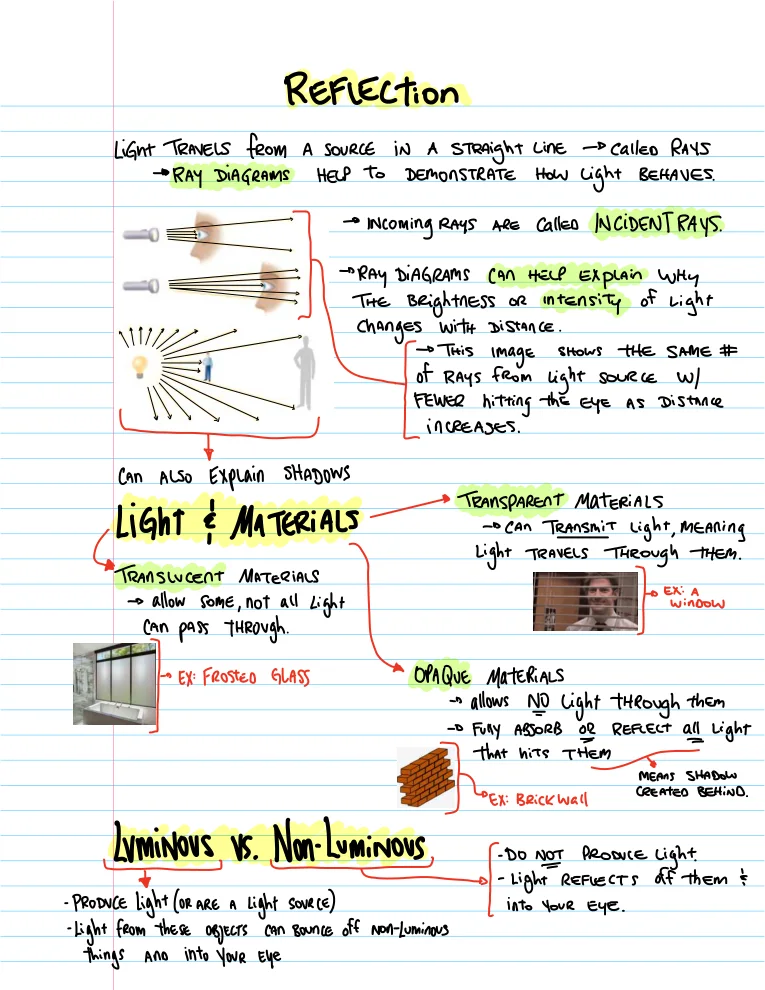
Reflection notes include light and materials.

Draw paths with a purpose

In a uniform transparent medium, the geometric ray model uses straight paths. Arrowheads show travel direction. A diagram includes selected rays, not every ray leaving a source. Use a ruler for straight segments and label the source, surface and observer.

Transmission and image clarity are different

Transparent materials transmit light with little scattering, so objects can be seen clearly through them. Translucent materials transmit light but scatter it enough to blur the view. Opaque materials transmit little or no visible light through the sample. Thickness and wavelength can matter.

A surface can do more than one thing

A glass window can transmit much of the light while reflecting some. A coloured surface absorbs some wavelengths more strongly than others. Absorption often transfers energy into thermal energy. Avoid assigning every object exactly one behaviour.

Rough surfaces still reflect

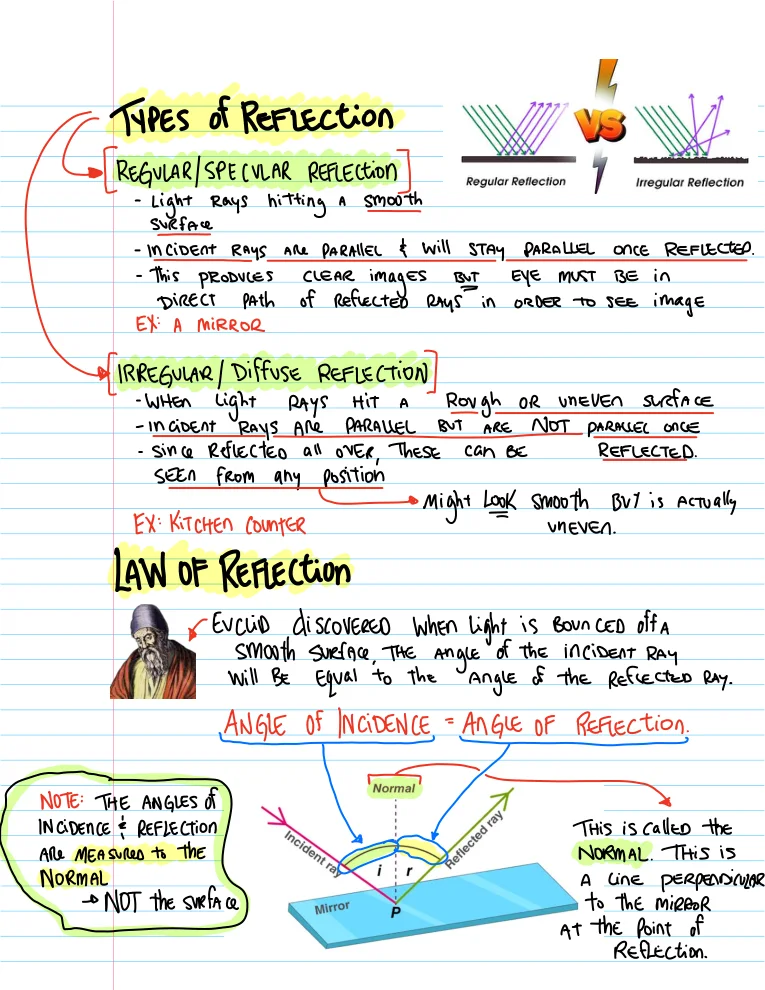
A smooth surface can preserve a coherent reflected image. On a rough surface, different small patches have different normals, scattering reflected light in many directions. The law of reflection still applies locally. A shadow forms where an object blocks light from reaching a region; an extended source can create a partial shadow.

Words worth knowing
Ray
A line with an arrow indicating a direction of light travel.
Transmission
Light passing through a material.
Absorption
Transfer of light energy into a material.
Diffuse reflection
Reflection in many directions from an uneven surface.
Learning goal

Use directional ray diagrams to distinguish transmission, absorption, regular reflection and diffuse reflection.

WATCH THE PHENOMENON

Why glass lets light through

TED-Ed · Animation

Solid does not mean opaque

Connect transmission with the material’s response to visible light. The microscopic explanation is an extension of the ray model.

Open on YouTube →
PREDICT · CHANGE · EXPLAIN

Build a shadow. Change one condition.

Drag the blocker toward the light or the screen. Then widen the light source to investigate a softer edge.

Straight-ray model of an opaque blocker and a uniform vertical light source. Brightness is schematic; this does not model scattering or inverse-square dimming.

FOLLOW THE REASONING

Work it through

Why can you see paper from several seats?

  1. Light from the source reaches the paper.
  2. The uneven surface diffusely reflects light in many directions.
  3. Different observers receive some of those rays.
  4. Paper is not “non-reflective” simply because it does not act as a clear mirror.

Classify a frosted window.

  1. Some light passes through, so it is not fully opaque.
  2. The transmitted light is scattered and the view is blurred.
  3. Describe it as translucent for visible light under these conditions.
TRY IT

Try it yourself

A material transmits light but blurs the view. State transparent, translucent or opaque and explain your reasoning.

Give me a hint

Separate light passing through from image clarity.

Compare with a worked response

Translucent materials transmit and scatter light.

Does diffuse reflection still obey the local law of reflection? State yes or no and explain your reasoning.

Give me a hint

Think about each small surface patch.

Compare with a worked response

Each patch has a normal; the reflected angle equals the incident angle at that patch.

TAKE IT FURTHER

Make the connection

Would adding more frosting make a window luminous? Explain.

Compare your reasoning

No. Scattering changes directions of incoming light. It does not turn the window into a source of visible light.

Common question: “A matte surface does not reflect light.”

If it reflected no visible light, it would appear very dark under illumination. Matte surfaces usually scatter reflected light rather than forming a sharp mirror image.

CHECK YOUR UNDERSTANDING

Put the ideas to work

Commit to an answer, then use the feedback to check your reasoning.

1. A clear glass pane can…

2. What belongs on a ray diagram?

3. A sharp mirror image is most associated with…

What are you curious about?

Search lessons, class notes and interesting questions.