GRADE 8 SCIENCE · FOLLOW THE LIGHT

Light, sources & scientific evidence

How do we know that light enters our eyes rather than coming out of them? Follow the evidence behind the models.

Class notes

Open PDF →

Select a page to enlarge it. The PDF contains the complete set.

Start with an explanation you can test

We see an object when light from that object reaches our eyes. The object may emit light itself or scatter light from another source. A book in a completely dark room cannot be seen just because your eyes are open. This observation challenges an explanation in which vision is caused only by rays leaving the eye.

Separate the source from the object

A glowing lamp is luminous. A desk lit by the lamp is not luminous: some incoming light is absorbed and some is scattered toward observers. A transparent object can also be non-luminous; non-luminous does not mean opaque. The Moon is visible mainly by reflected sunlight.

Knowledge develops through evidence

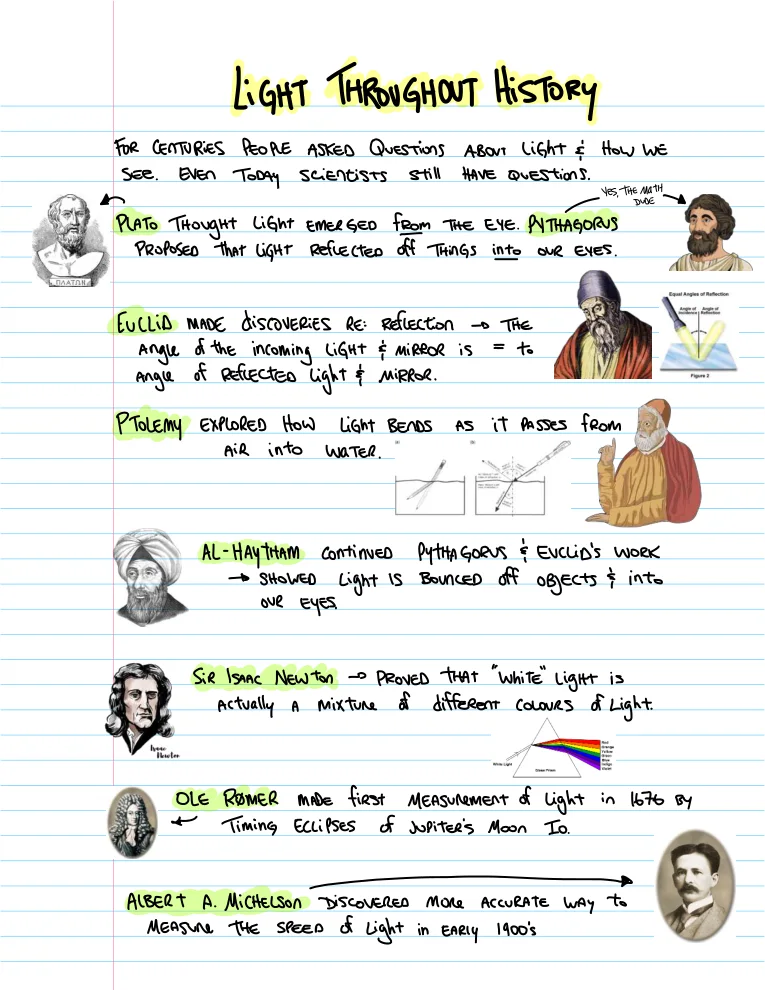
Historical thinkers proposed different explanations for vision. Ibn al-Haytham’s investigations helped establish the role of light entering the eye. Later investigations of prisms, mirrors and lenses expanded what scientists could explain. The point is not a list of names: ask which observation a proposed model can explain and which test could challenge it.

One model does not explain everything

The ray model is useful for direction, shadows and many images. Wave and photon models explain additional behaviour. We choose a model that matches the question rather than claiming one drawing describes all of light. Light is electromagnetic radiation; it does not require air to cross space.

Words worth knowing
Luminous
Produces its own visible light.
Illuminated
Visible because light from another source reaches it and then the observer.
Model
A representation used to explain observations and make predictions.
Learning goal

Distinguish luminous sources from illuminated objects and use observations to evaluate an explanation.

WATCH THE PHENOMENON

A camera and an eye

Physics Girl · Demonstration

Follow the incoming light

Separate the image formed by optics from the interpretation performed by a brain. Which part of seeing requires light to enter?

Open on YouTube →
LIVE RAY TRACING · PHYDEMO

A dark room can form an image

Move the optical components and follow the resulting light paths. The scene is ready to explore below.

Drag an outside light source. Trace only the rays that pass through the opening and reach the wall.

Explain what changed

Why does the top of the object appear at the bottom of the image?

FOLLOW THE REASONING

Work it through

Explain how you see a page beside a lamp.

  1. The lamp emits visible light.
  2. Some light reaches the page and scatters from it.
  3. Some scattered light reaches the eye; the visual system detects it.
  4. Blocking the path from lamp to page, or from page to eye, can make the page harder to see.

Evaluate “my eyes light up the room.”

  1. Prediction: opening your eyes in a completely dark room would make objects visible.
  2. Observation: without a light source, ordinary objects remain unseen.
  3. A better explanation needs light entering the eye from a source or illuminated object.
TRY IT

Try it yourself

Does an ordinary book emit its own visible light? State yes or no and explain your reasoning.

Give me a hint

Think about a completely dark room.

Compare with a worked response

A book is normally illuminated by another source.

Which must receive light for a person to see: the eye or the floor? State eye or floor and explain your reasoning.

Give me a hint

Follow the final part of the light path.

Compare with a worked response

Light must enter the eye to be detected.

TAKE IT FURTHER

Make the connection

Design a test that distinguishes a reflector from a small battery-powered lamp.

Compare your reasoning

Compare each in a darkened model with the outside light off, then on. The powered lamp emits light; the reflector needs incoming light. Keep the viewing position consistent.

Common question: “Anything I can see must be a light source.”

Visibility does not imply emission. The Moon, a wall and most classroom objects are visible because they redirect light from other sources.

CHECK YOUR UNDERSTANDING

Put the ideas to work

Commit to an answer, then use the feedback to check your reasoning.

1. Which is luminous while operating?

2. Which observation challenges light coming only out of our eyes?

3. Can a non-luminous object be transparent?

What are you curious about?

Search lessons, class notes and interesting questions.