GRADE 8 SCIENCE · FOLLOW THE LIGHT

Optical devices

Trace how a device collects, redirects and focuses light. Connect each component with a job.

Class notes

Open PDF →

Select a page to enlarge it. The PDF contains the complete set.

Begin with the purpose

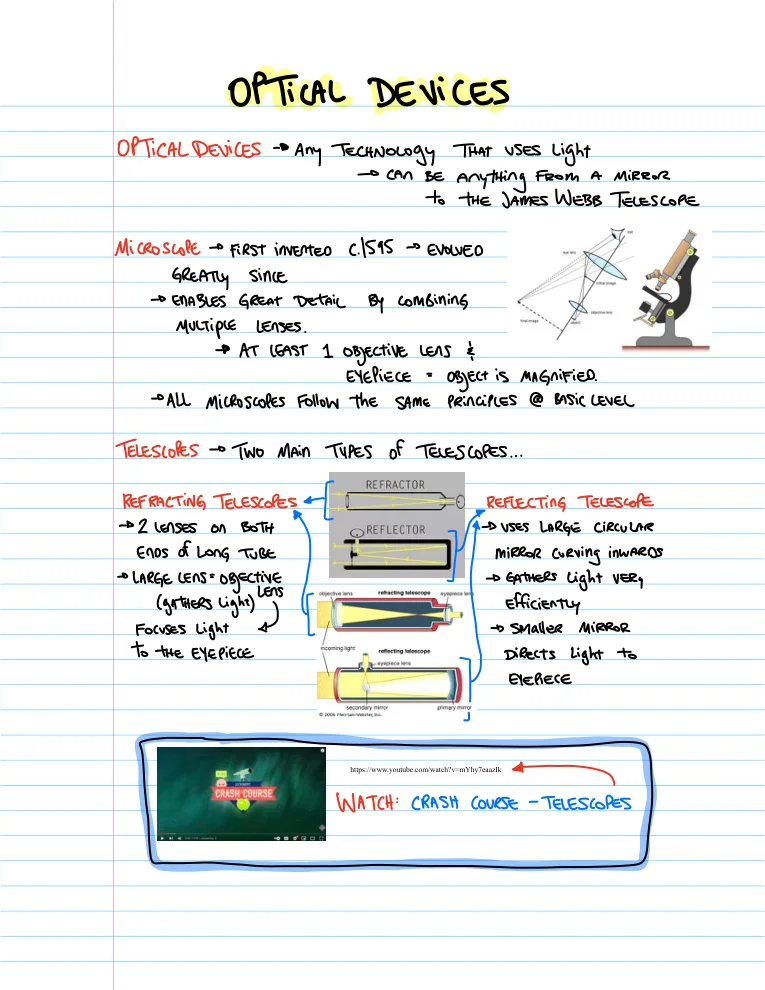
A microscope reveals small nearby structures; a telescope gathers light from distant objects. Magnification alone is not enough: a useful device must also gather light and resolve detail. Increasing magnification cannot recover detail that never reached the device.

Compare telescope designs

A refracting telescope uses an objective lens to form an image. A reflecting telescope uses a primary curved mirror. Other components direct the light to an eyepiece or detector. Real instruments have varied designs, so one two-element sketch is a simplified example.

Combine components deliberately

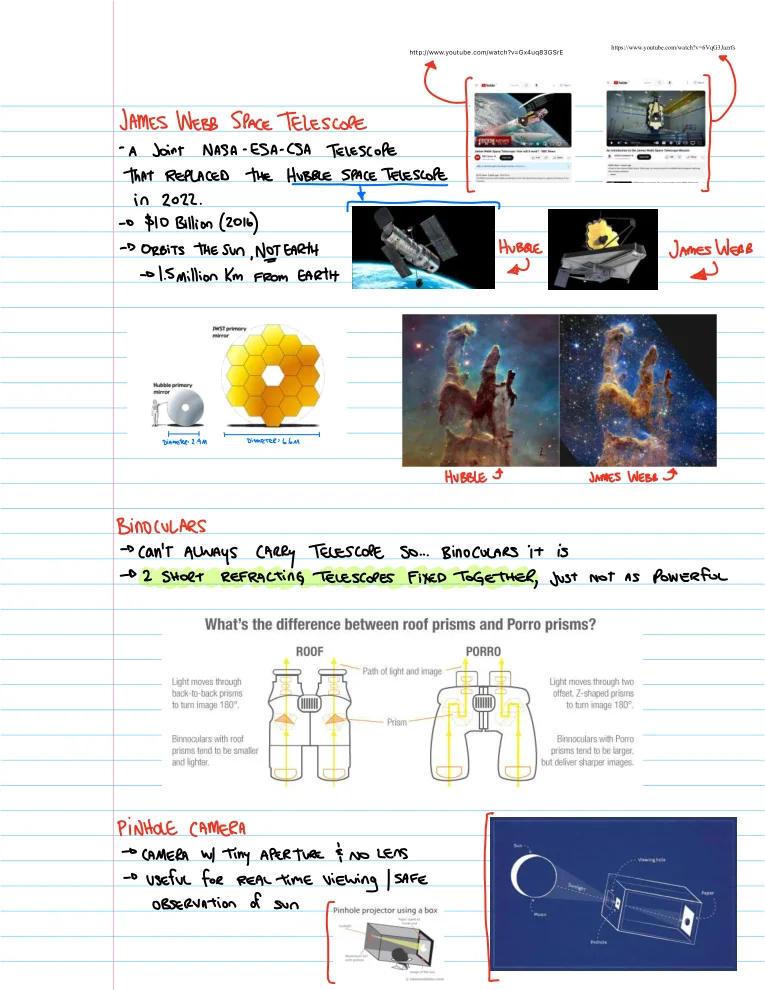
A compound light microscope uses an objective and an eyepiece. The objective forms a magnified intermediate image, which the eyepiece magnifies for viewing. Many binoculars combine two telescope systems with prisms that fold the path and orient the image.

A camera needs an image at a detector

A camera lens forms a real image on film or an electronic sensor. An aperture controls incoming light. A pinhole camera can form an inverted image without a lens by limiting which straight rays reach the screen. A projection is different from looking toward a source through a hole.

Words worth knowing
Objective
The main light-collecting lens or mirror near the object-facing end.
Eyepiece
Optical component used to view and magnify an intermediate image.
Aperture
An opening through which light enters.
Learning goal

Compare microscopes, telescopes, binoculars and cameras using their light paths.

WATCH THE PHENOMENON

Inside the world’s largest camera lens

Physics Girl · Behind the scenes

Follow real optical components

Identify the job of a lens in a large optical system. Why is a useful instrument about more than magnification?

Open on YouTube →
LIVE RAY TRACING · PHYDEMO

An optical bench you can rearrange

Move the optical components and follow the resulting light paths. The scene is ready to explore below.

Drag a lens along the optical axis. Follow the rays and their backward extensions. Reset to restore the original arrangement.

Explain what changed

Which lens forms the intermediate image, and which helps you view it?

FOLLOW THE REASONING

Work it through

Find total magnification for a 10× eyepiece and 4× objective.

  1. Multiply the component magnifications: 10 × 4 = 40.
  2. The approximate total magnification is 40×.
  3. That number does not by itself state resolution or image quality.

Select a telescope component for collecting light.

  1. Identify the design: refractor or reflector.
  2. The objective lens collects light in a refractor; the primary mirror does so in a reflector.
  3. An eyepiece helps view the image but is not the main collecting aperture.
TRY IT

Try it yourself

A microscope has 10× eyepiece and 20× objective. State the total magnification and explain your reasoning.

Give me a hint

Multiply, rather than add, the factors.

Compare with a worked response

10 × 20 = 200×.

Does a pinhole camera require a lens? State yes or no and explain your reasoning.

Give me a hint

Selected straight ray paths can form an image.

Compare with a worked response

A pinhole limits paths and can form an inverted image without a lens.

TAKE IT FURTHER

Make the connection

Why does a microscope need both illumination and a useful objective?

Compare your reasoning

The specimen must send light into the objective. The objective must resolve useful detail; an eyepiece can enlarge that image but cannot invent missing detail.

Common question: “All telescopes use two lenses.”

Reflecting telescopes collect light with a mirror. Instruments can also use detectors rather than a human eyepiece.

CHECK YOUR UNDERSTANDING

Put the ideas to work

Commit to an answer, then use the feedback to check your reasoning.

1. A reflecting telescope collects light mainly with…

2. A camera sensor receives a…

3. 10× eyepiece and 40× objective give…

What are you curious about?

Search lessons, class notes and interesting questions.