GRADE 8 SCIENCE · FOLLOW THE LIGHT

Animal eyes & adaptations

Compare solutions to visual challenges. Use structure and evidence rather than assuming every animal sees like a person.

Class notes

Open PDF →

Select a page to enlarge it. The PDF contains the complete set.

Start with a visual challenge

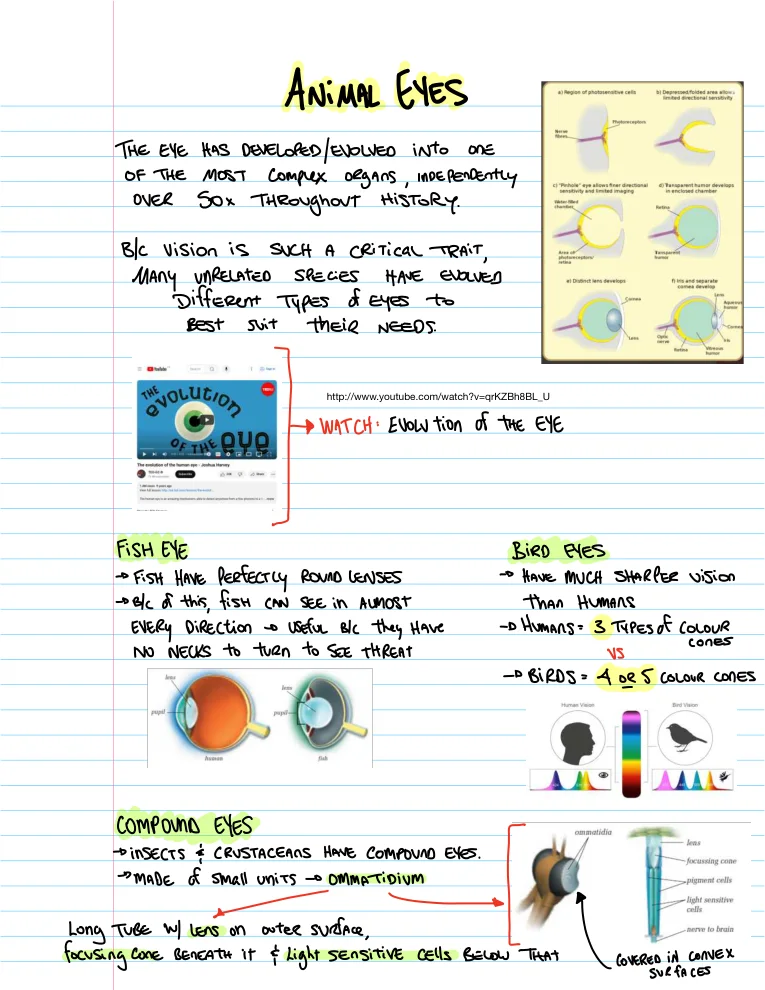
Animals may need to detect motion, judge distance, find food or work in dim conditions. There is no single “best eye” for every task. Compare what a structure helps detect and which other abilities may be limited. Species within a broad group can differ considerably.

Different architectures collect information

Camera-type eyes form images using a lens and a light-sensitive surface. Many arthropods have compound eyes containing repeated optical units called ommatidia. These sample directions across the scene and can support strong motion detection. Do not imagine many complete human-like views pasted together.

Low-light adaptations need some light

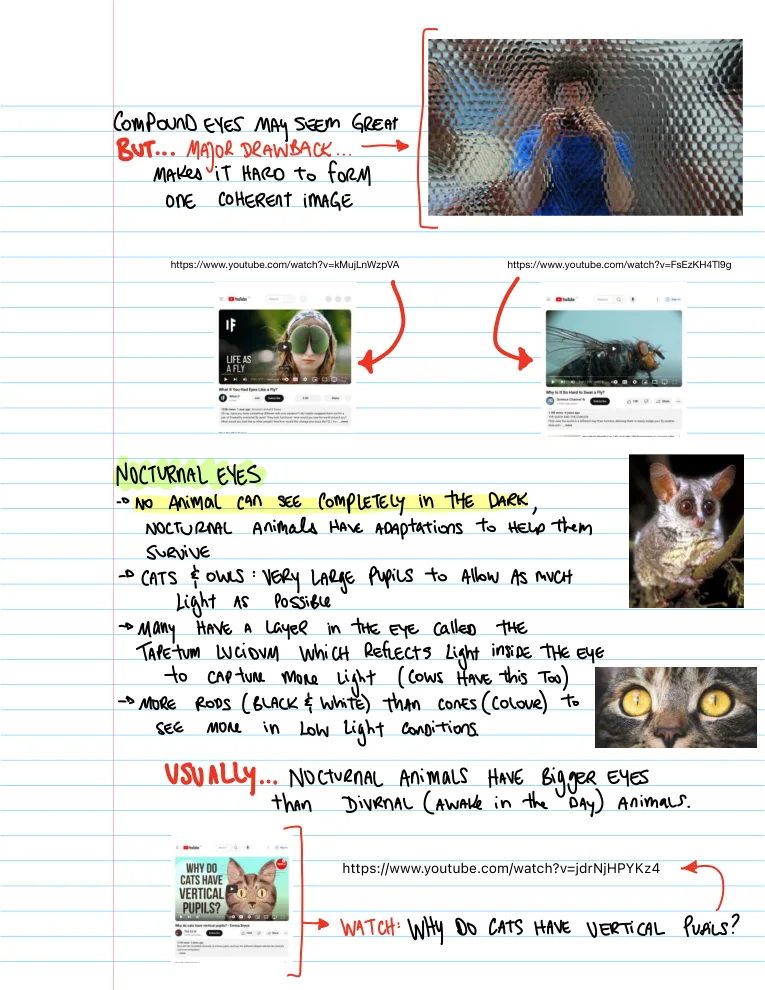
Large light-collecting openings, rod-rich retinas and—in some species—a reflective tapetum can support dim-light vision. A tapetum gives light another chance to interact with photoreceptors. These features do not allow visible-light vision in complete darkness, and not every nocturnal animal has every feature.

Eye position involves trade-offs

Forward-facing eyes often provide greater binocular overlap; more lateral placement can support a broader field. These are patterns, not a rule that identifies every predator or prey animal. Pupil shape, retinal structure, habitat and behaviour also matter. Colour sensitivity differs between species; avoid assigning one cone count to all birds or all fish.

Words worth knowing
Adaptation
An inherited feature that can contribute to survival or reproduction in a particular environment.
Compound eye
An eye made of many repeated light-detecting optical units.
Field of view
The region visible from a given viewing position.
Learning goal

Relate eye structures to environmental demands and identify trade-offs in visual systems.

WATCH THE PHENOMENON

Why do cats have vertical pupils?

TED-Ed · Animation

Compare adaptations, not rankings

Identify how pupil shape relates to an animal’s environment. Separate pupil shape from where the eyes sit on the head.

Open on YouTube →
PREDICT · CHANGE · EXPLAIN

A wider view or more overlap?

Change the eyes’ viewing directions, then move a target around the head. See which eye can detect it and where both views overlap.

Illustrative top-view model: each eye has a fixed 120° field. Values describe this model, not measured fields for a particular animal. Actual visual ability also depends on the retina, optics and nervous system.

FOLLOW THE REASONING

Work it through

Compare a wide field of view with binocular overlap.

  1. A grazing animal may benefit from noticing movement across a broad area.
  2. A hunter may benefit from overlapping views that support distance judgments.
  3. Both still face other visual demands. Eye placement alone does not prove diet.

Evaluate “a cat can see in total darkness.”

  1. Identify the proposed mechanism: collecting and detecting light.
  2. If no visible light is present, there is none for that mechanism to collect.
  3. Dim-light adaptations improve sensitivity; they do not produce a view from nothing.
TRY IT

Try it yourself

Can an eye detect visible light when none reaches it? State yes or no and explain your reasoning.

Give me a hint

A detector needs a signal.

Compare with a worked response

Dim-light sensitivity does not eliminate the need for light.

An eye with many ommatidia is called what? State compound or plane and explain your reasoning.

Give me a hint

Think of many arthropod eyes.

Compare with a worked response

A compound eye contains repeated optical units.

TAKE IT FURTHER

Make the connection

Can a cat’s reflective layer make vision possible with no light at all?

Compare your reasoning

No. The tapetum returns some incoming light through the retina for another opportunity to be detected. It does not create light.

Common question: “All nocturnal animals have identical eyes.”

Different lineages have different structures and histories. Describe a named species and supported feature instead of generalizing every feature to a whole group.

CHECK YOUR UNDERSTANDING

Put the ideas to work

Commit to an answer, then use the feedback to check your reasoning.

1. Which statement is best supported?

2. A tapetum helps by…

3. Eye placement alone always determines diet.

What are you curious about?

Search lessons, class notes and interesting questions.