Multiply 3/4 × 2/9.
Give me a hint
Look for common factors across the product before multiplying.
Compare a worked response
1/6
6/36 simplifies to 1/6. You can simplify 3 with 9 and 2 with 4 first.
A fraction of an amount can be smaller than the amount. Use an area model to explain the product.
Multiply positive fractions, mixed numbers and whole numbers, and justify the result with a model.
Three groups of 2/3 is 3 × 2/3 = 6/3 = 2. The denominator stays 3 when counting repeated thirds. Writing the whole number as 3/1 makes the general multiplication rule visible.
Predict a result, change a value, and use the diagram to explain your reasoning.
Every outlined unit rectangle represents one whole. Dots identify the overlap; the controls support fractions and mixed amounts up to two wholes.
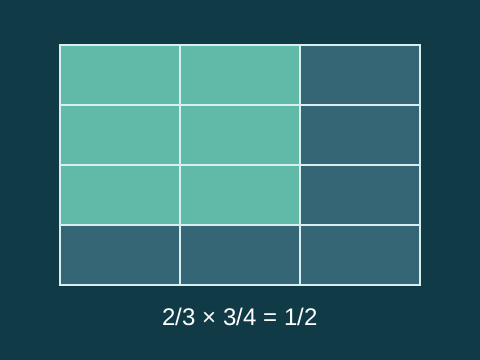
For 2/3 × 3/4, shade 2/3 of the width and 3/4 of the height of one rectangle. The overlap contains 6 of 12 equal small rectangles, so the product is 6/12 = 1/2 of the original whole.
The new unit parts come from both partitions: thirds by fourths make twelfths. Thus (a/b) × (c/d) = (a × c)/(b × d), with non-zero denominators. You do not need a common denominator first. Convert mixed numbers to improper fractions before using this rule.
 Khan Academy
Pause before the next step. Explain what the shaded region or group represents, then compare it with the model above.
Open on YouTube →The player loads when you choose to watch. Captions and availability depend on the provider.In 4/9 × 3/8, divide 4 and 8 by 4, and 3 and 9 by 3, before multiplying: 1/3 × 1/2 = 1/6. This works because the entire numerator and denominator form one product. For a positive amount, multiplying by a number between 0 and 1 makes it smaller; multiplying by a number greater than 1 makes it larger.
Work out the next step before opening the explanation.
Use paper or a whiteboard. Show the equal parts, calculation and explanation before comparing your response.
Look for common factors across the product before multiplying.
1/6
6/36 simplifies to 1/6. You can simplify 3 with 9 and 2 with 4 first.
First find one fifth of 20, then count three fifths.
12 litres
20 ÷ 5 = 4 litres; 3 × 4 = 12 litres.
Work through eight questions. Two independent correct answers introduce a harder version; supported answers bring the next question back to the foundation. You can use hints at any time.
This round saves on this device. It is practice, not a school mark.
Scaling a recipe by 3/4 means multiplying every ingredient by 3/4. Changing only one ingredient does not preserve the recipe.