How many 1/4-litre portions fit into 3/2 litres?
Give me a hint
Use quarters to count the groups.
Compare a worked response
6 portions
3/2 L = 6/4 L, which contains six quarter-litre portions.
Ask how many groups fit—or how large each share is—before using a reciprocal.
Model fraction division, explain the reciprocal rule and solve problems involving mixed or whole numbers.
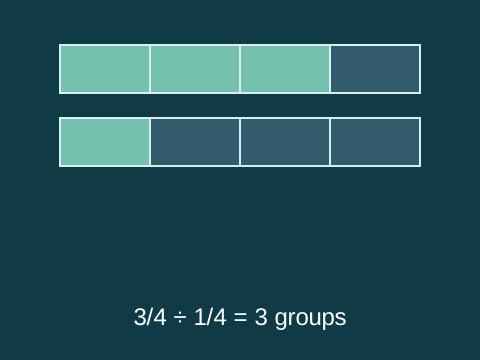
3/4 ÷ 1/8 asks how many one-eighth groups fit into three quarters. Rename 3/4 as 6/8. Six groups of 1/8 fit, so the quotient is 6. The answer counts groups, not eighths of the original whole.
Predict a result, change a value, and use the diagram to explain your reasoning.
Predict before changing a value. Every whole in a bar diagram uses the same size. The models use non-negative amounts up to two wholes per input.
1 ÷ 2/3 = 1 1/2. One complete group of 2/3 fits into 1, leaving 1/3. That remaining third is half of a two-thirds group. The fractional part of the quotient refers to the group size, not the original whole.
For 3/4 ÷ 2/3, rename in twelfths: (9/12) ÷ (8/12) = 9 ÷ 8 = 9/8. In general, (a/b) ÷ (c/d) = (ad)/(bc) = (a/b) × (d/c). Multiplying by the reciprocal of the divisor is a consequence of counting common units. The divisor must be non-zero.
 Khan Academy
Pause before the next step. Explain what the shaded region or group represents, then compare it with the model above.
Open on YouTube →The player loads when you choose to watch. Captions and availability depend on the provider.Convert mixed numbers to improper fractions. Leave the dividend unchanged, multiply by the reciprocal of the divisor, then simplify. To check, multiply quotient × divisor; it should recover the dividend. For positive numbers, dividing by a value less than 1 increases the numerical result.
Work out the next step before opening the explanation.
Use paper or a whiteboard. Show the equal parts, calculation and explanation before comparing your response.
Use quarters to count the groups.
6 portions
3/2 L = 6/4 L, which contains six quarter-litre portions.
Write the whole-number divisor as 2/1 before finding its reciprocal.
2/5
4/5 × 1/2 = 4/10 = 2/5. Splitting the amount into two equal shares halves it.
Work through eight questions. Two independent correct answers introduce a harder version; supported answers bring the next question back to the foundation. You can use hints at any time.
This round saves on this device. It is practice, not a school mark.
A 2 1/4-metre ribbon cut into 3/4-metre lengths makes three complete lengths. Division counts how many of the specified size fit.