Add 1/3 + 1/4.
Give me a hint
Use a common denominator of 12.
Compare a worked response
7/12
1/3 = 4/12 and 1/4 = 3/12; count seven twelfths.
You can combine the counts once the parts have the same name.
Add fractions and mixed numbers using equivalent fractions, then simplify and estimate.
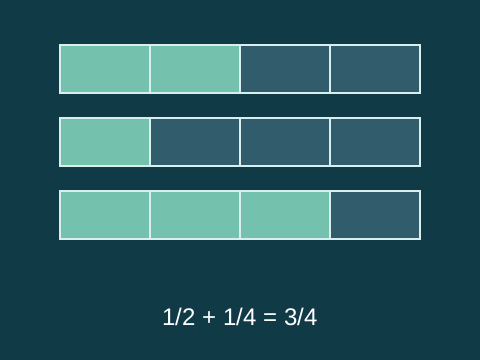
Two fifths plus one fifth is three fifths: 2/5 + 1/5 = 3/5. The denominator stays 5 because the parts are still fifths. Adding the denominators would change the unit size.
Predict a result, change a value, and use the diagram to explain your reasoning.
Predict before changing a value. Every whole in a bar diagram uses the same size. The models use non-negative amounts up to two wholes per input.
For 1/2 + 1/3, rename both in sixths. The sum is 3/6 + 2/6 = 5/6. A common denominator must be a multiple of both original denominators; it does not have to be the smallest, but smaller numbers often save work.
You may add the whole parts and fractional parts separately, then regroup. Or convert each mixed number to an improper fraction and add with a common denominator. Explain the equal units in either method.
 Khan Academy
Before each equivalent fraction is written, name the factor that changes both its numerator and denominator.
Open on YouTube →The player loads when you choose to watch. Captions and availability depend on the provider.An answer greater than one is allowed. Since 3/4 and 2/3 are each greater than 1/2, their sum must exceed 1. An estimate catches errors that a remembered procedure can hide. Finish in simplest form unless another form is requested.
Work out the next step before opening the explanation.
Use paper or a whiteboard. Show the equal parts, calculation and explanation before comparing your response.
Use a common denominator of 12.
7/12
1/3 = 4/12 and 1/4 = 3/12; count seven twelfths.
The fraction parts sum to more than one whole.
4 5/12
Whole parts total 3. The fraction parts total 17/12 = 1 5/12, giving 4 5/12.
Work through eight questions. Two independent correct answers introduce a harder version; supported answers bring the next question back to the foundation. You can use hints at any time.
This round saves on this device. It is practice, not a school mark.
Combining two measured amounts of flour uses addition. Keep the measurement unit and the reference whole consistent.