Why are snowflakes six-sided?
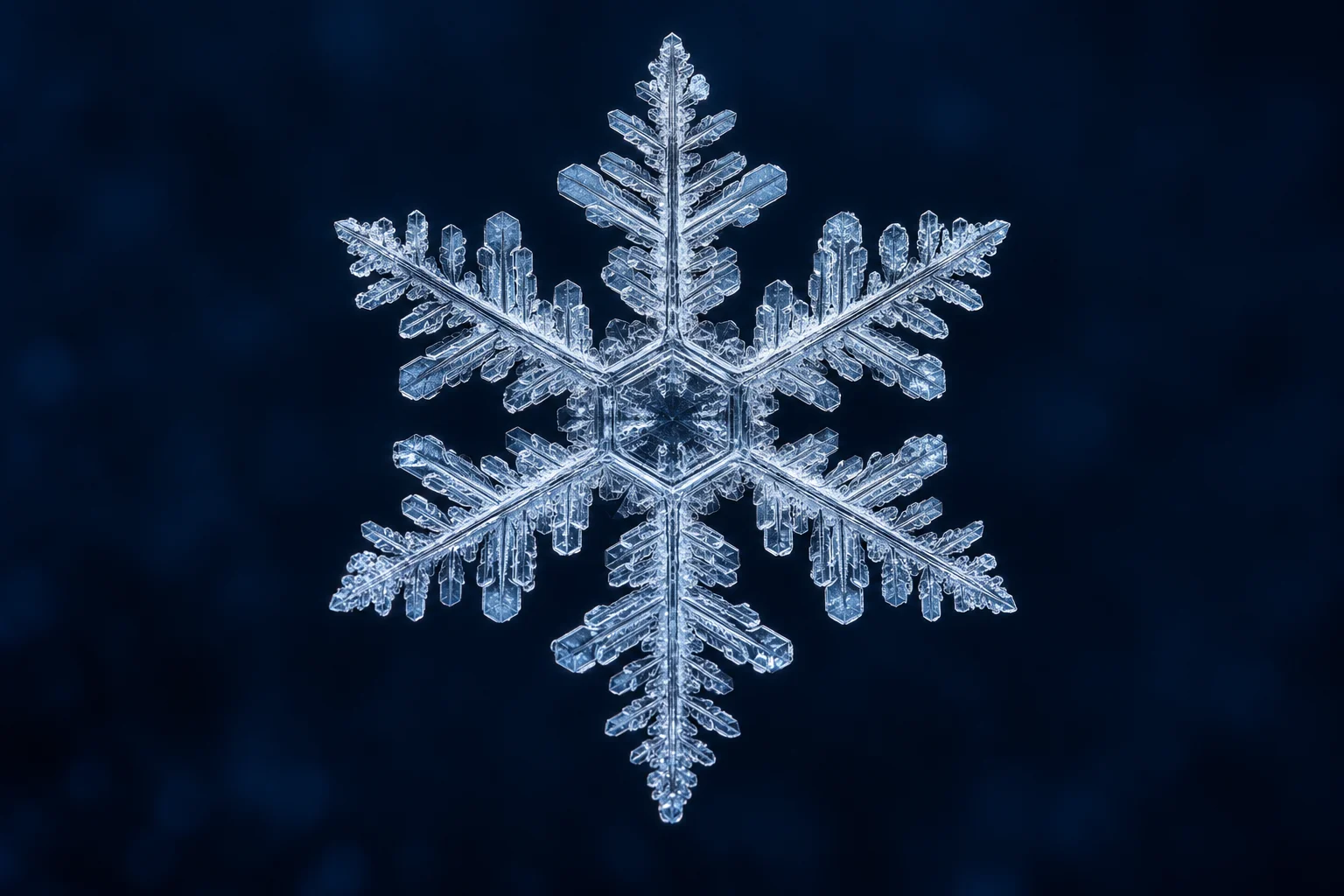
Snowflakes begin as tiny ice crystals in clouds. Their familiar six-fold symmetry comes from how water molecules arrange when ice grows under ordinary atmospheric conditions.
Structure shapes the crystal
A water molecule has one oxygen atom and two hydrogen atoms. Interactions between water molecules favour a crystal structure with hexagonal symmetry. This is why many snow crystals grow with six main arms.
As a crystal moves through a cloud, temperature and water vapour conditions influence its growth. The arms of one crystal pass through very similar conditions, so they can develop similar patterns.
Do all snowflakes look like stars?
No. Snow crystals can form plates, needles and columns as well as branching stars. Crystals can collide, break or collect droplets. The snow reaching the ground is often much less symmetrical than a textbook drawing.
Make the connection
A visible snow crystal shows how the arrangement of tiny particles can influence the shape and properties of matter.
Explore the related unitIllustration or photograph provides context; use the explanation to understand the science.